

Semaglutide for Weight Loss in Miami: A Medical Guide to GLP-1 Therapy
June 17, 2026
How to Lose Weight with Medical Help: A Comprehensive Guide for 2026
June 19, 2026
What if your “normal” lab report is actually the reason you still feel unwell? Most people assume that staying within the lines of a reference range equals perfect health, but those margins are often based on a broad population average rather than your individual peak performance. It’s completely natural to feel overwhelmed by technical jargon and the anxiety of seeing a result flagged in red. Interpreting blood work results should feel like reading a roadmap to your future wellness, not a cryptic puzzle that leaves you feeling more confused than when you started.
At Stay Medical Clinic, we believe you are an individual, not a clinical case. You deserve to know why a biomarker might be “in range” but far from optimal for your specific lifestyle. With significant 2026 updates to laboratory coding and the recent FDA approval of groundbreaking blood tests for cognitive health, the landscape of diagnostics is more powerful and precise than ever before. This guide will teach you how to identify key biomarkers, distinguish between standard and optimal values, and walk into your next consultation with the confidence of a dedicated partner in your own health journey.
Key Takeaways
- Understand the difference between screening for disease and monitoring for peak performance to turn your lab report into a personal health map.
- Gain confidence in interpreting blood work results by learning how to identify reference ranges and what high or low flags indicate about your internal systems.
- Discover why “normal” results don’t always explain why you feel unwell and how to target the “optimal range” for your individual vitality.
- Learn how to advocate for your health by connecting your symptoms to specific biomarkers and asking your provider about the underlying cause of any changes.
- Explore how a personalized approach to laboratory testing in Brickell provides the transparency and expert guidance you need to feel seen as an individual.
The Foundation of Blood Work: Why Labs Are Your Health’s Early Warning System
Think of your blood as a biological ledger. It records every metabolic transaction, nutrient deficiency, and inflammatory flare-up occurring beneath the surface of your skin. While many people view lab work as a diagnostic tool used only when something feels wrong, it’s actually your health’s most reliable early warning system. Routine testing allows us to move beyond simply screening for disease and toward monitoring for peak performance. Even if you feel vibrant today, baseline labs provide the data needed to maintain that vitality for years to come. A comprehensive blood panel Miami residents can rely on is the gold standard for wellness because it captures a snapshot of your internal systems before symptoms have a chance to manifest.
Common Panels: CBC vs. CMP
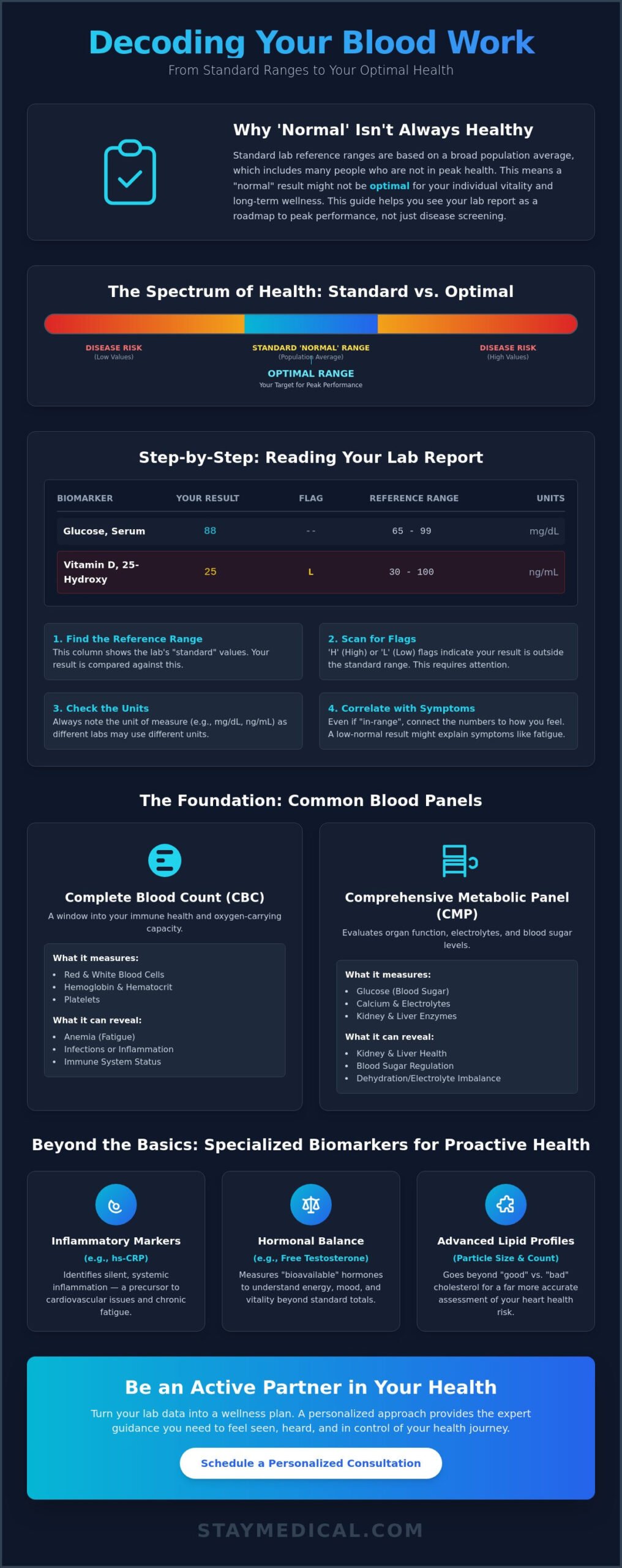
During a standard primary care visit in Brickell, the foundation of your assessment usually rests on two pillars: the Complete Blood Count (CBC) and the Comprehensive Metabolic Panel (CMP). The CBC offers a window into your immune health and oxygen-carrying capacity by measuring red and white blood cells alongside platelets. It helps us understand if your body is fighting an unspoken infection or if you’re experiencing fatigue due to anemia. Conversely, the CMP evaluates organ function, specifically looking at how your kidneys and liver are processing waste and managing blood sugar. Together, these tests provide a broad overview, but they are just the starting point for truly interpreting blood work results with clinical precision.
Beyond the Basics: Specialized Biomarkers
To get the full picture of your health, we often look at specialized biomarkers that standard screenings might overlook. These markers help us refine our understanding of your long-term risks and current energy levels.
- Inflammatory Markers: High-sensitivity C-Reactive Protein (hs-CRP) helps identify systemic inflammation. This is often a silent precursor to cardiovascular issues and chronic fatigue.
- Hormonal Balance: Looking at total testosterone is often only half the story. We examine free testosterone and binding globulins to see how much hormone is actually “bioavailable” for your body to use.
- Advanced Lipid Profiles: Modern medicine has moved beyond just “good” and “bad” cholesterol. We analyze particle size and count to better understand your actual heart health.
When you receive your report, you’ll see your numbers placed alongside reference ranges for blood tests. These ranges represent what is statistically common in the general population, but they don’t always represent what is optimal for your unique biology. Successfully interpreting blood work results requires looking at where you sit within those ranges and how those numbers correlate with your daily lifestyle and goals. This distinction is the core of a proactive, intentional approach to wellness that prioritizes your long-term success.
Step-by-Step: How to Read Your Laboratory Report Without the Stress
Receiving your laboratory report often feels like a moment of high stakes. You log into the portal, heart racing slightly, only to find a wall of abbreviations and numerical values that seem designed for a scientist rather than a patient. The first step in interpreting blood work results with ease is learning to navigate the layout of the page. Most reports follow a standard grid. Your primary focus should be the “Reference Range” column. This provides the baseline values that the lab considers standard for the general population. If your result falls within these two numbers, it is typically marked as “normal,” though as we’ll explore later, normal doesn’t always mean optimal for your vitality.
Next, scan for “Flags.” These are visual cues like the letters ‘H’ (High), ‘L’ (Low), or an asterisk. While these symbols immediately draw the eye, it’s vital to check the “Units of Measure” column. Labs might report values in mg/dL (milligrams per deciliter) or mmol/L (millimoles per liter). Misreading these units can lead to unnecessary worry. Additionally, verify your “Fast Status” at the top of the report. If you didn’t follow the 8 to 12-hour fasting requirement, your glucose and lipid numbers may appear artificially elevated. For more detail on the mechanics of your report, you can review this guide on How to Understand Your Lab Results from MedlinePlus.
Decoding Common Abbreviations
The shorthand used in labs can be confusing, but a few key abbreviations carry the most weight for your daily wellness. Hgb and Hct (Hemoglobin and Hematocrit) tell us about your iron levels and how well your blood carries oxygen. If these are low, you might feel chronically fatigued. ALT and AST are liver enzymes; think of them as indicators of how much stress your liver is under. Finally, keep an eye on eGFR (estimated Glomerular Filtration Rate). This is the most critical number for understanding your kidney’s ability to filter waste and maintain balance in your body.
Contextualizing Out-of-Range Flags
It’s important to remember that a single “high” or “low” flag isn’t always a cause for panic. Your blood chemistry is dynamic. A grueling workout the day before your test can spike liver enzymes or inflammatory markers temporarily. Even a high-carbohydrate meal or a period of intense stress can cause a statistical ripple in your data. Clinical significance is the difference between a statistical outlier and an actual health risk. To get a truly accurate picture, we look for trends over time rather than a single point on a graph. If you’re ready for a more personal look at your health, our team can help you navigate these numbers through a comprehensive laboratory testing session in our Brickell clinic. Successfully interpreting blood work results is about finding the story your body is trying to tell, ensuring you feel empowered rather than overwhelmed by the data.
Beyond the ‘Normal’ Range: Why Reference Intervals Aren’t One-Size-Fits-All
The reference intervals you see on your lab report aren’t universal truths of human health. Instead, they are statistical snapshots based on a bell curve of the general population. Because these ranges typically exclude only the top and bottom 2.5 percent of tested individuals, they essentially define “normal” as whatever is common within a specific group. In a society where chronic fatigue and metabolic dysfunction are increasingly prevalent, being “average” may not actually align with being healthy. This is why interpreting blood work results requires a more nuanced lens that looks at the “optimal” middle rather than just the “normal” edges.
Your individual baseline is entirely unique. Factors like your age, gender, and even your specific athletic history shift what a healthy number looks like for your body. For example, a testosterone level that is technically within the reference range for an 80-year-old might be functionally debilitating for a man in his 30s. By learning How to Understand Your Lab Results, you begin to see that these numbers are relative. They are meant to be interpreted in the context of your symptoms and your personal history rather than in a vacuum.
The ‘Optimal’ Philosophy for Vitality
At Stay Medical, we utilize tighter optimal ranges, particularly when managing Testosterone Replacement Therapy. We pay close attention to subclinical results. These are numbers that haven’t quite crossed the threshold into a “disease” state but are clearly trending away from peak wellness. Catching these shifts early allows for proactive intervention before they evolve into clinical problems. We prioritize tracking these trends over multiple years. A single snapshot can be misleading; a five-year trend line tells the true story of your metabolic health and long-term success.
When ‘Normal’ Labs Hide Issues
It’s a common and frustrating experience to feel unwell while being told your labs are perfect. This often happens because standard panels don’t dig deep enough. For instance, a standard thyroid screening might miss subtle dysfunctions that a full panel would catch. Micronutrient deficiencies in B12, Vitamin D, or Magnesium can also cause profound symptoms while remaining technically “in range.” If your lived experience doesn’t match your data, it’s a sign that more investigation is needed. Successfully interpreting blood work results means trusting your body’s signals as much as the ink on the page. You are the ultimate authority on how you feel, and your care should reflect that reality.
Turning Data into Wellness: How to Discuss Your Results with a Healthcare Provider
Data is a powerful tool, but it only becomes transformative when paired with a thoughtful clinical dialogue. Once you have moved past the initial phase of interpreting blood work results on your own, the next step is to bring that information into a consultation. This conversation is where raw numbers are translated into a personalized roadmap for your wellness. To make the most of this time, you should arrive prepared with a list of symptoms that correlate with specific markers you’ve identified. If you’ve been feeling sluggish and noticed your iron or Vitamin D levels are at the low end of the range, that connection is a vital piece of the diagnostic puzzle.
Don’t be afraid to ask about “The Why.” If a marker has shifted significantly since your last exam, don’t just accept a new prescription as the only answer. Ask what biological or lifestyle factors caused that shift in the first place. You should also request a full copy of your laboratory report for your personal records. Tracking these values over several years allows you to see the long-term trajectory of your health, ensuring you stay ahead of potential issues before they require intensive intervention. Before jumping to pharmaceutical solutions, discuss how lifestyle changes like sleep hygiene, nutritional adjustments, or targeted IV therapy can help restore balance to your system. For patients who require formal medical evidence or a private consultation during this process, Ready Health offers accessible clinical support.
Key Questions to Ask Your Doctor
A productive consultation relies on asking the right questions to bridge the gap between “average” and “optimal.” Consider using these prompts during your next visit:
- “Is this specific result optimal for my age and activity level, or is it just sitting in the middle of the average population range?”
- “Looking at my history, how has this marker changed since my last physical exam, and should that trend concern us?”
- “Are there specific lifestyle interventions we can try first to move this number back into a healthier range?”
Integrating Results into a Holistic Plan
At Stay Medical, we view your lab results as the blueprint for a much larger strategy. For those looking to manage their weight, we use blood work to customize a medical weight loss program that accounts for your unique metabolic hurdles. This ensures that we aren’t just treating a number on a scale, but rather optimizing the underlying hormones and nutrients that drive your success. Whether it’s addressing a micronutrient deficiency through a vitamin injection or adjusting a primary care plan, the goal is always a partner-based approach. If you are ready to stop guessing and start knowing, contact our team today to schedule a comprehensive review of your health markers. Successfully interpreting blood work results is the first step toward a life of intentional, proactive vitality.
Comprehensive Diagnostics at Stay Medical: Personalized Insights in Brickell
At Stay Medical Clinic, we believe that the process of interpreting blood work results should be as refined and intentional as the care that follows. We’ve replaced the sterile, detached environment of traditional healthcare with a boutique experience designed to make you feel seen and understood. Our commitment to transparency means you’ll never be left wondering what a specific marker indicates about your vitality. Instead, we prioritize a collaborative approach where every data point is explained with clinical precision and empathetic warmth, ensuring you feel like a partner in your own health journey rather than just another case number.
Efficiency is a cornerstone of our practice. By offering on-site laboratory testing Brickell Miami professionals can count on, we provide faster results that are integrated seamlessly into your personalized treatment plan. This on-site capability allows our experienced healthcare professionals to review your data in real-time, facilitating immediate adjustments to your wellness strategy. Whether we’re monitoring your metabolic health or fine-tuning a hormonal balance, having the lab and the provider in the same space ensures a level of continuity and accuracy that traditional diagnostic models often lack.
Our Modern Approach to Miami Healthcare
Our clinic is situated in the heart of Brickell, specifically designed for the busy professional who values both time and quality. We recognize that true wellness requires more than a standard 15-minute doctor visit. We take the time to explore the nuances of your biology, looking beyond the surface to find the underlying drivers of your health. To stay at the forefront of medical science, we also participate in clinical trials in Miami. This involvement allows us to incorporate the latest diagnostic advancements and ethical research into our daily practice, providing our patients with access to cutting-edge insights that aren’t yet available in standard primary care settings.
Start Your Wellness Journey Today
Empowerment begins with accurate data and a trusted guide. Whether you need a comprehensive annual physical exam or a specialized panel to investigate persistent symptoms, we make the booking process effortless. We invite you to experience a healthcare environment where moral integrity and long-term outcomes are paramount. Successfully interpreting blood work results is about more than avoiding illness; it’s about unlocking a higher standard of living. Contact us at our SW 2nd Ave location to schedule your consultation and take the first step toward a more proactive, intentional approach to your well-being. Your path to optimal health is unique, and we’re here to help you navigate it with confidence.
Take Charge of Your Biological Narrative
Your blood work is far more than a simple checklist for illness; it’s a dynamic map of your internal landscape. By moving beyond standard reference ranges to focus on optimal biomarkers, you can address the root causes of fatigue or discomfort before they become clinical concerns. Mastering the art of interpreting blood work results empowers you to walk into every medical consultation with clarity and purpose. It’s about shifting the focus from simply being “not sick” to achieving a state of vibrant, intentional wellness.
At Stay Medical, our expert medical team in Brickell is dedicated to providing a personalized interpretation of every biomarker, ensuring your data translates into actionable success. Within our modern, boutique clinic environment, we prioritize your long-term well-being through transparency and compassionate care. You don’t have to navigate your health journey alone. Schedule your comprehensive blood work at Stay Medical today and experience the difference of a partner who truly sees the person behind the numbers. Your most vital self is waiting to be discovered.
Frequently Asked Questions
What does it mean if my lab result is slightly outside the reference range?
A result just outside the lines doesn’t always signal a medical emergency or a disease. Reference ranges are calculated based on 95% of a healthy population, which means 5% of perfectly healthy individuals will naturally fall slightly high or low. We focus on the clinical significance of the number and how it correlates with your symptoms and long-term health trends rather than viewing it as an isolated error.
How long does it typically take to get blood work results back?
Most routine panels, such as a Complete Blood Count or a Metabolic Panel, provide results within 24 to 48 hours. More complex investigations, including genetic markers or specialized hormone tests, can take up to a week for full processing. At our Brickell clinic, we prioritize on-site coordination to ensure your data is integrated into your treatment plan as quickly as possible so you aren’t left waiting.
Do I really need to fast before my blood test for accurate results?
Fasting is essential if your provider specifies it, particularly for glucose and lipid tests. Consuming food or drink other than water within 8 to 12 hours of your draw can cause temporary spikes in blood sugar and triglycerides. These fluctuations skew the data, making it difficult for your healthcare partner to get an accurate baseline of your metabolic health and nutrient levels.
Can exercise or stress affect my blood work numbers?
Intense physical activity or high levels of acute stress can certainly impact your data. A grueling workout the day before your test might temporarily elevate liver enzymes or inflammatory markers like CRP. Similarly, high stress can cause a surge in cortisol and glucose. It’s best to maintain a calm, routine schedule in the 24 hours leading up to your appointment for the most stable results.
Why are my lab results different between two different clinics?
Different laboratories often utilize varying equipment, chemical reagents, and reference intervals. Since there isn’t a single universal standard for every testing machine, your numbers may show slight variations between facilities. This is why we recommend consistent testing with one provider, as it allows for more accurate longitudinal tracking when interpreting blood work results over several years.
What is the difference between a screening test and a diagnostic test?
Screening tests are proactive tools used to identify potential health risks in individuals who don’t yet have symptoms. They act as an early warning system. Diagnostic tests are more targeted investigations performed to confirm or rule out a specific condition once symptoms appear or a screening result comes back flagged. Both are vital components of a comprehensive, intentional approach to your personal wellness.
How often should I have comprehensive blood work done?
Most healthy adults should schedule a comprehensive blood panel Miami providers recommend at least once a year during their annual physical exam. If you are actively managing a condition or participating in a specialized program like testosterone replacement, we may recommend testing every three to six months. Frequent monitoring ensures that we can make precise, data-driven adjustments to your care plan as your body evolves.
What should I do if my labs are ‘normal’ but I still feel tired or unwell?
You should seek a deeper investigation that looks beyond the standard “normal” range. Being technically in range doesn’t mean your biomarkers are optimal for your specific lifestyle or age. When interpreting blood work results for patients who still feel unwell, we often dig into micronutrient deficiencies, thyroid nuances, or hormonal imbalances that standard screenings frequently overlook, ensuring your care matches your lived experience.
Disclaimer
This content is for informational purposes only and does not replace evaluation, diagnosis, or treatment by a medical professional. Always consult a qualified healthcare provider for personalized care.






3 Comments
[…] understanding of what each biomarker means for your unique biology, our comprehensive guide to interpreting blood work results walks you through every step of the process. Whether we’re adjusting your nutritional intake […]
[…] One of the most common frustrations we hear is from patients who feel sub-par despite being told their labs are “normal.” The problem is that “normal” is a wide statistical average, not a target for peak performance. We focus on narrow optimal bands, the specific ranges where the human body functions at its highest level. If your Vitamin D or Testosterone levels are at the very bottom of a “normal” range, you won’t feel your best. For a deeper dive into this philosophy, we encourage you to read our sibling guide on Interpreting Blood Work Results. […]
[…] We don’t just hand you a printout and send you on your way. Our physicians spend time interpreting blood work results through the lens of your personal wellness goals. Whether you’re tracking metabolic markers […]