
What to Do After an IV Drip: Aftercare and Recovery
November 12, 2026
Semaglutide Weight Loss by Week: What to Expect Over Time
November 14, 2026
Starting testosterone replacement therapy is a monitored process, not a one-size-fits-all injection schedule. A TRT protocol for beginners typically begins by confirming low testosterone with two morning tests, then tailoring treatment and follow-up to the person’s health and response.
It’s understandable to want clear answers about what happens first, how injections are given, and when changes might become noticeable. The route matters: testosterone may be injected into a muscle or, with some treatments, under the skin. Each approach has its own instructions, and injections should be used as prescribed, not adjusted independently.
This guide explains how TRT works, what an initial assessment and blood tests may involve, and which health considerations can affect treatment. It also covers intramuscular and subcutaneous injections, the purpose of follow-up, and why medical supervision keeps the focus on both symptom relief and safety.
Key Takeaways
- TRT is intended to address clinically low testosterone, with treatment guided by symptoms, test results, and ongoing response.
- Early follow-up and blood tests help assess hormone levels and identify changes that may call for a treatment adjustment.
- Monitoring considers more than testosterone alone; safety checks can include blood counts and prostate-related assessment.
- Intramuscular and subcutaneous injections use different administration methods, so follow the instructions provided for your prescribed treatment.
- Discuss fertility plans and relevant health history before starting, since these can affect whether TRT is appropriate.
What is testosterone replacement therapy (TRT)?
A TRT protocol for beginners is best understood as a monitored treatment plan, not a fixed injection schedule. It begins with a clinical reason for treatment, then takes the formulation, symptoms, and follow-up into account.
How TRT Affects Natural Testosterone Production
TRT supplies testosterone from outside the body, which can affect the signals that regulate natural testosterone production. Treatment may reduce sperm counts, an important consideration for anyone planning to have children. Symptoms and hormone levels can also respond differently from person to person. For example, one person may notice a change in energy, while another sees little change in that symptom.
Stabilizing Testosterone Levels
Stabilization describes the time it takes for testosterone levels to settle into a pattern on a consistent dose. Levels typically stabilize after 4-8 weeks. Injection timing can create rises and declines between doses, so the result of a blood test depends partly on when it’s taken. For beginners, a TRT protocol should make the dose schedule and timing of follow-up tests clear.
Testosterone cypionate has a half-life of around 8 days, while testosterone enanthate has a half-life of around 7 days. Testosterone undecanoate lasts longer than enanthate and propionate. These differences help explain why one formulation may use a different injection interval from another. A clinician interprets results alongside the medication schedule and symptoms, rather than treating one reading as the full picture.
Testosterone Formulations and Dosing
Cypionate, enanthate, and undecanoate are testosterone formulations with different durations of action. Intramuscular injections are commonly given every one to two weeks. A conservative starting dose described for TRT is 50-100 mg every 1-2 weeks. FDA-approved testosterone cypionate labeling gives a dosage range of 50-400 mg every 2-4 weeks, adjusted according to clinical response and testosterone levels. These ranges are not interchangeable instructions.
A TRT protocol for beginners should connect the prescribed dose with the person’s formulation, symptoms, and test results. In the United States, the FDA approves TRT for males with low testosterone due to a known medical condition, such as hypogonadism. Treatment follows a clinical evaluation; insurance coverage varies by plan and may depend on diagnosis and documentation.
TRT costs vary with the formulation, laboratory testing, and follow-up visits. The price depends on the case and is given after a quote request.
Early treatment timeline and follow-up testing
Starting TRT involves more than choosing a dosage: evaluation, symptom tracking, and follow-up testing help guide care. A useful timeline connects blood test results with how you feel and when each test is taken.
Evaluation before treatment
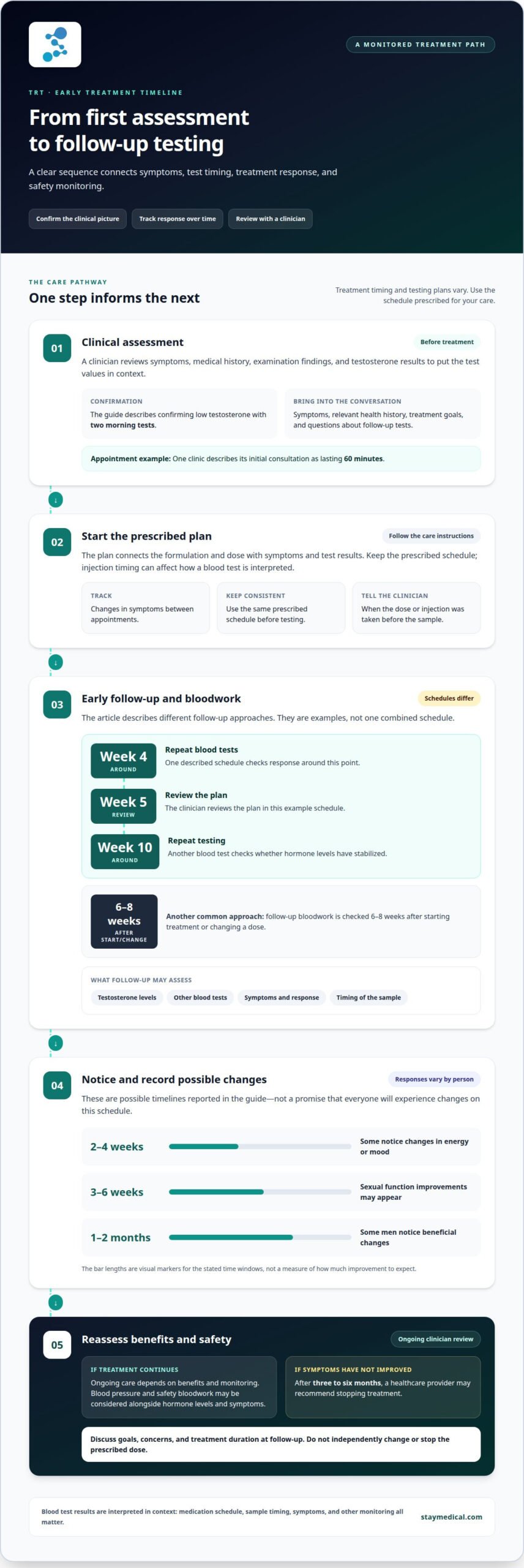
Before treatment, a clinician reviews symptoms, medical history, examination findings, and testosterone results. This puts test values in context and helps identify factors that may affect the decision to start therapy. Bring a clear account of your symptoms and relevant health history. Ask how treatment goals will be assessed and which follow-up tests are planned.
An initial TRT consultation may include a medical history, physical examination, and discussion of benefits and risks. One clinic describes this appointment as lasting 60 minutes. The clinician can explain the proposed formulation, dosage, monitoring plan, and how treatment decisions will be revisited.
Early follow-up and testing
Bloodwork timing varies with the care plan and the purpose of testing. One schedule checks repeat blood tests around week 4 to assess response, reviews the plan at week 5, and repeats testing around week 10 to see whether hormone levels have stabilized. Follow-up bloodwork is also commonly checked 6-8 weeks after starting or changing a dose. These timings reflect different approaches, so results should be interpreted alongside the prescribed schedule.
Testosterone levels alone don’t show the full picture. Follow-up may include other blood tests to monitor treatment and unwanted effects. The timing of an injection or dose can affect test results, so the clinician considers when the sample was taken. Keep appointments and follow the same prescribed schedule before testing to make comparisons more meaningful.
What changes to expect
Some people notice changes in energy or mood within 2-4 weeks of testosterone injections. Sexual function improvements often appear within 3-6 weeks, while some men notice beneficial changes only after 1-2 months. These timelines describe possible responses, not a schedule every person follows. Tracking symptoms between appointments gives the clinician practical information alongside blood test results.
TRT may continue when benefits and monitoring support ongoing treatment. If symptoms haven’t improved after three to six months, a healthcare provider may recommend stopping. Discuss goals, concerns, and treatment duration during follow-up, rather than changing or stopping the dosage independently. For a focused conversation about evaluation and follow-up, explore TRT care and testing.
Monitoring and blood pressure
TRT monitoring brings together hormone levels, safety blood work, symptoms, and blood pressure. No single result describes the whole response. A testosterone value needs context, including the formulation, injection schedule, and timing of the blood draw. Blood pressure readings add another part of the clinical picture and can be discussed alongside laboratory results and changes in how you feel.
For intramuscular TRT, the Alabama Board of Medical Examiners guidelines say mid-dose-interval testosterone levels should never be above 700 ng/dl. The same guidelines say a mid-dose-interval result above 700 ng/dl suggests a peak testosterone level above 800 ng/dl. These figures apply to the stated testing point and route; they aren’t a universal target for every formulation. Consistent timing around doses helps make results easier to interpret over time.
Blood work also checks for changes beyond the testosterone hormone itself. The Alabama Board of Medical Examiners guidelines recommend checking testosterone, hemoglobin and hematocrit, and PSA 3 months after starting TRT. During treatment, they recommend repeating safety labs, including mid-dose-interval testosterone and hemoglobin and hematocrit, every 6 months. They also recommend PSA testing at least annually. For men with a father or brother who had prostate cancer, or a personal history of prostate cancer in durable remission, the guidelines say physicians should consider PSA testing every 6 months.
Blood pressure should be part of follow-up conversations, alongside laboratory findings and symptoms. A reading is useful context, not a substitute for blood work. Share changes in readings with the clinician managing treatment, especially when discussing dose adjustments or other health changes. The available treatment facts don’t establish a specific blood pressure threshold for changing TRT, so it should be interpreted within the person’s overall clinical assessment.
Fertility belongs in monitoring discussions, too. Testosterone therapy can reduce sperm counts, which may matter if you’re trying to have children. Sharing fertility plans before and during treatment gives the clinician important context for assessing ongoing care. Muscle changes or shifts in symptoms also deserve discussion, but shouldn’t replace scheduled testing.
Keep the prescribed dose and injection schedule consistent before a planned blood test, and note when the last dose was taken. That helps distinguish a result related to timing from a pattern that may need clinical review. The Alabama Board of Medical Examiners guidelines also say safety screening labs should be on file from within the previous 6 months before a TRT prescription is refilled. Regular visits connect those results with blood pressure, symptoms, and treatment goals.
Eligibility and precautions
Testosterone replacement therapy is considered when symptoms and testing support low testosterone, not solely because levels change with age. Alabama Board of Medical Examiners guidelines say men should generally be considered for TRT only when they have symptoms and serum testosterone below 300 ng/dl, confirmed by a subsequent morning evaluation. That follow-up result helps distinguish a persistent finding from one isolated test. Evaluation also considers health history, examination findings, treatment goals, and possible risks.
Age-related decline alone is not the same as a diagnosed medical condition. As of 2025, the FDA had not approved TRT for males who naturally experience a decline in testosterone as they age. The distinction matters when deciding whether treatment is appropriate and what a person hopes to achieve. Symptoms deserve assessment, but starting testosterone without clinical evaluation can expose someone to treatment effects without establishing a suitable medical reason.
Some health events call for particular caution. Alabama Board of Medical Examiners guidelines list a major cardiac or thromboembolic event within the previous 6 months as a contraindication to starting TRT. A heart attack or stroke within the past six months is also a reason not to use testosterone therapy. Discussing cardiovascular history before treatment helps ensure that a significant event informs the decision and the timing of any action.
Fertility is another key consideration. Testosterone therapy can reduce sperm counts, which may affect men trying to have children. Share fertility plans before treatment rather than treating this as a side issue after starting. TRT can also raise red blood cell measures, including hemoglobin and hematocrit; blood-count monitoring helps identify changes during treatment. Symptom goals should be weighed against reproductive plans and blood-related safety findings.
Prostate history can shape monitoring. Alabama Board of Medical Examiners guidelines say physicians should consider checking PSA every 6 months for men with a father or brother who had prostate cancer, or a personal history of prostate cancer in durable remission. This is a monitoring recommendation for those specified histories, not a universal schedule for every patient. Sharing family and personal history gives the clinician relevant context for follow-up decisions.
Discuss long-term effects before committing to ongoing therapy. Cleveland Clinic notes that studies of TRT’s effects over decades are limited and have mixed results. That uncertainty makes clear treatment goals, symptom reviews, and scheduled safety checks important to decision-making. A clinician weighs these considerations alongside testosterone levels and medical history, then reviews whether treatment continues to support the intended benefit. Report new concerns promptly instead of changing the dose independently.
Intramuscular and subcutaneous administration
Testosterone injections can be given into a muscle or under the skin. The route, formulation, and schedule determine how therapy is administered and which instructions apply. Intramuscular injections are usually given into a muscle, typically the buttocks, by or under the direct supervision of a healthcare professional. Subcutaneous injections go into the tissue beneath the skin and use a different technique.
Common TRT options include injections, skin gels, patches, pellets, and other formulations. Gels and patches are applied daily as directed, while pellets are implanted under the skin every three to six months. Injections may be given into a muscle or under the skin, depending on the medication. These options differ in how they’re administered and how often, so treatment choice should reflect the prescribed product and the patient’s routine.
Some subcutaneous testosterone products are designed for home use after training. Xyosted is injected under the skin in the stomach area, and patients or caregivers may be trained to administer it. People using Xyosted at home should rotate injection areas and track sites to help prevent skin problems. Use a new needle for each testosterone injection.
Other injections are intended for administration in a medical setting. Some long-acting testosterone formulations can be injected every 10 weeks, but they must be administered in a medical office. This differs from weekly subcutaneous schedules or intramuscular injections commonly given every one to two weeks. The prescribed formulation sets the schedule; patients shouldn’t adjust it themselves to smooth out perceived fluctuations.
Injection technique and timing both matter. A clinician’s instructions should specify the route, dose, schedule, and whether administration takes place at home or in an office. For home injections, training covers the prescribed product’s specific steps, site rotation, and needle use. If you miss a dose, ask the prescribing doctor or pharmacist for instructions instead of doubling a later dose or changing the schedule independently.
The practical takeaway is that the route alone doesn’t determine the best balance of convenience and treatment consistency. Your prescribed formulation determines whether an injection is intramuscular or subcutaneous, how often it is given, and whether professional administration is required. Keep to the injection schedule, note any concerns, and discuss them at follow-up before making changes. This helps the doctor interpret your response in context and adjust therapy based on the plan and monitoring results.
Stay Medical Clinic
Stay Medical Clinic offers Testosterone Replacement for people exploring whether treatment may suit their symptoms, test results, and health goals. Primary Care can support broader health discussions, while the Weight Loss Program and IV Therapy address other wellness needs. A conversation about TRT can help clarify the evaluation, monitoring, and treatment questions that matter to your situation.
Contact Stay Medical Clinic to discuss your next step.
Make Your Next Step a Clear One
A useful next step is to define what you want treatment to help change. Note the symptoms affecting your daily life, the questions you still have, and any personal priorities that could shape your decision. This gives your conversation a practical focus without assuming TRT is the right answer.
A TRT protocol for beginners is most useful when it supports an informed discussion, not a fixed expectation. Consider what ongoing care would mean for your routine, comfort with monitoring, and longer-term health goals. Take time to weigh these factors and ask for explanations in language that feels clear to you.
Stay Medical Clinic can help you discuss whether testosterone treatment fits your health needs and what a considered next step may involve. Bring your questions, priorities, and concerns to the conversation. A thoughtful decision starts with understanding what matters to you.
A clear conversation can help you move forward with greater confidence and care.
Frequently Asked Questions
How does TRT work?
TRT adds prescribed testosterone to address low levels associated with a medical condition. This added hormone can affect the body’s own production signals, so treatment involves more than using an injection or another formulation. A clinician considers symptoms, test results, and the chosen product together to assess whether treatment supports the person’s health goals and whether monitoring reveals changes that may call for a different approach.
What are the benefits of TRT?
For men with low testosterone, treatment may help improve symptoms such as low energy, mood changes, or reduced sexual function. Changes aren’t necessarily immediate or the same for everyone. To assess benefit, note which symptoms affect daily life before treatment, then discuss any changes during follow-up. If a symptom doesn’t improve, that information helps guide a conversation about whether the treatment plan remains appropriate.
How long does it take to see results from TRT?
Some changes may appear within weeks, while other effects take longer or may not occur. For example, energy and mood changes may be noticed within 2-4 weeks, and sexual function improvements often appear within 3-6 weeks. These are possible timelines, not guarantees. Track meaningful changes in daily life, such as energy during work or interest in sex, and share them at follow-up alongside test results.
Is 1 ml enough testosterone for a week?
Not necessarily. A milliliter measures liquid volume, not the amount of testosterone a person is prescribed. A 1 ml vial usually contains 200 mg of testosterone, although product concentrations vary, and the prescribed dose and schedule determine how much is used. Don’t infer a weekly dose from the vial size or change the amount yourself. Follow the prescription and ask the prescribing clinician or pharmacist if the label or instructions are unclear.
Is TRT safe?
TRT requires an assessment of potential benefits and risks, followed by appropriate monitoring. Safety depends on factors such as health history, symptoms, test results, and response during treatment. For example, a major cardiac or thromboembolic event within the previous 6 months is listed as a contraindication to starting TRT in Alabama Board of Medical Examiners guidelines. Share relevant health history before treatment and discuss new concerns during follow-up.
Once you start TRT, can you stop?
Discuss stopping with the clinician managing treatment, especially if symptoms haven’t improved or the plan no longer fits your goals. A healthcare provider may recommend stopping if TRT hasn’t improved symptoms after three to six months. Don’t stop or change a prescribed regimen without discussing it first. Before deciding, review the reason for treatment, symptom changes, test findings, and any concerns that have arisen.
What are the risks of TRT?
TRT can reduce sperm counts, which may affect fertility. Monitoring also includes hemoglobin and hematocrit to assess blood-count changes. Prostate-related monitoring may be relevant depending on personal and family history. For example, tell the clinician if you’re trying to have children or have a close relative with prostate cancer. This context helps shape a discussion about precautions and the monitoring plan.
What is TRT?
TRT, or testosterone replacement therapy, is medical treatment that supplies testosterone for males with low testosterone due to a known medical condition, such as hypogonadism. It isn’t simply a treatment for aging or a way to pursue a particular body composition. Symptoms and clinical evaluation help establish whether treatment is being considered for an appropriate reason. The prescribed formulation and monitoring plan are then tailored to the treatment decision.
Disclaimer
This content is for informational purposes only and does not replace evaluation, diagnosis, or treatment by a medical professional. Always consult a qualified healthcare provider for personalized care.