

IV Therapy Before and After: Prep and Results
November 16, 2026
How to Manage TRT Side Effects and Reduce Health Risks
November 18, 2026
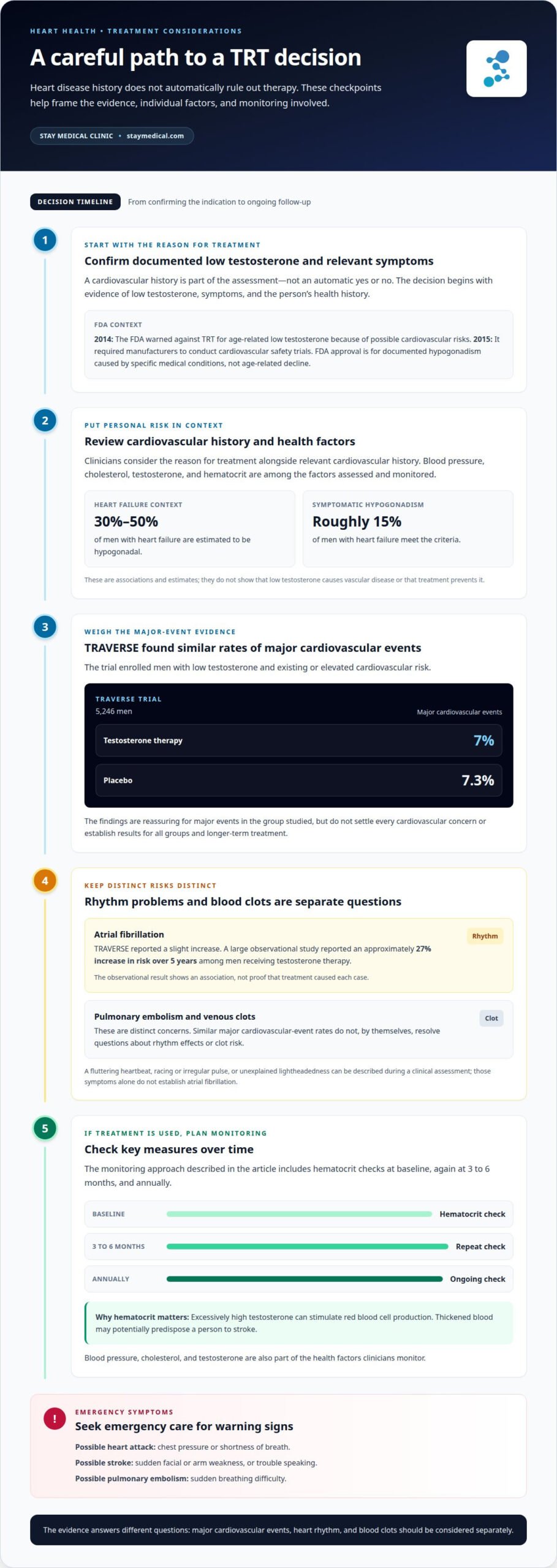
A history of heart disease doesn’t automatically rule out TRT, but it does make a careful risk-benefit discussion essential. In the TRAVERSE trial, 5,246 men with low testosterone and existing or elevated cardiovascular risk had similar rates of major cardiovascular events with testosterone therapy and placebo: 7% and 7.3%, respectively. This makes the evidence on TRT and cardiovascular health risks more reassuring for major events, but it doesn’t settle every concern.
It’s understandable to wonder whether testosterone replacement therapy (TRT) could affect an existing heart condition, trigger an irregular heartbeat, or raise the risk of blood clots. The evidence is nuanced: the TRAVERSE trial found no higher rate of major cardiovascular events with TRT, while reported signals involving atrial fibrillation and pulmonary embolism still deserve consideration.
This article explains what the TRAVERSE findings do and don’t show, how arrhythmia and clot concerns fit into the evidence, and which health factors can shape a TRT decision when heart disease is part of your history.
Key Takeaways
- A history of heart disease doesn’t automatically rule out TRT; the decision depends on documented low testosterone and an individual’s cardiovascular history.
- Major cardiovascular events, atrial fibrillation, and blood clots are distinct concerns, so evidence about one shouldn’t be taken to settle the others.
- TRAVERSE offers useful evidence for men with existing or elevated cardiovascular risk, but its findings have limits when applied to other groups or longer-term treatment.
- Blood pressure, cholesterol, and red blood cell levels are important parts of understanding treatment-related cardiovascular considerations.
- Learn which health details and monitoring considerations can shape a more informed discussion about whether TRT is appropriate.
Can individuals at risk for heart disease receive TRT?
Heart disease risk alone doesn’t automatically rule out TRT, but it affects how potential benefits and harms are weighed. The decision starts with evidence of low testosterone, relevant symptoms, and your cardiovascular history.
Testosterone and Cardiovascular Disease Links
Testosterone levels and cardiovascular disease can be associated, but an association doesn’t prove that low testosterone causes vascular disease or that treatment prevents it. An estimated 30% to 50% of men with heart failure are hypogonadal, while roughly 15% meet criteria for symptomatic hypogonadism.
TRT’s effect on heart attack and stroke risk depends on which evidence is considered. The TRAVERSE trial found similar rates of major cardiovascular events with testosterone therapy and placebo, while earlier observational studies raised concerns. These findings answer different questions: trials compare treatments under defined conditions, while observational studies may reflect differences in participants’ underlying health.
TRT Considerations With Prior Heart Disease
A history of heart disease calls for individualized assessment, not an automatic yes or no. One study found a roughly doubled risk of heart attack shortly after starting therapy among men younger than 65 with a history of heart disease. By contrast, TRAVERSE enrolled men with existing or elevated cardiovascular risk and did not find more major events with treatment.
Study results aren’t interchangeable: participants, design, and measured outcomes all affect what findings can tell you. The comparison is not simply TRT versus untreated low testosterone, because the available evidence doesn’t establish a universal risk from leaving low testosterone untreated. Symptoms such as reduced libido, less frequent shaving, loss of muscle or body hair, shrinking testicles, and breast enlargement can prompt a medical evaluation.
Prescribing Guidance and Heart Health Monitoring
The U.S. Food and Drug Administration warned in 2014 against using TRT for age-related low testosterone because of possible cardiovascular risks. In 2015, the FDA required manufacturers to conduct cardiovascular safety trials. FDA approval is for documented hypogonadism caused by specific medical conditions, not age-related decline.
Before and during therapy, clinicians assess the reason for treatment and relevant cardiovascular history, then monitor blood pressure, cholesterol, testosterone, and hematocrit. The listed monitoring approach checks hematocrit at baseline, again at 3 to 6 months, and annually. Excessively high testosterone can stimulate red blood cell production, thickening blood and potentially predisposing a person to stroke.
Unregulated testosterone-boosting supplements and anabolic steroids aren’t substitutes for prescribed TRT or an evaluation of symptoms. An analysis of 37 human studies found about 30% reported increased testosterone and about 45% found no effect from common supplement ingredients. Seek emergency care for possible heart attack symptoms, such as chest pressure or shortness of breath; stroke signs, including sudden facial or arm weakness or trouble speaking; or possible pulmonary embolism, such as sudden breathing difficulty.
Atrial fibrillation and nonfatal arrhythmia
Atrial fibrillation is an irregular heart rhythm, and research has examined whether testosterone replacement affects its likelihood. This matters because an irregular rhythm is a different outcome from a heart attack or stroke. Findings about major cardiovascular events cannot, by themselves, answer every question about rhythm-related effects.
One large observational study reported about a 27% increase in atrial fibrillation risk over 5 years among men receiving testosterone therapy. That result identifies an association, not proof that treatment caused each case. Observational findings can reflect differences in participants’ health, treatment decisions, or other factors, so they need careful interpretation.
TRAVERSE also reported a slight increase in atrial fibrillation among men receiving testosterone therapy. This finding deserves consideration alongside the trial’s results for major cardiovascular events, but it is a distinct outcome. Atrial fibrillation and nonfatal arrhythmia concern heart rhythm; major cardiovascular outcomes include events such as nonfatal heart attack and stroke.
For someone considering treatment, the practical step is an individualized review of symptoms and health history. A fluttering heartbeat, racing or irregular pulse, or unexplained lightheadedness are examples to describe during a clinical assessment. These experiences don’t establish atrial fibrillation on their own; identifying the heart rhythm requires appropriate clinical evaluation.
Testosterone levels need context, too. Palpitations don’t demonstrate low testosterone, and a low result alone doesn’t explain an irregular rhythm. Treatment decisions should connect a documented deficiency and relevant symptoms with your cardiovascular history, rather than treating testosterone replacement as a response to every change in energy or heartbeat.
Supplements marketed to increase testosterone are another consideration. They aren’t equivalent to prescribed testosterone therapy, and their ingredients and effects can differ. Tell the clinician assessing your heart rhythm about any supplements and hormone products you use. This helps provide a clearer picture of possible influences without assuming a product caused a particular symptom.
A history of arrhythmia, current heart symptoms, and the reason for treatment all shape the discussion. Ask how rhythm concerns will be considered alongside testosterone levels and treatment goals. If a new or severe symptom occurs, seek prompt medical attention rather than adjusting testosterone or supplements on your own.
For men with documented low testosterone, a testosterone replacement evaluation can put symptoms, treatment goals, and rhythm concerns into one clinical discussion. The reported 27% association over 5 years is a reason to understand the evidence, not a personal prediction. Distinguishing an observed study result from an individual assessment helps keep decisions grounded.
Pulmonary embolism and venous thromboembolism concerns
TRAVERSE recorded pulmonary embolism in 0.9% of participants receiving testosterone and 0.5% receiving placebo. This difference makes clotting an important part of discussions about testosterone replacement therapy, especially for people already concerned about cardiovascular risk. The figures describe trial participants, not a personal forecast or a guarantee of what will happen during treatment.
Venous thromboembolism, or VTE, refers to blood clots that form in veins. Deep vein thrombosis usually involves a clot in a deep vein, often in the leg; pulmonary embolism occurs when a clot reaches the lungs. These conditions differ from arterial events such as heart attack and stroke, so findings about one outcome shouldn’t be treated as proof about another.
The TRAVERSE pulmonary embolism rates need context. The trial compared testosterone and placebo groups of men with hypogonadism and existing or elevated cardiovascular risk. The reported percentages describe what occurred in those groups, but don’t show why each clot happened or establish the risk for every person receiving testosterone replacement.
That distinction matters when interpreting studies. A trial can identify an outcome worth considering without demonstrating that testosterone caused each event. Participants also have individual medical histories, and findings from one group don’t automatically apply to people with different health circumstances. For treatment decisions, consider the potential benefits of treating documented low testosterone alongside your own clotting and cardiovascular history.
A clinical discussion can cover previous VTE, known clotting disorders, current medicines, and any health changes since treatment began. Sharing these details gives the clinician a clearer basis for considering cardiovascular risk and treatment monitoring. A previous clot is particularly relevant because it changes the context for evaluating any new therapy.
Distinguish prescribed testosterone from unregulated supplements or anabolic steroids. They aren’t interchangeable: products can differ in ingredients, dose, and intended use. Tell the clinician about any hormone products and supplements you use rather than assuming an over-the-counter label answers questions about clot risk.
The TRAVERSE figures are one part of the evidence, not the whole decision. Ask how the pulmonary embolism findings relate to your diagnosis, treatment goals, and medical history. A clear discussion can distinguish the trial’s observed event rates from the factors that matter for you, without treating testosterone replacement as automatically safe or unsuitable for everyone with cardiovascular disease.
TRAVERSE trial and major cardiovascular events
TRAVERSE tested whether testosterone replacement increased major cardiovascular events in men with low testosterone and elevated cardiovascular risk. Its findings help frame a common concern, but they don’t answer every question about treatment. Understanding TRT and cardiovascular health risks starts with knowing which outcomes the trial measured.
TRAVERSE Trial Findings on Major Events
The trial’s primary outcome combined cardiovascular death, nonfatal myocardial infarction, and nonfatal stroke. Testosterone therapy was noninferior to placebo for this composite, with a hazard ratio of 0.96. In practical terms, the result did not show a higher rate of the combined outcome with therapy during the trial’s follow-up.
Mean follow-up was 33 ± 12.1 months, while mean treatment duration was 21.7 ± 14.1 months. These measures describe different things: follow-up tracks observation, while treatment duration reflects time receiving medicine. The results offer meaningful evidence for men resembling the enrolled patients, but don’t establish long-term safety beyond the period studied.
That distinction matters when making a decision. Findings about the combined outcome don’t mean that every individual event or other cardiovascular concern had identical results. Anyone weighing TRT and cardiovascular health risks should understand which outcome was measured and how the study population compares with their own health history.
Risks Across TRT Regimens
The available findings don’t establish that cardiovascular risk differs by dose, formulation, or duration. Individual treatment decisions still involve the prescribed amount, delivery method, achieved testosterone levels, and length of use. Consider these factors alongside the reason for treatment and any cardiovascular disease or other health conditions.
TRAVERSE’s follow-up and average treatment duration provide a time frame for interpreting the results, not proof about every longer course. Don’t assume that a result from one study applies unchanged to every testosterone replacement regimen. Treatment changes should take symptoms, laboratory results, and cardiovascular monitoring into account.
Low testosterone should also be assessed in context. The trial enrolled men whose testosterone levels were below 300 ng/dL, but a laboratory result alone doesn’t explain symptoms such as reduced libido. The clinical question is whether documented low levels and relevant symptoms support treatment, while cardiovascular history informs the risk discussion.
TRAVERSE helps clarify one major concern: in the studied population, testosterone therapy did not produce a higher rate of the combined outcome of cardiovascular death, nonfatal heart attack, and nonfatal stroke. This doesn’t make every patient’s decision automatic. The trial’s duration, measured outcome, treatment approach, and your health profile all shape how its findings apply.
How does TRT affect blood pressure, cholesterol, and red blood cell count?
Blood pressure, cholesterol, and hematocrit are important measures during testosterone therapy. They help clinicians assess cardiovascular health alongside symptoms, testosterone levels, and treatment goals. Monitoring doesn’t mean these measures will change in the same way for everyone; it helps make changes visible and informs a careful review.
Blood pressure provides a practical snapshot of cardiovascular status before and during treatment. Comparing readings over time helps clinicians interpret changes alongside other health information, rather than relying on one isolated measurement. A blood pressure reading is one part of an assessment, not a complete account of cardiovascular risk.
Cholesterol is also monitored after testosterone therapy begins. Results contribute to the broader picture of cardiovascular health, together with blood pressure and medical history. Interpret a cholesterol result in context, rather than treating it as proof that testosterone caused a change or that treatment alone explains cardiovascular disease.
Red blood cell production deserves particular attention. Excessively high testosterone levels can stimulate bone marrow to produce more red blood cells. A higher red blood cell concentration can thicken the blood and potentially predispose a person to stroke. Hematocrit, the proportion of blood made up of red cells, helps track this response.
The monitoring schedule described for testosterone therapy checks hematocrit at baseline, again at 3 to 6 months, and then annually. These checkpoints can show whether red cell levels are changing after treatment starts. The result matters alongside the testosterone dose and the person’s health history, rather than as an isolated laboratory value.
One physician interviewed generally stops testosterone therapy if hematocrit exceeds 54 to 55%. That threshold illustrates why follow-up testing matters: it can identify a level that prompts a change in treatment. It isn’t a substitute for interpreting results in the context of the individual’s health and other findings.
For someone with cardiovascular disease, a useful review connects blood pressure, cholesterol, hematocrit, and testosterone levels. Ask how each result affects the plan and what follow-up findings could lead to an adjustment. This keeps monitoring focused on the specific risks being tracked, rather than treating one normal result as the whole picture.
Testosterone therapy may not improve energy when severe fatigue is not caused by low testosterone. Clinicians who prescribe testosterone replacement typically monitor cholesterol, prostate health, and testosterone levels after treatment begins. Short- and medium-term testosterone replacement therapy does not increase the risk of heart disease.
Stay Medical Clinic
Stay Medical Clinic offers Primary Care and Testosterone Replacement to support an individualized discussion about low-testosterone symptoms, your health history, and cardiovascular considerations. Bring up concerns such as a previous heart event, irregular heartbeat, blood clots, or changes in blood pressure, cholesterol, or hematocrit. Together, you can discuss whether treatment may fit your needs and what monitoring to consider. If TRT isn’t appropriate, the conversation can still help clarify next steps for your health.
Make your next decision with clarity
The next step is a focused conversation about what you want treatment to address and how your health history affects that choice. A clear understanding of TRT and cardiovascular health risks comes from weighing symptoms, treatment goals, and heart-health considerations together, rather than treating any single concern as the whole answer.
Before deciding, identify the questions that matter most to you. You might want to discuss what a documented low testosterone result means, how ongoing monitoring fits your care, or how a previous cardiovascular concern affects treatment planning. These priorities can keep the discussion practical and centered on your circumstances.
Stay Medical Clinic can help you explore these questions through a personalized conversation about testosterone care and your broader health needs. The aim is an informed next step, with room to consider whether treatment aligns with your goals and medical context.
You deserve care that takes your questions seriously and helps you move forward with confidence.
Frequently Asked Questions
What does research say about testosterone replacement therapy and heart attack or stroke risk?
Research doesn’t show one uniform answer for every patient or treatment period. In TRAVERSE, the combined rate of cardiovascular death, nonfatal heart attack, and nonfatal stroke was not higher with testosterone therapy than placebo. Earlier observational findings raised concerns in some groups, including men with prior heart disease. These differences make study design and participant health important when interpreting results for an individual.
Does TRT increase the risk of blood clots, pulmonary embolism, or deep vein thrombosis?
TRAVERSE recorded pulmonary embolism more often in the testosterone group than in the placebo group, but this observation alone doesn’t establish that TRT caused each event. Deep vein thrombosis is a separate type of venous clot, and the findings provided don’t give a separate rate for it. A history of clots or a known clotting disorder is important context for discussing treatment and monitoring.
What did the TRAVERSE trial find about cardiovascular safety of testosterone therapy?
TRAVERSE found testosterone therapy noninferior to placebo for its combined outcome of cardiovascular death, nonfatal heart attack, and nonfatal stroke, with a hazard ratio of 0.96. The trial included men aged 45-80 with hypogonadism and existing or elevated cardiovascular risk. Its findings are most relevant to people resembling those participants, and don’t establish safety for groups outside the trial’s age range.
Which people are at higher cardiovascular risk from TRT, including those with heart disease or prior stroke?
People with established heart disease, a prior stroke, or a history of blood clots need particular attention during treatment decisions. One interviewed physician avoids starting testosterone within 6 months of a major cardiovascular event or stroke; this describes that physician’s practice, not a universal rule. The timing of the event, current health, symptoms, and treatment goals all shape an individualized assessment.
How do the cardiovascular risks of TRT compare with risks from untreated low testosterone?
In TRAVERSE, major cardiovascular events occurred at similar rates with TRT and placebo: 7% and 7.3%. The available findings do not establish a universal cardiovascular risk from leaving low testosterone untreated.
Disclaimer
This content is for informational purposes only and does not replace evaluation, diagnosis, or treatment by a medical professional. Always consult a qualified healthcare provider for personalized care.