

IV Therapy for Detoxification in Aventura
November 20, 2026
What if asking more questions is the simplest way to make a first visit feel more useful? Yes, it’s okay to ask questions to a new primary care doctor about routine physicals, preventive care, chronic conditions, and your personal health concerns. There’s no required script: focus on what matters to your health and what you need to understand.
A first appointment can feel like a lot to take in, especially when you’re sharing your health history with someone new. Preparing a few questions to ask a new primary care doctor helps you focus on what matters and understand how the doctor approaches your care.
Use this guide to prepare for a routine physical, understand what primary care can cover, discuss ongoing conditions and heart disease risk, and communicate clearly with your doctor. You’ll also find questions about test results, medications, follow-up, and what to bring, so you can leave with a clearer plan.
Key Takeaways
- Prepare a short list of questions about preventive care, tests, and vaccines so your routine physical reflects your needs.
- Clarify how primary care can support ongoing health concerns and coordinate care with specialists.
- Bring home blood pressure or blood glucose readings to help explain patterns over time.
- Share relevant family history and ask how it may shape a discussion about heart disease risk.
- Bring your medication list, records, and written concerns to help make communication with a new doctor clearer.
1. What questions should I ask the doctor at a routine physical?
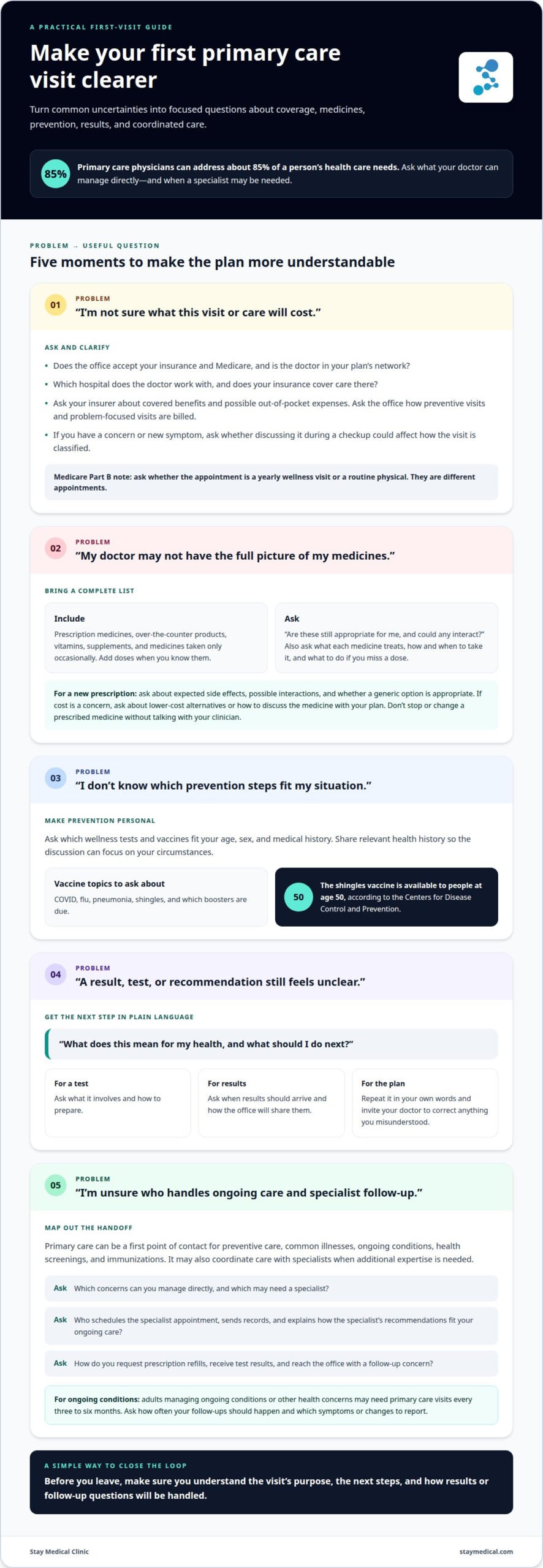
At your first appointment, ask whether the doctor accepts your health insurance and Medicare, and whether they’re in your plan’s network. You can also ask which hospital they work with and whether your insurance covers care there. These questions clarify how your coverage and care connect.
Ask your insurer which benefits your plan covers and what out-of-pocket expenses may apply. Then ask the office how preventive visits and problem-focused visits are billed. Discussing a new symptom during a checkup may affect how the visit is classified, so ask about this before your appointment.
Bring a current list of prescription medicines, over-the-counter products, vitamins, and supplements. Ask, “Are these still appropriate for me, and could any interact?” Include doses when you know them, along with medicines you take only occasionally, such as an over-the-counter pain reliever. A complete list gives your doctor a clearer picture.
Ask how to use each medicine safely: what it treats, how and when to take it, and what to do if you miss a dose. For a new prescription, ask about expected side effects, possible interactions, and whether a generic option is appropriate. If cost is a concern, say so and ask about lower-cost alternatives or how to discuss the medicine with your plan. Don’t stop or change a prescribed medicine without talking with your clinician.
For prevention, ask which wellness tests and vaccines fit your age, sex, and medical history. Adults can ask whether they need COVID, flu, pneumonia, or shingles vaccination, and which boosters are due. The Centers for Disease Control and Prevention states that the shingles vaccine is available to people at age 50. Share relevant health history so the discussion can focus on your circumstances.
If you have a routine physical under Medicare Part B, ask whether the appointment is a yearly wellness visit or a routine physical. They’re different appointments. Ask what each includes and whether a concern you want addressed should be scheduled separately. Knowing the distinction helps you prepare and understand the visit’s purpose.
Ask for a plain-language explanation if a result or recommendation isn’t clear. Try, “What does this mean for my health, and what should I do next?” Then repeat the plan in your own words and invite the doctor to correct anything you misunderstood. For a recommended test, ask what it involves, how to prepare, when results should arrive, and how the office will share them. Specific questions make follow-up easier.
2. What is primary care, and what does it cover?
Primary care is often the first point of contact for a new health concern. A primary care provider helps with preventive care, common illnesses, ongoing conditions, and health screenings. Care may also include immunizations and coordination with specialists when additional expertise is needed. For example, you can start with a primary care appointment to discuss recurring symptoms and possible next steps.
Routine care is one part of the role. A primary care doctor can review health concerns, discuss prevention, and help manage chronic conditions over time. Primary care physicians can address about 85% of a person’s health care needs. Ask which concerns the doctor can manage directly and which may require a specialist, so you understand how care will be organized.
A doctor’s specialty helps explain their focus. Family medicine doctors treat patients of all ages, while internal medicine doctors treat adults and often manage ongoing conditions. Ask, “What is your specialty, and which patients do you typically see?” Most healthy adults benefit from at least one annual wellness visit with a primary care doctor, though individual needs vary.
Board certification is another useful topic. Ask whether the doctor is board certified and in which specialty. Board certification indicates that a doctor has met national standards for education, knowledge, experience, and skills in a medical specialty. The answer can help you understand the doctor’s training and how it relates to your needs.
Specialist coordination may involve deciding whether a referral is appropriate, sharing relevant records, and clarifying follow-up. Ask, “Who schedules the specialist appointment, and who sends my records?” Also ask who will explain the specialist’s recommendations and how they fit your ongoing care. Knowing who handles each step can prevent confusion after a referral.
Ask what to do after a specialist visit. Find out whether you should schedule a follow-up with your primary care provider and how to share the specialist’s plan. If you see several specialists, ask how their recommendations are brought together. A clear process helps keep medication changes, test results, and next steps connected.
Ask how to request prescription refills, who reviews them, and how test results are shared. You can also ask whether a patient portal supports secure messaging, appointment scheduling, refill requests, and access to results. These practical details show how to manage routine needs between visits and where to direct questions about a referral or a new result.
To prepare, write down the names of your specialists and the questions you want answered. Ask how to reach the office with a follow-up concern and who responds when your doctor is unavailable. If you’re looking for a consistent point of contact for ongoing health needs, explore primary care support.
3. Chronic condition management
An ongoing condition needs a plan that works beyond one appointment. Ask how often follow-up visits should happen, which symptoms or changes to report, and what each visit should cover. Adults managing ongoing conditions or other health concerns may need primary care visits every three to six months. The timing and focus of each visit help keep your plan current.
For diabetes, ask which measures the doctor will use to follow your health and how to share readings between visits. If you monitor blood glucose at home, bring your records and note patterns or questions. Ask what changes in your readings mean for your plan and which concerns should prompt follow-up. Records over time can provide more context than a single measurement.
Blood pressure is another useful topic for ongoing care. If you monitor it at home, bring your readings and explain when you took them. Ask how the doctor interprets them alongside measurements taken during appointments. Home blood pressure or blood glucose records can give a more useful picture of an ongoing condition than one exam-room measurement. If you manage both, ask how they fit into your overall plan.
Include treatment options in the conversation. Ask, “What are my options, and what does each involve?” If a condition is ongoing, ask how to manage it over time and which changes may matter most to your daily routine. You can also ask for reliable sources to learn more. Clear explanations help you distinguish information about your diagnosis from advice that may not fit your situation.
Prevention also matters when managing an ongoing condition. Ask which habits may support your health and whether an exercise routine can be adapted to your fitness level. For eating guidance, ask for a plan that supports your health and, if desired, weight loss, rather than relying on fad diets. Discuss practical details, such as meals that fit your routine, so the advice is easier to use.
Ask how your follow-up plan connects with other care. If a specialist recommends a change, clarify how it fits your current treatment. Keep a list of your medicines and note questions about possible interactions or changes. For diabetes or another ongoing concern, ask who should receive new readings and how results will be discussed. A clear process helps you know which information to bring to each conversation.
Before leaving, summarize the agreed next steps in your own words. Include the follow-up timing, any records to bring, and what you’ll track at home. Ask the doctor to correct anything you misunderstood. This quick recap turns a discussion about ongoing care into a practical plan you can refer to between visits.
4. Heart disease risk and family history
Heart disease is the No. 1 killer of American adults. Use appointments to ask how your personal health information and family history shape a discussion of your heart health. Try, “Which details matter most when you assess my risk?” This invites a focused conversation instead of a general estimate. Ask what the doctor can explain during a physical and what should be revisited later.
Before your visit, write down close relatives’ heart-related conditions, if known. Include details such as a parent with heart disease or a sibling who had a stroke. Note when the condition began if you know, but don’t guess. Family history can be incomplete, so tell the doctor which details are known and which are unclear. Ask whether that history changes what they recommend discussing.
Personal health information adds context to the conversation. Ask how factors such as blood pressure, cholesterol results, diabetes history, and smoking history inform the assessment. Bring previous measurements or test results, or note where they were taken. Ask which results matter for your situation and how the doctor will explain them. This helps you understand the basis for a recommendation.
Consider these questions for your next appointment:
- Which parts of my family history are most relevant to heart health?
- Would a relative’s heart condition change the screening or follow-up we discuss?
- Which personal health measures should we review together?
- What changes should prompt me to contact the office?
Keep the discussion practical with a few focused questions. Ask for an explanation of any unfamiliar term, result, or proposed next step. If the doctor recommends a test, ask what question it is meant to answer and how the result could affect your care plan. If no test is recommended, ask what information supports that approach. Understanding the reasoning helps you take part without interpreting results alone.
Family medicine appointments can connect preventive care with your everyday routine. Ask which changes to eating, activity, or other habits suit your health and preferences. For example, explain what exercise fits your current routine, then ask what adjustments the doctor suggests. If a recommendation feels difficult to follow, describe the obstacle and ask about a more workable approach.
Close by summarizing the plan: the health details reviewed, any next step, and when to revisit the discussion. You might say, “I understand that we’ll review these results at my next appointment. Is that right?” Ask where to direct questions that come up afterward. A written note of the agreed steps can help carry the conversation into future visits.
5. Choosing and communicating with a new primary care doctor
A good fit depends on more than a convenient appointment. Ask whether the doctor is accepting new patients, what ages the practice sees, and whether its approach matches your needs. Family doctors care for patients of every age, while some primary care practices see adults only. If access for your family matters, clarify who the practice treats before scheduling.
Ask about the doctor’s approach to care: how they involve patients in decisions, discuss treatment options, and consider lifestyle. You might say, “How do you approach prevention and ongoing health concerns?” The answer can help you understand what conversations with the doctor may be like. Also ask whether the doctor is board certified and in which specialty to understand their professional focus.
Practical details affect how easily you can stay connected. Ask about office hours, how far ahead appointments are usually scheduled, and whether the practice offers in-person and video visits for routine care. Find out whether a patient portal supports secure messages, appointment requests, prescription refills, or access to test results. These details matter between annual visits, especially when questions come up afterward.
Ask who handles care when your doctor is away. Find out whether another clinician sees patients, who responds to messages, and how coverage works during absences. If you prefer a group practice or an individual doctor, include that in your decision. Also ask which hospital the doctor admits patients to, if hospital access is relevant to your care.
Before your first appointment, bring your insurance card, a list of prescription and over-the-counter medicines, supplements, and vitamins, as well as recent lab results or specialist records. Add a written list of concerns and questions. Include home blood pressure or blood glucose readings if you track them. These details give your provider useful context without relying on memory during a short visit.
Communication works best when you can speak openly. Ask whether someone in the office speaks your preferred language, and consider whether a doctor’s age, sex, race, or religion matters to you. Share how you prefer to receive information, such as a direct explanation or written next steps. The National Institute on Aging publishes a guide for older patients about talking with doctors.
Ask questions to build a working relationship, not to test your doctor. If an explanation is unclear, request simpler wording, then repeat the plan in your own words. Ask how to raise a new concern, how results are shared, and who to contact about follow-up. Those answers show how the practice supports communication beyond the exam room.
Stay Medical Clinic: Primary Care
Stay Medical Clinic provides primary care for people seeking an ongoing partner in their health. Turn to the clinic for preventive care, routine health concerns, or support managing an ongoing condition. Appointments can make space to discuss your priorities, understand recommended next steps, and plan care around your needs.
Bring your questions, medication list, and relevant health records to help guide the conversation. Clear communication helps your provider understand what matters to you and what you want from your care.
Contact Stay Medical Clinic to discuss primary care.
Make your next health conversation count
Your relationship with a primary care doctor can evolve as your priorities change. Treat each visit as a chance to set a shared direction: name what matters now, discuss what you want to work toward, and agree on a practical next step. The questions to ask a new primary care doctor can change too, as your health needs and goals develop.
For broader support, Stay Medical Clinic also offers a Weight Loss Program, Testosterone Replacement, and IV Therapy. These services may be relevant when they align with the concerns you want to discuss as part of your health.
When you’re ready to explore care that fits your needs, start a conversation with Stay Medical Clinic.
A thoughtful first step can make future conversations clearer and more personal.
Frequently Asked Questions
Is It Okay to Ask Your Doctor All of This?
Yes. Asking questions helps you understand your care and take part in decisions. A thoughtful set of questions to ask a new primary care doctor can clarify next steps, especially when you’re unfamiliar with a diagnosis or recommendation. If time feels limited, bring a short written list and begin with your main concern. You can also ask which topics need a separate appointment.
What is primary care, and what does it cover?
Primary care is a central place to discuss health needs that arise over time. It can include prevention, common illnesses, ongoing conditions, and help coordinating specialist care. For example, if a new symptom affects your sleep or work, describe when it started and how it affects daily life. Ask what the primary care provider can address directly and what follow-up makes sense.
What questions should I ask the doctor at a routine physical?
Ask what the visit is intended to cover and which concerns deserve attention first. If you’ve noticed a new symptom, describe when it began, what changes it, and how it affects your routine. Ask whether it belongs in the current appointment or needs another visit. You can also ask what to expect after a test, including how the office will communicate results and next steps.
What should I ask about a doctor’s experience, training, and approach to care?
Ask about the doctor’s specialty, board certification, and experience caring for people with concerns like yours. Then ask how they explain options and involve patients in decisions. Try, “How do you approach a health concern when there’s more than one treatment option?” The response can show whether the doctor’s communication style suits your preferences and whether you feel comfortable raising questions.
How can I ask about appointment availability, wait times, and after-hours care?
Ask how far ahead routine appointments are usually scheduled and how the office handles requests for an earlier visit. Clarify whether a cancellation list is available and how patients hear about openings. For after-hours concerns, ask which number or process to use and who responds when the usual clinician is away. These details help you plan access without assuming every concern follows the same path.
How does a primary care doctor’s office handle urgent concerns and medical records?
Ask how to report a concern that needs prompt attention, how the office decides what happens next, and what to do if it arises outside office hours. Ask how to send previous test results and specialist notes, and how to request copies later. If the office uses a patient portal, clarify whether it supports secure messages and record access before relying on it.
How do I discuss costs, copays, billing, and insurance with a new doctor’s office?
Ask whether the office accepts your insurance and whether the doctor is in your plan’s network. Before a visit or test, clarify how the appointment will be billed and whether a separate concern could affect its classification. Then ask your insurer about covered benefits, copays, and possible out-of-pocket expenses. Keeping the office’s billing explanation with your plan details can make statements easier to understand.
What are signs that a primary care doctor is a good fit for me?
A good fit means you can explain your concerns, understand the response, and leave knowing the next step. Notice whether the doctor listens without rushing you and invites you to clarify what matters. Practical fit counts too: consider communication options, travel, and appointment access. If you live in Aventura, Bal Harbour, Bay Harbor Islands, Biscayne Park, Coral Gables, Cutler Bay, Doral, El Portal, Florida City, Golden Beach, Hialeah, Hialeah Gardens, Miami, Brickell, or Key Biscaya, include travel to appointments in your decision.
Disclaimer
This content is for informational purposes only and does not replace evaluation, diagnosis, or treatment by a medical professional. Always consult a qualified healthcare provider for personalized care.