

Risks of buying testosterone online, from unregulated sources to health monitoring
October 24, 2026
Establishing a long-term patient-doctor relationship begins when a physician affirmatively examines, diagnoses, treats, or agrees to treat a patient. Ongoing care grows from that initial connection through continuity, clear communication, and a shared understanding of the patient’s health history. A single appointment may establish a relationship, but trust and familiarity develop over time.
It’s understandable to want more than a name on a chart: a doctor who knows your health story can make care feel more connected and personal. This article explains when the relationship begins and how regular visits, honest conversations, and a record of your health history can support continuity. You’ll also learn how an ongoing primary care relationship can help with prevention and coordination when specialist care is involved.
Key Takeaways
- A physician-patient relationship generally begins when a physician examines, diagnoses, treats, or agrees to treat you.
- Keep your health history and share updates about medications, treatments, symptoms, and lifestyle changes with your primary care physician.
- Regular visits with the same physician can help connect new concerns with your health history and support coordinated care.
- Ask questions, voice concerns openly, and clarify anything you don’t understand to make conversations more useful.
- Trust can make it easier to discuss sensitive symptoms and personal health changes, helping your physician better understand your needs.
When Is a Patient-Physician Relationship Established?
A patient-physician relationship generally begins when a physician examines, diagnoses, treats, or agrees to treat someone. Booking an appointment alone doesn’t establish that care has begun. For example, when a primary care physician reviews your symptoms and creates a treatment plan, they have taken an active role in your care. That first encounter can become the foundation for ongoing medical care.
Continuity develops when visits, health information, and follow-up connect over time. A study published in JAMA Internal Medicine found that patients with continuous physician relationships experienced lower mortality rates and fewer emergency room visits. The Match Made in Medicine study found that four out of five people were likelier to take advice from a doctor they knew. Familiarity can help a primary care physician recognize changes and reduce gaps or conflicting treatment plans.
What should I consider when choosing a long-term primary care doctor? Consider whether the physician’s approach supports clear communication, continuity, and attention to your medical history. Choose a primary care doctor you can speak openly with and whose office can help coordinate follow-up when specialist care is involved.
Does my health insurance require me to choose an in-network primary care doctor? Requirements depend on your plan’s network and referral rules. Review your plan to see whether you must designate an in-network primary care physician and whether specialist visits require a referral.
What does it cost to establish care with a primary care doctor without insurance? Without insurance, the price depends on the visit, examination, and any tests involved, and is given after a quote request. The services included in the appointment are the main cost factors.
How do I find a primary care doctor accepting new patients near me? Search your health plan’s directory or local clinic listings for primary care practices, then review their new-patient information. Compare location, the appointment process, and whether the practice can support your routine and ongoing medical needs.
How can I transfer medical records to a new doctor? Ask your previous practice to send your records to the new office, or request copies to share yourself. Include relevant medical history, medication lists, test results, and specialist recommendations so your new physician can understand your care to date.
How often should I see a primary care doctor for routine checkups? Regular appointments and annual check-ups can help a physician notice health changes and provide preventive care. Your schedule should reflect factors such as your medical history, current symptoms, medications, and chronic conditions. Follow through on screenings and tests recommended during those visits.
Continuity, trust, and patient-provider communication
Continuity depends on more than repeat appointments; it also grows through attentive, honest conversations. Clear communication helps patients share concerns and take part in decisions about their care.
Empathetic and Open Communication
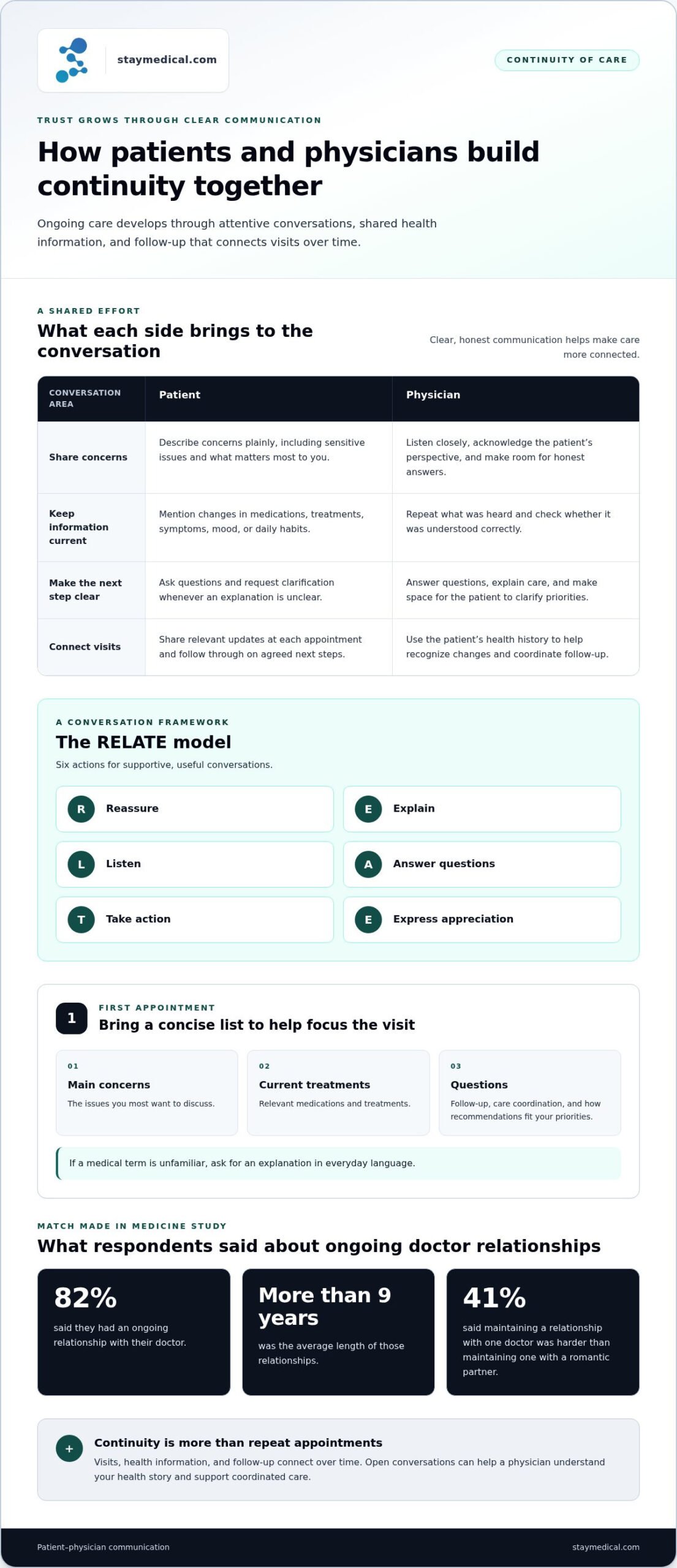
Empathetic communication means listening closely, acknowledging a patient’s perspective, and making room for honest answers. A physician can repeat what they heard and ask whether they understood correctly, giving the patient a chance to clarify symptoms or priorities. Patients can help by describing concerns plainly, including sensitive issues, and mentioning changes in medication, mood, or daily habits.
That openness can deepen the connection over time. In the Match Made in Medicine study, 82% of respondents said they had an ongoing relationship with their doctor, and those relationships averaged more than nine years. The study also found that 41% said maintaining a relationship with one doctor was harder than maintaining one with a romantic partner. Consistent attention and candid conversations can help patients stay engaged rather than leaving important questions unspoken.
How can I build trust and communicate effectively with my doctor over time? Share concerns openly, including what matters most to you, and ask for clarification when an explanation is unclear. At each appointment, mention relevant changes since your previous visit and agree on the next step together.
Communication Tools and First Appointments
The RELATE model offers a practical framework for supportive conversations: Reassure, Explain, Listen, Answer questions, Take action, and Express appreciation. It matters because patients need both clear medical information and space to respond. At a first appointment, bring a concise list of your main concerns, current treatments, and questions about follow-up or care coordination.
What questions should I ask at a first appointment with a new doctor? Ask how the physician prefers to handle follow-up, what to do if symptoms change, and how recommendations fit your health priorities. You can also ask for an explanation in everyday language if a medical term is unfamiliar.
Finding the Right Doctor and Maintaining Care
A good fit includes communication that respects your language, cultural background, accessibility needs, and gender preferences. Explain what helps you feel comfortable, such as a particular language for medical discussions or an accessible appointment setting, so those needs can be considered in your care.
How do I find a doctor who fits my language, cultural, accessibility, or gender preferences? Identify which preferences matter most for clear, comfortable communication, then raise them when arranging care. Explain any access needs or communication support that would help you participate fully.
What should I do if I need to change doctors or my doctor leaves the practice? Request that your medical records be sent to your next physician, and keep a current list of medications and ongoing care plans. A primary care visit can help organize priorities and follow-up as you continue care; learn about primary care visits.
Trust and comfort in the patient-doctor relationship
Trust develops through repeated encounters where a physician listens, explains decisions, and follows through. That consistency can make personal health conversations more meaningful and support shared care decisions.
Building Trust and Rapport
Rapport is the mutual understanding that grows when a physician treats you as a person, not just a set of symptoms. It matters because patients who feel heard can more readily explain what affects daily life. For example, describing how pain interferes with work gives your primary care physician useful context for discussing treatment priorities.
Small actions help establish that connection. A physician can ask about your concerns, acknowledge difficult news with empathy, and explain the reason for a recommended test. Notice whether the physician listens without interrupting, answers questions clearly, and follows through on agreed steps. Trust grows when words and actions align, not through promises about outcomes.
The Match Made in Medicine study found that 70% of patients felt comfortable discussing embarrassing symptoms with a long-term doctor, compared with 40% with a doctor they had just started seeing. For example, a patient may find it easier to mention a sensitive symptom after prior conversations were met with respect. That added openness gives the physician a fuller picture to consider.
Comfort, Openness, and Treatment Participation
Comfort means feeling able to share concerns and participate in decisions about your care. Treatment plans work best as discussions, not instructions delivered without context. You can explain which parts of a plan fit your daily routine, while your physician describes options and listens to your preferences.
Familiarity may also support conversations about family history and mental health. In the Match Made in Medicine study, 74% felt comfortable discussing family history with a long-term doctor, compared with 49% with a new doctor. For mental health, the figures were 72% and 41%, respectively. These differences highlight why an ongoing relationship can make sensitive subjects easier to raise.
Try bringing a concern to each appointment and asking what choices are available. If a recommendation feels difficult to follow, explain the barrier, such as a schedule conflict or concern about side effects. Your physician can then discuss adjustments and next steps with you. Shared decisions can include family members you want involved.
Shared understanding of priorities and limitations is important, too. Taking time to listen, avoiding rushed appointments, and focusing on your concerns can help build rapport. Availability, accessibility, and affability can make it easier to raise questions and explain what matters to you, while giving your physician room to respond with attention and care.
Physicians build trust by keeping their word and avoiding promises about outcomes they cannot reasonably provide. They can also personalize appointments by asking about something important in your life, such as family, hobbies, or work. Those details add human context and help ensure your circumstances are considered. Honest expectations, a welcoming manner, and focused listening can support a relationship where you feel comfortable speaking openly and participating in decisions.
Early detection through knowledge of a patient’s health baseline
A health baseline is the picture formed by your history, usual symptoms, test results, and daily routines. A physician who knows that picture can compare a new concern with what is typical for you. For example, noting when fatigue began and how it differs from your usual energy gives a clinic visit more useful context than simply saying you “feel off.”
Changes in family life, work, sleep, or stress can affect health and deserve mention alongside physical symptoms. You might tell your physician that headaches began after a change in your work schedule, or that a new symptom feels difficult to discuss. Health questionnaires can help bring forward concerns that matter to you, including topics you might otherwise forget to raise during an appointment.
Share changes clearly and specifically. Note when a symptom started, what makes it better or worse, and whether it affects activities such as walking or sleeping. Tell your primary care physician about medication or treatment changes made by other health care professionals. A new prescription or a stopped medication, for example, can change how your physician interprets symptoms and plans follow-up.
A connected health history also helps put test results and specialist recommendations into context. Bring previous lab results when available, and mention tests or treatments you have already completed. If a specialist recommends a new medication, sharing that plan with your primary care physician can help coordinate it with your overall care. Access to past results can also help avoid unnecessarily duplicated tests or treatments.
Regular visits and annual check-ups give a physician opportunities to notice changes and provide preventive care. A family physician may identify signs associated with diabetes, heart disease, or hypertension before those conditions become serious. Screening discussions can reflect your individual history and concerns, rather than treating each appointment as an isolated event. Follow through on recommended screenings, tests, and treatment plans.
To make each visit more informative, bring a current medication list, note recent symptoms, and share relevant changes in daily life. These steps connect your health history with what is happening now. If you are managing a chronic condition, continuity can help your physician assess changes over time and coordinate care as your needs evolve.
You can support a strong relationship with your primary care physician by being open about health concerns, lifestyle habits, and symptom changes. Be practical and direct: describe what you have noticed, explain which habits or routines may be relevant, and say when something feels different from your usual experience. You do not need a complete explanation before raising a concern. Sharing what you know, including uncertainty, gives you and your physician a clearer starting point for discussion.
If a subject feels personal or difficult to raise, you can say so and share what you feel comfortable sharing. A question or brief note can help you begin. Focus on what has changed and what concerns you most, while making room for your physician to ask follow-up questions. This candid exchange keeps health concerns, everyday habits, and symptoms in the same conversation.
Benefits of long-term doctor-patient relationships
A long-term relationship gives a primary care physician context that a single visit cannot provide. Over time, the physician can connect new symptoms, earlier decisions, and your priorities. That fuller view supports personalized care, especially when several conditions or specialists are involved. The value of establishing a long-term patient-doctor relationship lies in this growing context, not familiarity alone. It creates a more coherent basis for health decisions.
Continuity also matters for health outcomes. A study published in JAMA Internal Medicine found that patients with continuous physician relationships experienced lower mortality rates and fewer emergency room visits. These findings point to the value of care that considers your history rather than treating each visit separately. A familiar physician can help prioritize concerns and track how a plan works over time.
For people managing a chronic disease, repeated conversations can connect everyday challenges with treatment decisions. You might explain that a medication schedule conflicts with work or that a treatment plan is difficult to follow. Your physician can use that information to discuss practical options and make shared decisions. This engagement can help you complete care tasks and follow recommendations.
A long-term primary care physician can also help coordinate specialist care. When a specialist recommends a new treatment, your primary care physician can consider how it fits your broader health strategy and check medication compatibility across specialties. This coordination can reduce confusion when different clinicians make recommendations at different times.
Knowing your history can make conversations more efficient. Instead of rebuilding context at every appointment, you and your physician can focus on what has changed and needs attention now. For example, a physician who knows how you responded to an earlier treatment can discuss how a new option differs. Establishing a long-term patient-doctor relationship gives those decisions a continuing point of reference.
Long-term care can be especially useful after a hospital visit or a new diagnosis. Your primary care physician can help interpret specialist recommendations, organize follow-up, and identify questions that remain. Bring discharge instructions or updated medication information to your next appointment. This gives the conversation a practical starting point and helps connect hospital care with ongoing health needs.
The clearest takeaway is that continuity turns separate encounters into an ongoing care relationship. You can contribute by sharing changes, discussing barriers, and taking part in decisions. Physicians can use that context to coordinate care and adjust recommendations as circumstances evolve. A continuing primary care relationship can provide a steady reference for anyone seeking personalized, connected medical care.
Stay Medical Clinic: Weight Loss Program
Stay Medical Clinic offers Primary Care and a Weight Loss Program for people seeking ongoing support with their health and weight-related goals. If weight management is part of your broader health picture, primary care provides a place to discuss your concerns and medical history as you consider next steps. The Weight Loss Program may suit people seeking care focused on weight management. Stay Medical Clinic also offers Testosterone Replacement and IV Therapy as part of its care services. The right starting point depends on your health needs and priorities. Visit staymedical.com or contact Stay Medical Clinic to discuss your care.
Make Your Next Health Conversation Count
Establishing a long-term patient-doctor relationship is an ongoing choice to make your health conversations part of a connected plan. Before your next appointment, consider what you want help prioritizing, which changes you’ve noticed, and what questions remain. Bringing those thoughts forward can help you and your physician focus the visit on what matters to you now.
If your health goals include weight management or other concerns, Stay Medical Clinic offers a Weight Loss Program, Testosterone Replacement, and IV Therapy. These services can be a starting point for discussing your needs within the care available at the clinic. Your next step can be a conversation about your priorities and the care that fits them.
Meaningful care begins with a conversation. Take the next step when you’re ready, and keep building a health plan that reflects your needs.
Frequently Asked Questions
What are the benefits of continuity of care with the same doctor?
Continuity helps your doctor interpret new concerns alongside your established care plan. For example, if you’re in Miami and a symptom returns after treatment, note when it appeared, what changed, and which steps helped. That record gives your doctor a clearer starting point for the visit and can make follow-up decisions more focused. It also helps you keep track of questions between appointments.
Disclaimer
This content is for informational purposes only and does not replace evaluation, diagnosis, or treatment by a medical professional. Always consult a qualified healthcare provider for personalized care.