

Diet Plan for Tirzepatide Users: A Practical, Flexible Guide
October 9, 2026
PCOS Weight Loss Doctor in Miami: What to Expect from Medical Care
October 11, 2026
What if a high blood pressure reading is a clue, not a conclusion? If you’ve searched “causes bp,” you may be trying to understand whether stress, daily habits, medication, or an underlying health condition could be affecting your numbers. A single high reading doesn’t tell the whole story, and high blood pressure often has no noticeable symptoms.
It’s understandable to feel uncertain about what to do next. Blood pressure can be influenced by several factors at once, so focusing on just one possible cause may leave important details out. Repeat readings, considered alongside your health history and lifestyle, can help make the picture clearer.
This article explains common, potentially changeable influences on blood pressure and health conditions that can contribute to it. You’ll also learn what details may be useful to discuss with a clinician, why routine screening matters, and how to take a sensible next step without trying to diagnose yourself. A primary care visit can provide a setting to review your readings and personal risk factors, including at Stay Medical Clinic in Brickell, Miami.
Key Takeaways
- One high reading doesn’t establish a diagnosis; repeat measurements can help reveal whether the elevation persists.
- Everyday habits and body systems may influence blood pressure, but lifestyle isn’t necessarily the only explanation.
- Learn the difference between lasting causes bp and temporary influences such as stress, caffeine, exercise, or measurement conditions.
- Record readings and relevant context so a clinician can review the pattern alongside your health history and medicines.
- Repeated high readings deserve a timely conversation with a primary care clinician, even if you feel well.
What Causes High Blood Pressure, and What Does “High BP” Mean?
An unexpectedly high reading can be unsettling, but one measurement alone doesn’t diagnose hypertension. Blood pressure can shift, so clinicians consider the pattern across properly taken readings and your health history. The question behind searches for “causes bp” is often not just what raised a number today, but whether several influences may be shaping it over time.
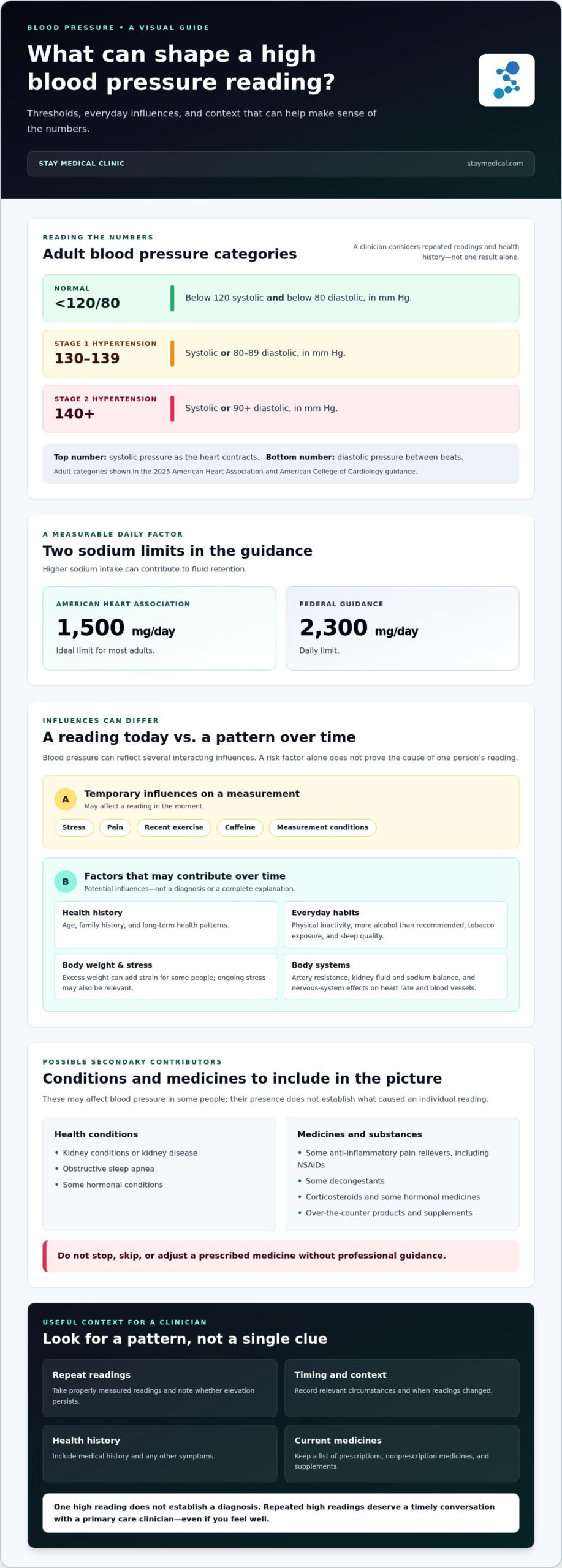
Blood pressure measures the force of blood pushing against artery walls. The top number, systolic pressure, records pressure as the heart contracts; the bottom number, diastolic pressure, records pressure between beats. Under the adult categories in the 2025 American Heart Association and American College of Cardiology guidance, normal pressure is below 120/80 mm Hg. Stage 1 hypertension is 130-139 systolic or 80-89 diastolic, and Stage 2 is 140 or higher systolic or 90 or higher diastolic. A clinician considers repeated readings, not a single result, when assessing whether high blood pressure is present.
Hypertension is persistently elevated pressure in the arteries, identified through blood pressure measurements and clinical assessment. It describes a health condition, not a symptom, and often has no obvious warning signs. Its development can reflect interacting influences rather than one clear-cut cause. The overview of Hypertension (High Blood Pressure) also explains the distinction between primary and secondary forms.
Primary hypertension: when there is no single identifiable cause
Primary, or essential, hypertension develops gradually and has no single identifiable cause. Age, family history, and long-term health patterns may each contribute, but none guarantees that someone will develop high blood pressure. A family tendency is useful context, not a prediction. “No single cause” doesn’t mean the condition is imaginary or unimportant; it means several influences may contribute to the overall pattern over time.
Secondary hypertension: when another condition or substance contributes
Sometimes high blood pressure is associated with another health condition, a medication, or another substance. Kidney conditions are one example; certain medicines, including some anti-inflammatory pain relievers or decongestants, may also affect pressure in some people. This doesn’t mean a particular medicine or condition caused your reading. Don’t stop a prescribed medicine on your own. Instead, share what you take, including nonprescription products and supplements, with your clinician.
To investigate a possible secondary cause, a clinician may consider when the readings changed, your medical history, medicines, and any other symptoms. This context can help distinguish a persistent pattern from a temporary influence and guide whether further evaluation is appropriate. A personalized primary care visit in Brickell provides a setting to review readings and relevant health history with a clinician.
How Do Everyday Habits and Body Systems Influence Blood Pressure?
Blood pressure reflects more than one part of the body. Narrower or less flexible arteries create more resistance to blood flow, while the kidneys help regulate the body’s fluid and sodium balance. The nervous system can also change heart rate and tighten or relax blood vessels. These systems interact, so the causes bp searchers are looking for may involve a mix of long-term patterns and short-lived influences.
A risk factor is something associated with a greater chance of developing high blood pressure; by itself, it doesn’t prove what caused one person’s reading or condition. Stress, pain, or recent exercise may affect a measurement temporarily, while repeated patterns and health conditions may matter over time. The CDC’s Risk Factors for High Blood Pressure overview distinguishes factors people may be able to change from others, such as age and family history.
Which health and lifestyle factors can raise hypertension risk?
Everyday patterns can influence risk, but they don’t explain every person’s blood pressure. Higher sodium intake can contribute to fluid retention. The American Heart Association recommends an ideal limit of 1,500 mg of sodium per day for most adults, while federal guidance sets a limit of 2,300 mg per day. Physical inactivity, drinking more alcohol than recommended, and tobacco exposure are also factors worth discussing with a clinician.
Body weight is another possible influence: for some people, excess weight can increase strain on the heart and circulation. This isn’t a judgment or a complete explanation, and it doesn’t apply in the same way to everyone. Sleep quality and ongoing stress may also be relevant. A clinician can consider how these factors fit with your readings and other health information rather than treating any one of them as proof of a cause.
Can medicines and health conditions affect blood pressure?
Yes. Some medicines can raise blood pressure or affect its control in certain people. Examples include nonsteroidal anti-inflammatory drugs (NSAIDs), some decongestants, corticosteroids, and some hormonal medicines. Effects vary by person and product, so keep a current list of prescriptions, over-the-counter medicines, and supplements to review with a healthcare professional.
Kidney disease, obstructive sleep apnea, and some hormonal conditions can also contribute to secondary hypertension. A clinician may weigh these possibilities alongside your medical history and the timing of changes in your readings. Don’t stop, skip, or adjust a prescribed medicine without professional guidance. A primary care visit in Brickell gives you an opportunity to discuss readings, health history, and medicines. Stay Medical Clinic offers personalized primary care in Brickell, Miami.
Which Blood Pressure Causes Are Lasting, and Which May Be Temporary?
A blood pressure reading is a snapshot, not a complete explanation. It can reflect a lasting pattern, a short-term response, or the way the measurement was taken. Understanding these differences helps put an unexpected number in context, but it can’t determine the cause on its own. Note what was happening around the reading and look for patterns with a clinician.
| Type of reading | What may contribute | What to keep in mind |
|---|---|---|
| Persistent elevation | Ongoing influences, health conditions, or a combination of factors | A clinician interprets the pattern across appropriate measurements. |
| Temporary influence | Stress, caffeine, nicotine, exercise, or pain | A short-term rise doesn’t establish or rule out hypertension. |
| Measurement-related variation | Recent activity, talking, posture, cuff fit, or an unsupported arm | Technique and setting can affect the result. |
Why can blood pressure rise for a short time?
The body responds to what’s happening around it. During exercise, the heart works harder to supply muscles; emotional stress or pain can activate a short-lived alert response. Caffeine and nicotine may also influence a reading. These effects vary, and a temporary rise isn’t the same as a diagnosis. But don’t assume a high number is harmless just because it followed a stressful moment.
Record the reading and relevant context, such as recent activity, caffeine, nicotine, pain, or stress. Note how and where you measured it, too. These details can help a clinician interpret the result alongside other readings. A pattern needs appropriate measurement and professional interpretation, not a personal rule based on one reading or circumstance.
Why can blood pressure be high without symptoms?
High blood pressure often has no noticeable symptoms. Feeling well doesn’t confirm that pressure is normal, and symptoms such as a headache or dizziness can’t reliably establish that it’s high. Measurement, rather than how you feel, reveals the reading. Routine screening matters because symptoms alone can’t confirm or exclude hypertension, whether carried out during a primary care appointment or through community health services like Merali Pharmacy & Clinic.
Seek emergency help for severe or sudden concerning symptoms, such as chest pain, trouble breathing, sudden weakness, or difficulty speaking. If a reading is above 180/120 mm Hg, wait at least one minute and measure again. If it remains that high, contact a healthcare professional promptly; if it’s accompanied by concerning symptoms, call emergency services. Don’t delay urgent help to keep rechecking.
How Can You Work Out What May Be Raising Your Blood Pressure?
Finding possible causes bp takes more than looking at one number. A clear record gives a clinician useful context without asking you to diagnose yourself. Start with careful repeat measurements, note what was happening around them, review relevant health details, then discuss the information with a clinician.
- Measure consistently. Use a properly fitting upper-arm cuff and follow its instructions. Before measuring, sit quietly with your back supported, feet flat, and arm supported at heart level. Avoid measuring right after exercise, smoking, or caffeine. Take readings as directed by current clinical guidance, and bring the monitor to an appointment if you’d like its technique reviewed.
- Record the circumstances. Note the date, time, reading, and anything that may help explain the context, such as recent activity, stress, pain, caffeine, or a medication change. Don’t try to decide from a handful of numbers whether you have hypertension.
- Review your health history. Gather a current list of prescription and over-the-counter medicines, supplements, known health conditions, and relevant family history. Include changes in sleep or health that may be useful to discuss.
- Discuss the record. A clinician can interpret your readings alongside your health history and decide whether further evaluation is appropriate. A primary care visit in Brickell offers a setting to review these details with a Stay Medical Clinic clinician.
What information should you record before an appointment?
Keep the log simple: include each reading with its date and time, plus brief notes about relevant circumstances. Bring your medication and supplement list, including recent starts, stops, or dose changes. Add known health conditions and family history of high blood pressure or related health concerns. The goal isn’t to interpret a trend alone; it’s to help your clinician see the fuller picture.
When might a clinician consider laboratory testing?
Laboratory work may be considered when a clinician believes it could help assess relevant health factors. Whether testing is appropriate depends on your history, examination, readings, and clinical judgment. It isn’t a universal test that identifies every cause of high blood pressure, and the specific tests depend on the individual. Stay Medical Clinic provides laboratory testing as part of its primary care offering; a clinician can determine whether it fits your evaluation.
Organized readings and a current health history can make the conversation more focused. If you’ve had repeated high measurements, share the record rather than relying on how you feel or on a single result.
When Should You Discuss High Blood Pressure With a Miami Primary Care Clinician?
Repeated high readings are worth discussing with a clinician, even if you feel completely well. Hypertension often has no noticeable symptoms, and waiting for discomfort can delay a useful evaluation. If you’re researching “causes bp,” a clinician can help put your readings in context instead of relying on guesswork or a single measurement.
A primary care clinician can review your readings and how they were taken, your health and family history, your medicines and supplements, and relevant changes in your health or daily routine. That broader view can help identify factors worth exploring. It doesn’t guarantee that one cause will be found, and evaluation or follow-up depends on your individual circumstances.
What can a primary care visit help clarify?
Bring your blood pressure record, including dates, times, and notes about circumstances around the measurements. Share known health conditions, family history, and a current list of prescription medicines, over-the-counter products, and supplements. A clinician can consider these details together, discuss whether further evaluation is appropriate, and explain possible next steps based on your situation.
If a reading is above 180/120 mm Hg, wait at least one minute and measure again. If it remains that high, contact a healthcare professional promptly. If a very high reading occurs with severe or sudden symptoms such as chest pain, trouble breathing, sudden weakness, or difficulty speaking, call emergency services rather than waiting for a routine appointment.
How to take a calm, useful next step in Brickell
Preparing a short record can make the conversation more focused. Consider bringing:
- Recent readings with dates and times
- A current medicine and supplement list, including recent changes
- Notes about relevant health history, family history, or changes you’ve noticed
Stay Medical Clinic in Brickell, Miami, provides personalized primary care where you can review readings and relevant health history with a clinician. The clinic serves its local community across Miami and nearby areas, including Aventura, Bal Harbour, Bay Harbor Islands, Biscayne Park, Coral Gables, Cutler Bay, Doral, El Portal, Florida City, Golden Beach, Hialeah, Hialeah Gardens, and Key Biscaya. A primary care visit can help you discuss your personal risk and determine an appropriate next step without assuming a diagnosis in advance.
Take the Next Step With Confidence
Understanding possible causes bp is a starting point, not a reason to blame yourself or draw conclusions from a single number. Your next step can be simple: keep a record of what you notice, gather questions that matter to you, and bring them into a conversation with a clinician. You don’t need to arrive with a theory or have every detail figured out.
Blood pressure concerns are personal. A thoughtful clinical conversation can help you consider your readings alongside your health history and decide what follow-up makes sense for you. Stay Medical Clinic offers primary care and laboratory testing with a personalized, compassionate approach in Brickell, Miami.
Small, informed steps can make uncertainty feel more manageable. You deserve care that meets you with clarity, respect, and support as you move forward.
Frequently Asked Questions
Can stress cause high blood pressure?
Stress can temporarily raise blood pressure, but a stressful moment alone doesn’t establish the cause of someone’s ongoing readings. For example, a measurement taken just after a tense meeting may differ from one taken after a quiet rest. Note what was happening when you measured, and share that context with a clinician. Stress is one possible influence to discuss, not a diagnosis.
Is high blood pressure caused by too much salt?
High sodium intake can contribute to high blood pressure, but salt isn’t the only possible explanation. Sodium also appears in foods that may not taste especially salty, such as packaged meals, sauces, and some breads. Check the nutrition label’s serving size as well as sodium per serving, since portions can change the amount you eat. A clinician can help you consider dietary patterns in the context of your overall health.
Can medications raise blood pressure?
Yes, some medicines can raise blood pressure or affect its control, though the effect varies by person. Stimulant medicines and certain immune-suppressing drugs are examples worth including in a medication review. Share the names, doses, and any recent changes with your healthcare professional, including nonprescription products and supplements. Don’t stop or alter a prescribed medicine on your own; a clinician can help weigh possible effects against the reason you take it.
Why is my blood pressure high if I feel fine?
High blood pressure can occur without symptoms, so feeling well can’t confirm that your reading is normal. Symptoms such as a headache may have many causes and aren’t a dependable way to judge blood pressure. That’s why screening and properly taken measurements matter, even when you feel healthy. If you’re concerned about a reading, record it and discuss it with a clinician rather than waiting for symptoms to appear.
Can kidney problems cause high blood pressure?
Yes, some kidney conditions can contribute to high blood pressure because the kidneys help regulate fluid and salt balance. The relationship can also work in the other direction: persistent high blood pressure may harm blood vessels in the kidneys over time. This connection doesn’t mean a high reading proves kidney disease. A clinician can consider your history and decide whether an evaluation, which may include laboratory testing, is appropriate.
How can I tell whether high blood pressure is temporary or ongoing?
You can’t reliably distinguish a temporary rise from an ongoing pattern by how you feel or by one measurement. A clinician may compare readings taken at home and in the office, since some people have higher readings in clinical settings. Follow the measurement schedule they recommend and bring your record for review. Stay Medical Clinic’s Brickell primary care setting serves people in Miami and nearby communities, including Coral Gables, Doral, and Aventura.
Disclaimer
This content is for informational purposes only and does not replace evaluation, diagnosis, or treatment by a medical professional. Always consult a qualified healthcare provider for personalized care.