

Choosing a Primary Care Doctor in Miami: A Comprehensive 2026 Guide
August 1, 2026
IV Therapy in Miami: Medical-Grade Wellness for Vitality and Recovery
August 3, 2026The medication is not the miracle. The medical team behind it is. That distinction matters enormously when you’re considering semaglutide weight loss in Miami, where clinics of every kind have rushed to offer GLP-1 treatments with little more than a prescription and a goodbye. If you’ve spent years cycling through diets that deliver results only to take them back, you already know that the treatment itself is only part of the equation.
You deserve to feel understood, not processed. The frustration of yo-yo dieting is real, and so are the legitimate concerns around side effects like muscle loss, the anxiety of self-administering injections without clinical support, and the difficulty of finding a provider in Miami who actually monitors your progress with the attention it requires.
This article is your guide to what medically supervised semaglutide treatment looks like when it’s done right. You’ll discover how a boutique, primary-care-integrated approach in Brickell can deliver not just weight loss, but a genuine metabolic reset built to last. From how the medication works to what ongoing monitoring should include, here’s everything you need to make a confident, informed decision about your health.
Key Takeaways
- Semaglutide works through a dual mechanism — slowing digestion and signaling fullness to the brain — making it fundamentally different from traditional weight loss approaches.
- Pursuing semaglutide weight loss in Miami without comprehensive baseline lab work and ongoing medical supervision significantly increases your risk of side effects and suboptimal results.
- Semaglutide and Tirzepatide are not interchangeable — understanding the difference between single-hormone and dual-hormone therapy is essential to choosing the right program for your metabolism.
- A medically supervised program in Brickell integrates weight loss treatment with primary care, ensuring your entire metabolic picture is evaluated — not just the number on the scale.
- Long-term success after GLP-1 therapy depends on a deliberate transition strategy; stopping without a plan puts your results at serious risk of reversal.
What is Semaglutide and How Does it Work for Weight Loss?
Semaglutide is a GLP-1 receptor agonist, a class of medication that works by mimicking glucagon-like peptide-1, a hormone your body produces naturally after eating. That might sound like a clinical footnote, but the implications are profound. Rather than forcing your body into a caloric deficit through restriction alone, semaglutide works with your physiology, activating the same hormonal pathways that regulate hunger, digestion, and blood sugar in a healthy metabolic state.
The mechanism operates on two fronts simultaneously. First, it slows gastric emptying, meaning food moves through your digestive system more gradually, extending the physical sensation of fullness after meals. Second, it signals the hypothalamus, the brain’s appetite control center, to reduce hunger. The result isn’t just eating less. It’s wanting less. That distinction changes everything.
The Role of GLP-1 in Metabolic Health
GLP-1 does more than suppress appetite. It regulates insulin secretion in response to rising blood sugar, which is why semaglutide was first developed as a Type 2 diabetes treatment before researchers recognized its broader metabolic potential. For Miami’s high-stress professionals, this matters in a specific way: chronic stress elevates cortisol, which disrupts insulin sensitivity and amplifies what clinicians often call “food noise,” the relentless mental chatter about cravings, snacks, and emotional eating. Semaglutide quiets that noise at a biological level, not through willpower, but through hormonal recalibration. Sustainable fat loss isn’t possible without a stable metabolic foundation, and GLP-1 therapy addresses that foundation directly.
Semaglutide vs. Traditional Dieting
Traditional diets fail most people not because of weak resolve, but because of biology. When you restrict calories, your body interprets the deficit as a threat and responds by intensifying hunger hormones like ghrelin. You’re fighting your own physiology. That’s a battle most people eventually lose.
Semaglutide reframes the entire equation. Think of it as a metabolic thermostat for the body, resetting the set point at which your system regulates hunger, energy storage, and fat utilization. The weight loss this produces isn’t the superficial water-weight fluctuation common with crash diets. It reflects genuine metabolic recalibration, including measurable improvements in insulin sensitivity and inflammatory markers.
This is precisely why 2026 clinical standards for semaglutide weight loss in Miami now prioritize personalized dosing protocols. A starting dose that works for one patient’s metabolic profile may be inadequate or excessive for another. Titrating semaglutide carefully, under the supervision of an experienced medical team, is what separates a program that delivers lasting results from one that simply hands you a prescription.
Specialized wellness platforms like Helio Peptide echo this philosophy, offering physician-supervised peptide therapy and GLP-1 programs that prioritize precision dosing and long-term metabolic health.
The Importance of Medically Supervised Weight Loss in Miami
There’s a meaningful difference between receiving a semaglutide injection and receiving semaglutide care. Across Miami, med spas and aesthetic clinics have made the former widely accessible. But accessibility without accountability isn’t medicine. It’s a transaction. When you’re altering your metabolic hormones, the absence of clinical depth doesn’t just limit your results; it introduces real risk that a consultation focused on aesthetics simply isn’t designed to catch.
A primary care framework changes the entire picture. Rather than evaluating you through the narrow lens of weight alone, an integrated medical team examines the full context of your health before a single dose is prescribed. That means understanding your thyroid function, your kidney health, your blood sugar regulation, and any contraindications that might make a particular protocol inappropriate or dangerous for your specific physiology. This is what separates genuine semaglutide weight loss in Miami from a prescription handed across a reception desk.
Comprehensive Diagnostics and Lab Work
Baseline comprehensive blood panels aren’t optional preparation; they’re the clinical foundation everything else is built on. Before initiating GLP-1 therapy, your provider should assess:
- Thyroid function (TSH, T3, T4): Undiagnosed hypothyroidism can mask as weight resistance and significantly impair your response to treatment.
- Kidney health markers (BMP or CMP): Semaglutide affects fluid balance and digestion; compromised renal function changes how the medication is tolerated.
- Hemoglobin A1C and fasting glucose: These establish your baseline insulin sensitivity and help calibrate dosing for metabolic impact, not just appetite suppression.
- Lipid panel and inflammatory markers: Weight loss affects cardiovascular risk in measurable ways; tracking these confirms that internal health is improving alongside external results.
Having on-site laboratory testing in Brickell removes the friction that often delays treatment initiation or disrupts ongoing monitoring. Results inform decisions in real time, rather than waiting days for an outside lab to return values your provider then needs to interpret at a follow-up. Ongoing monitoring at regular intervals ensures the numbers inside your body are moving in the right direction, not just the number on your scale.
Managing Side Effects Safely
GI symptoms, including nausea, bloating, and changes in bowel habits, are the most commonly reported experiences during semaglutide initiation. They’re also highly manageable when a physician is actively involved in your care. Careful dose titration, the practice of starting low and increasing gradually based on your individual tolerance, is the single most effective tool for minimizing discomfort without sacrificing efficacy. A med spa following a standardized injection schedule doesn’t offer this. A primary care physician does.
Rapid weight loss also carries a less-discussed risk: the loss of lean muscle mass alongside fat. This is sometimes called “semaglutide face” in popular media, referring to the gaunt appearance that can result when the body breaks down muscle for energy during aggressive caloric restriction. Preventing it requires intentional nutritional guidance, adequate protein intake, and hydration strategies that support tissue preservation throughout the process.
IV therapy plays a practical supporting role here. During active weight loss, many patients experience fatigue and micronutrient depletion as their caloric intake decreases. Targeted IV infusions can restore hydration, replenish B vitamins and electrolytes, and sustain the energy levels needed to stay active, which directly protects muscle mass. It’s not an indulgence; it’s a clinical tool that supports the integrity of your results.
If you’re evaluating your options, it’s worth exploring what a primary care visit in Brickell looks like before committing to any weight loss program, because the quality of that initial evaluation often determines everything that follows.
Semaglutide vs. Tirzepatide: Which Miami Program is Right for You?
Not every GLP-1 program is built the same, and the choice between semaglutide and tirzepatide isn’t simply a matter of which medication is newer or stronger. It’s a clinical decision rooted in your individual metabolic profile, health history, and what your body has already proven resistant to. Getting that decision right from the start is what separates a program that moves the needle from one that stalls after a few months.
Semaglutide targets a single receptor pathway, the GLP-1 receptor, producing meaningful reductions in body weight through appetite suppression and slowed gastric emptying. Tirzepatide works on two pathways simultaneously, activating both GLP-1 and GIP (glucose-dependent insulinotropic polypeptide) receptors. That dual mechanism produces a more pronounced effect on insulin sensitivity and fat metabolism, which explains why clinical trials have consistently shown higher average weight loss percentages with tirzepatide in head-to-head comparisons. But “more powerful” doesn’t automatically mean “better for you.”
Who is the Ideal Candidate for Semaglutide?
Semaglutide is clinically appropriate for adults with a BMI of 27 or above when accompanied by at least one weight-related health condition, or for those with a BMI of 30 or above without additional comorbidities. For Brickell professionals managing demanding schedules, the once-weekly injection protocol is a significant practical advantage. There’s no daily pill, no multiple-dose regimen. One injection per week, calibrated to your tolerance, fits into a life that doesn’t slow down. A thorough primary care visit establishes your baseline and confirms whether semaglutide aligns with your health picture before anything is prescribed.
When to Consider Tirzepatide Instead
Tirzepatide becomes the more compelling option when metabolic resistance is a documented factor. If you’ve already attempted lifestyle interventions without sustained results, or if your lab work reveals significant insulin dysregulation, the dual GIP/GLP-1 mechanism addresses a broader range of physiological barriers. It’s not that tirzepatide is universally superior; it’s that it’s better suited to a specific metabolic context.
Side effect profiles differ in meaningful ways too. Both medications share common GI adjustment symptoms during the titration phase, but individual tolerability varies considerably. Some patients transition from one medication to the other mid-program, and that transition requires careful clinical management, not a simple swap. Adjusting dosing timelines, monitoring labs, and tracking response markers throughout the process is precisely what a medically supervised semaglutide weight loss Miami program provides that a prescription-only service cannot.
The bottom line is this: the right medication is the one chosen with full knowledge of your health, not the one that’s trending. That determination belongs in a clinical conversation, not a comparison article.
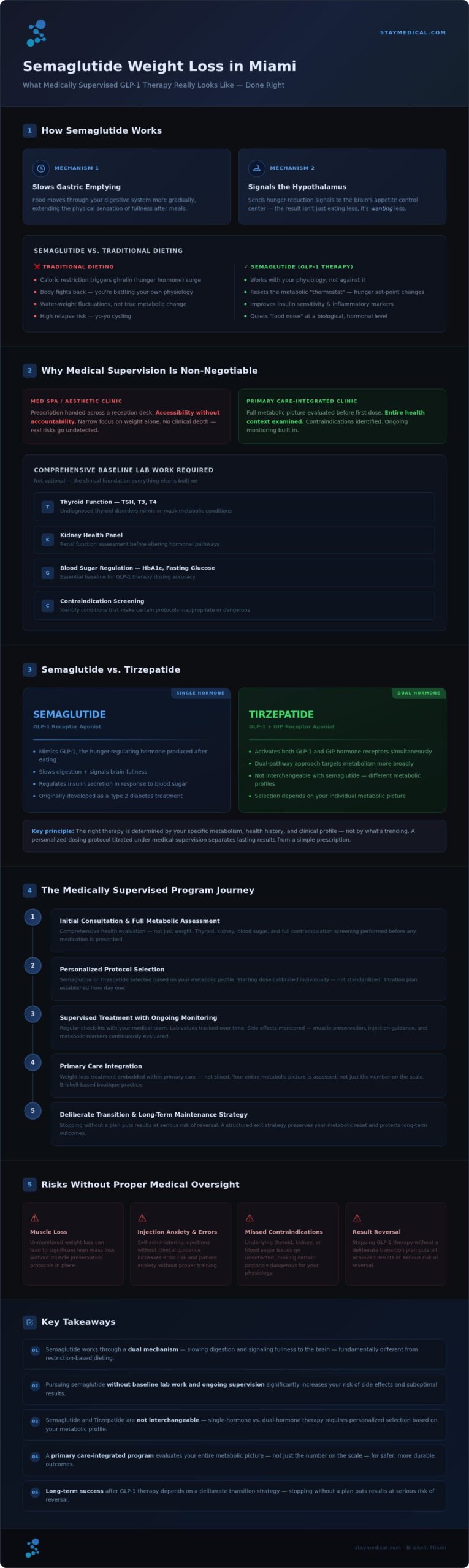
The Stay Medical Journey: Weight Loss in the Heart of Brickell
Knowing that semaglutide works is one thing. Knowing exactly what happens from your first phone call to your sixth month of treatment is another. The difference between a program that delivers and one that disappoints often comes down to process, and at Stay Medical, that process is deliberate at every step.
The journey begins with a comprehensive metabolic health audit, not a cursory intake form. Your initial consultation is a genuine clinical evaluation: a review of your health history, current medications, lifestyle factors, and the baseline lab work that establishes your metabolic starting point. This isn’t administrative routine. It’s the clinical intelligence that shapes every decision that follows. From that foundation, your Weight Loss Program is built specifically around your physiology, not a standardized protocol pulled from a template.
Once your program is designed, your first injection appointment includes something most clinics skip entirely: a thorough “what to expect” conversation. Titration schedules, common adjustment symptoms, hydration guidance, and how to reach the medical team if something feels off. You leave informed, not just medicated.
From there, monthly check-ins and repeat lab work keep the program calibrated to your actual response. If your numbers are moving in the right direction, that’s confirmed clinically, not just felt subjectively. If an adjustment is needed, it happens proactively, not after weeks of stalled progress.
A Boutique Clinic Experience
Located at 33 SW 2nd Ave in Brickell, Stay Medical was designed to feel nothing like a traditional medical office. The environment is calm, private, and intentionally unhurried. For professionals managing demanding schedules, that matters. Your primary care and your weight loss treatment exist under one roof, which means your providers share context about your full health picture rather than working in silos. Questions between appointments don’t require scheduling another visit; the medical team is accessible when you need clarity.
Integrating Lifestyle and Nutrition
Semaglutide is a tool, not a cure. That framing isn’t a disclaimer; it’s a clinical truth that shapes how Stay Medical approaches the lifestyle component of your program. Miami’s social calendar doesn’t pause for a weight loss protocol. Dining out, corporate dinners, weekend brunches in Wynwood: these aren’t obstacles. They’re scenarios your care team helps you navigate with practical, realistic nutritional guidance that fits how you actually live.
Protein prioritization, hydration habits, and strategic meal timing are the pivots that compound semaglutide’s effects without requiring a complete lifestyle overhaul. For patients experiencing fatigue during active weight loss, IM injections for B12 provide targeted energy support that keeps you functional and active, which directly protects lean muscle mass throughout the process.
This is what pursuing semaglutide weight loss in Miami through a primary-care-integrated clinic actually looks like: structured, supported, and built around you.
Schedule your initial consultation at Stay Medical in Brickell
Life After Semaglutide: Maintaining Your Results in Miami
Reaching your goal weight isn’t the finish line. It’s the beginning of a different kind of work. The biology behind weight regain is real and well-documented: your body has a metabolic “set point,” a weight range your physiology actively defends through hormonal signals. GLP-1 therapy recalibrates that set point over time, but stopping treatment abruptly, without a structured plan, allows those hunger-regulating hormones to rebound. The result is the very cycle most people are trying to escape permanently.
This is the gap that most weight loss programs in Miami simply don’t address. They celebrate the number on the scale and send you on your way. What happens next is left entirely to you.
The Maintenance Phase Strategy
Responsible semaglutide care doesn’t end when you hit your target. It transitions. Tapering protocols, where dosing is gradually reduced rather than stopped, give your body time to consolidate its recalibrated hunger signaling without the shock of sudden withdrawal. Some patients do well on a low maintenance dose long-term. Others transition off medication entirely with the right metabolic scaffolding in place. That determination is clinical, not arbitrary.
Regular metabolic check-ups during this phase aren’t optional extras. Repeat laboratory testing tracks the markers that matter: fasting glucose, inflammatory indicators, lipid levels, and body composition trends. These numbers tell the real story of whether your metabolic reset is holding. Maintenance, done correctly, is a collaborative medical phase rather than an endpoint, and it deserves the same clinical attention as active treatment.
Muscle preservation remains the most underestimated factor in long-term success. Lean muscle mass is metabolically active tissue; it burns calories at rest and stabilizes your set point. Prioritizing protein intake, staying consistent with resistance-based movement, and maintaining adequate hydration aren’t lifestyle suggestions. They’re the structural pillars that protect everything you’ve built.
Holistic Wellness and Vitality
Sustainable weight loss doesn’t exist in isolation. As body composition improves, many patients experience measurable shifts in energy, mood, and hormonal balance. For men especially, excess adipose tissue suppresses testosterone production. Addressing weight through a medically supervised program often produces meaningful improvements in hormonal health, and for patients where a clinical gap remains, testosterone replacement can be evaluated and managed within the same primary care framework.
The psychological dimension matters too. Sustainable body transformation builds a different relationship with food, energy, and self-efficacy. That shift compounds over time in ways that no single medication can produce alone.
Stay Medical’s commitment doesn’t stop when your semaglutide weight loss Miami journey reaches its first milestone. Through ongoing primary care, accessible follow-up, and a medical team that knows your full health history, you have a partner invested in your vitality through every life stage, not just your first six months on a GLP-1.
Connect with the Stay Medical team in Brickell to build your long-term plan.
Your Metabolic Reset Starts With the Right Team
Semaglutide weight loss Miami isn’t a shortcut. It’s a clinically grounded path to lasting change, and the quality of care surrounding your treatment determines whether those results hold. What you’ve read here makes that case clearly: comprehensive baseline lab work matters, the choice between semaglutide and tirzepatide is a clinical decision, and maintenance is as important as active treatment.
At Stay Medical in Brickell, those principles aren’t talking points. They’re built into every step of your care, from on-site laboratory testing and experienced primary care integration to a boutique clinic environment designed around your experience as an individual.
You don’t have to navigate this alone, and you shouldn’t have to settle for a prescription without a plan behind it.
The version of your health you’ve been working toward is closer than you think. The right team makes all the difference.
Frequently Asked Questions About Semaglutide Weight Loss in Miami
Is Semaglutide safe for long-term weight loss in 2026?
Yes, semaglutide has a well-established safety profile supported by years of clinical data across both its diabetes and weight loss applications. Long-term use is considered appropriate for many patients, particularly when treatment is supervised by a physician who monitors your labs, adjusts dosing as needed, and evaluates your full health picture at regular intervals. Safety isn’t a static determination; it’s something your medical team actively maintains throughout your program.
The key distinction is supervision. Patients who receive ongoing monitoring, including repeat bloodwork and consistent check-ins with their provider, are far better positioned to use semaglutide safely over time than those who receive a prescription without follow-up care.
How much weight can I expect to lose with a Miami semaglutide program?
Results vary meaningfully depending on your starting metabolic profile, adherence to the program, and how well lifestyle factors like protein intake and activity are integrated alongside treatment. Clinical trials have shown average body weight reductions in the range of 10 to 15 percent with semaglutide, though individual outcomes differ. Some patients exceed that range; others see more modest results depending on their physiology and how consistently they engage with the full program.
What matters more than a projected number is whether your results are built on genuine metabolic change. A medically supervised program tracks internal markers, not just scale weight, so you know the progress is real and sustainable rather than temporary.
What are the most common side effects of semaglutide injections?
Gastrointestinal symptoms are the most frequently reported adjustment experiences: nausea, bloating, mild constipation, or changes in appetite patterns. These typically occur during the early weeks of treatment and tend to resolve as your body adapts to the medication. Careful dose titration, starting low and increasing gradually, is the most effective way to minimize discomfort without compromising how well the medication works.
Less common experiences include fatigue and mild headaches during the initiation phase. A physician-supervised program addresses these proactively rather than reactively, which is why having a medical team accessible between appointments matters as much as the injections themselves.
Does insurance cover semaglutide for weight loss at Stay Medical?
Insurance coverage for GLP-1 weight loss medications varies considerably by plan, and coverage policies continue to shift across carriers. We recommend contacting your insurance provider directly to confirm whether semaglutide or tirzepatide for weight loss is included in your specific plan’s benefits. Stay Medical’s team can help clarify what’s involved in the program so you have the right information before that conversation.
It’s worth verifying coverage details before your initial consultation rather than assuming either direction. The specifics of your plan, including prior authorization requirements, will determine what applies to your situation.
Can I drink alcohol while on a semaglutide program in Miami?
Alcohol isn’t strictly prohibited during semaglutide treatment, but it does interact with your program in ways worth understanding. Because semaglutide slows gastric emptying, alcohol may be absorbed differently than you’re accustomed to, meaning its effects can feel more pronounced with smaller amounts. Alcohol also adds empty calories and can disrupt the sleep and recovery patterns that support fat metabolism.
The practical guidance from a clinical standpoint is moderation with awareness. Miami’s social environment is real, and a well-designed program accounts for it. Your care team can give you specific guidance based on your health history and how your body is responding to treatment.
How do I start the weight loss program at the Brickell clinic?
The process begins with scheduling an initial consultation at Stay Medical, located at 33 SW 2nd Ave in Brickell. That first visit is a genuine clinical evaluation covering your health history, current medications, lifestyle context, and on-site baseline lab work. From that foundation, your provider designs a program specific to your metabolic profile rather than defaulting to a standardized protocol.
You won’t leave your first appointment with a prescription and no context. The medical team walks you through your titration schedule, what to expect during the adjustment period, and how to reach them if questions come up between visits. The starting point is a real clinical relationship, not a transaction.
Will I gain the weight back if I stop taking semaglutide?
Stopping semaglutide abruptly without a structured plan does carry a meaningful risk of weight regain, because the hunger-regulating hormones that the medication suppresses can rebound once treatment ends. This is a biological reality, not a personal failure. It’s also why the maintenance phase of a responsible program deserves the same clinical attention as active treatment.
A tapering protocol, where dosing is reduced gradually rather than stopped suddenly, gives your body time to consolidate the metabolic changes made during treatment. Ongoing lifestyle scaffolding, including protein prioritization, consistent movement, and periodic lab monitoring, provides the structural support that protects your results over the long term. The goal is a recalibrated set point, not indefinite medication dependence.
What is the difference between Ozempic, Wegovy, and compounded semaglutide?
All three contain semaglutide as the active ingredient, but they’re approved for different purposes and come in different dose ranges. Ozempic is FDA-approved for Type 2 diabetes management and carries a maximum approved dose of 2 mg weekly. Wegovy is FDA-approved specifically for chronic weight management and reaches a higher maintenance dose of 2.4 mg weekly. The difference in dosing reflects the distinct clinical targets each is designed to address.
Compounded semaglutide refers to versions prepared by licensed compounding pharmacies, typically used when branded medications face supply constraints or when a patient’s clinical needs require formulation adjustments. Compounded versions are not FDA-approved as finished drug products, which is why sourcing and oversight matter. Your provider at Stay Medical will recommend the appropriate option based on your health profile and current availability, not on what’s most convenient to prescribe.
Disclaimer
This content is for informational purposes only and does not replace evaluation, diagnosis, or treatment by a medical professional. Always consult a qualified healthcare provider for personalized care.