How to Prepare for a Blood Draw, Including Fasting and Medications
November 14, 2026
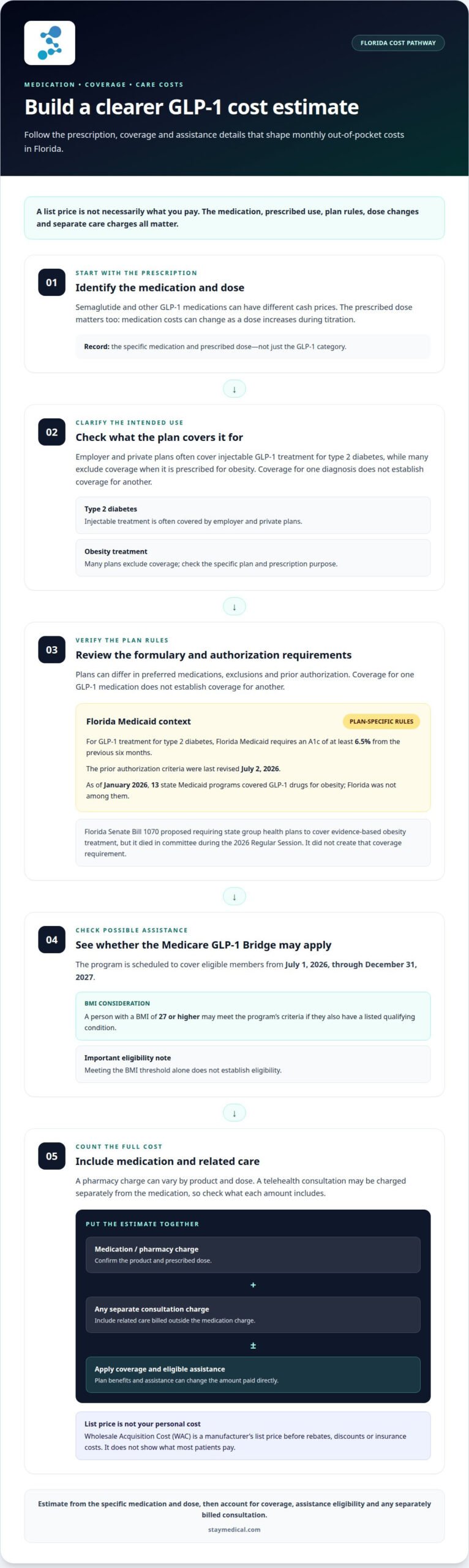
Insurance often covers injectable GLP-1 medication for type 2 diabetes, while many plans exclude coverage when the treatment is prescribed for obesity. That difference can shape the cost of GLP-1 medications in Florida, along with the specific medication, your coverage, and any assistance programs you qualify for. Costs may also change as your dose increases during treatment.
If you’re trying to understand what treatment could mean for your budget, the details matter: a list price isn’t necessarily what you’ll pay, and coverage for diabetes doesn’t automatically mean coverage for weight loss. This guide explains how insurance decisions, medication type, and Florida retail prices affect out-of-pocket costs.
This guide explains common cost factors, differences between branded and compounded medications, and how to compare pharmacy prices in Florida. Use it to prepare questions about coverage and costs before discussing treatment options with a clinician.
Key Takeaways
- Estimate your potential out-of-pocket cost by considering medication choice, insurance coverage, and dose changes during treatment.
- Understand why coverage for GLP-1 treatment may differ when it’s prescribed for type 2 diabetes versus weight loss.
- Learn the key distinction between FDA-approved medications and compounded GLP-1 options before weighing affordability.
- Use Florida’s prescription price comparison tools to get a clearer picture of retail costs.
- See how weight-management eligibility and a clinician-guided approach fit into treatment decisions.
What Does GLP-1 Weight Loss Cost?
Monthly out-of-pocket costs depend on the medication, coverage, and dose. In Florida, the Medicare GLP-1 Bridge and cash-pay options create different payment paths.
Monthly Out-of-Pocket Costs
Monthly out-of-pocket cost is the amount paid directly for medication and related care. The program is scheduled to cover eligible members from July 1, 2026, through December 31, 2027.
That range is a general market guide, not a quote for a specific medication or care plan. A telehealth consultation may be charged separately from the medication, so include both when estimating your monthly budget.
Eligibility can affect access to the Medicare Bridge. According to the Centers for Medicare & Medicaid Services, a person with a BMI of 27 or higher may meet the program’s criteria if they also have a listed qualifying condition. Meeting that threshold alone does not establish eligibility.
Factors Affecting Treatment Costs
Treatment cost is the combined effect of medication choice, dose, coverage, and assistance eligibility. Semaglutide and other GLP-1 medications can have different cash prices, while insurance can change the amount paid at the pharmacy. The prescribed dose matters, too: medication costs can change as a patient’s dose increases during titration.
Coverage rules also affect what you pay. A plan may cover a medication for one indication but exclude it for another, so the prescription’s intended use matters. Assistance programs add another variable because eligibility depends on their criteria. Compare the pharmacy cost with any separate consultation charge, then consider how both fit the treatment schedule.
Wholesale Acquisition Cost, or WAC, is a manufacturer’s list price before rebates, discounts, or insurance costs. It does not show what most patients pay. To estimate your costs, identify the prescribed medication and dose, then account for coverage and any assistance for which you qualify.
Costs Without Insurance
Cost without insurance is what a patient pays without plan benefits applied. These figures are not interchangeable offers, so check what each amount covers, including whether consultation charges are separate.
Cash-pay treatment may involve more than the medication price. A pharmacy’s charge can vary by product and dose, and a telehealth consultation may be billed separately. For example, if you’re considering compounded semaglutide, distinguish the medication charge from any consultation fee before estimating monthly spending.
Use a simple cost check: identify the medication and prescribed dose, find out whether insurance applies, and include separate consultation costs. Then assess eligibility for assistance, including the Medicare Bridge criteria where relevant. This gives you a clearer estimate than relying on a single advertised amount.
Does insurance cover GLP-1 medication?
Coverage depends on the health plan, the medication, and its prescribed purpose. In Florida, employer and private plans often cover injectable GLP-1 treatment for type 2 diabetes, while many exclude coverage for obesity treatment.
Which Florida health insurance plans cover GLP-1 weight-loss medications? Coverage varies by plan, and Florida Medicaid was not among the state Medicaid programs covering GLP-1 drugs for obesity as of January 2026. Eligible Medicare members may access certain drugs through the Medicare GLP-1 Bridge beginning July 1, 2026.
Employer and Private Plan Coverage
Employer and private plan coverage means the benefits a health plan applies to a prescribed GLP-1 medication. Plans usually cover injectable treatment for type 2 diabetes, but many exclude medications prescribed for obesity. That distinction can leave two people using the same medication with different costs, depending on each prescription’s purpose and plan benefits.
Employer size alone doesn’t tell you whether a plan covers Wegovy for weight loss. Check the plan’s drug list, coverage exclusions, and prior authorization rules. Employer-sponsored benefits vary, so the specific plan matters more than the label “employer plan.”
For private insurance, find out whether the medication is covered for weight management or only for another indication. A formulary listing can show preferred drugs, while an exclusion may rule out coverage for a particular use. For Wegovy, coverage for one diagnosis does not establish coverage for weight loss.
Coverage by Medication and Plan
Coverage by medication and plan describes how a plan’s rules affect the drug and the patient’s share of costs. Formularies and prior authorization requirements can differ, so coverage for one GLP-1 medication doesn’t establish coverage for another. A covered diabetes prescription may also receive different treatment from a weight-loss prescription.
Florida Medicaid coverage for GLP-1 treatment for type 2 diabetes requires an A1c of at least 6.5 percent from the previous six months. Its prior authorization criteria were last revised July 2, 2026. As of January 2026, 13 state Medicaid programs covered GLP-1 drugs for obesity, and Florida was not among them.
Florida’s Senate Bill 1070 would have required state group health plans to cover evidence-based obesity treatment, but it died in committee during the 2026 Regular Session. The proposal did not create that coverage requirement.
To understand a plan’s decision, identify the prescribed medication and indication, then review its formulary and authorization rules. A clinician-guided weight-loss care plan can help connect treatment decisions with a person’s health needs, while insurance determines its own coverage.
Branded versus compounded GLP-1 medications
A branded GLP-1 medication is a regulated product sold under a manufacturer’s brand name. Compounded GLP-1 medication is prepared by a pharmacy for an individual prescription rather than sold as that branded product. The distinction affects how FDA approval and product quality are established.
Are compounded GLP-1 medications legal and safe in Florida? The U.S. Food and Drug Administration says compounded GLP-1 medications are not FDA-approved for safety, effectiveness, or quality. FDA approval and legality are separate questions, so that fact alone does not determine whether a specific prescription is legally permissible in Florida.
What “Branded” and “Compounded” Mean
A branded medication has a named manufacturer and an FDA-approved product label. Wegovy and Zepbound are examples of branded medicines used for weight management; Ozempic and Mounjaro are other semaglutide and tirzepatide brands prescribed for type 2 diabetes. A brand name identifies a specific product, not a guarantee that insurance covers every use.
Compounding involves combining or altering ingredients to prepare medication for an individual patient. A compounded medication is not the same product as an FDA-approved branded medicine, even if both contain semaglutide or tirzepatide. A lower price may appeal to people without coverage, but affordability alone does not establish equivalent approval, effectiveness, or quality.
Generic and Brand-Name Options
A generic medication contains an active ingredient also used in a brand-name drug, but it is not simply another label for a compounded preparation. Liraglutide is an example of a generic injectable GLP-1 option. The name of the active ingredient helps distinguish it from branded products such as Saxenda, while the prescription and pharmacy label identify what is dispensed.
Branded options include Wegovy, Zepbound, Saxenda, Ozempic, Mounjaro, and Rybelsus. They are not interchangeable: medications can differ in approved use, formulation, and administration. For example, Wegovy is available as an injection and an oral tablet, while Zepbound is injectable. A doctor considers a person’s health needs and intended treatment when selecting a medication.
Comparing Products Before Paying
Compare the exact product, not just the ingredient name. Discounted Wegovy and Zepbound products offered through licensed telehealth platforms and retail pharmacies are FDA-approved versions, not compounded injectable GLP-1s. A telehealth listing or pharmacy offer does not change the product’s identity; check whether it names a branded medicine or describes a compounded preparation.
Insurance may cover a brand differently depending on the prescribed condition and plan rules. For example, diabetes coverage does not establish coverage for weight management. Before paying, identify the medication and formulation, confirm whether it is branded or compounded, and review what the quoted amount includes. This makes comparisons clearer without treating a lower price as proof of equivalence.
Searching and comparing Florida prescription drug retail prices
Retail prices are pharmacy cash prices before insurance affects a patient’s share. In Florida, compare the exact medication, formulation, and prescription terms, not just the active ingredient.
For Ozempic, Wegovy, Mounjaro, and Zepbound, U.S. baseline rates often serve as a starting point, though local pricing varies. Patients at Stay Medical Clinic should note that these are reference list prices, not guaranteed quotes from Florida pharmacies.
Coupons and Prescription Savings
A prescription savings offer can lower the cash cost of a qualifying medication under its terms. Savings depend on the drug and eligibility rules, so compare the final pharmacy amount rather than assuming a coupon applies to every prescription.
Florida’s MyFloridaRx price locator compares retail prices for the state’s 400 most dispensed prescription drugs. Use it to compare available pharmacy prices for the exact medication and formulation. A coupon or savings program may affect cash payment, while insurance coverage and plan rules can produce a different amount.
Monthly Cash Prices for Named Medications
Monthly cash price is the amount paid directly for a prescription without insurance benefits. The approximate U.S. average cash prices provide a helpful benchmark for budgeting purposes.
These figures provide a basis for comparison, but a Florida pharmacy’s retail price may differ. The prescribed formulation and dose matter, as can any discount applied at purchase. Check the medication name, strength, and quantity on the prescription before comparing prices. Comparing different forms can be misleading.
Compounded Medication Costs and Assistance
A compounded medication is prepared by a pharmacy for an individual prescription rather than supplied as an FDA-approved branded product.
That broader range does not establish a specific price for compounded tirzepatide at every Florida pharmacy or clinic. The amount may depend on the medication, prescribed dose, and what the quote includes. To compare costs, check the prescription’s cash price through MyFloridaRx where listed, and consider any applicable manufacturer programs or savings offers.
Formularies, Prior Authorization, and Cost Sharing
A formulary is an insurance plan’s list of covered prescription drugs. Its tiers group medications according to the plan’s cost-sharing rules, so the same prescription may cost different amounts under different plans. Check whether the exact medication is listed and which tier applies.
Prior authorization is a plan’s review before it approves coverage for a prescription. The prescriber submits the information the plan requires, and the decision can affect whether insurance contributes to the cost. For weight management, distinguish a pharmacy’s cash price from the amount you owe after coverage; they are separate ways to estimate what you may pay.
GLP-1 medications and weight loss
Weight-management eligibility describes who falls within the usual FDA-labeled criteria for certain branded medications. Adults with a BMI of 30 or higher, or a BMI of 27 or higher with a weight-related condition, fall within the typical eligibility group.
That threshold is a starting point, not a complete treatment decision. A clinician considers health history, the medication’s approved use, and whether treatment fits the person’s needs. For example, someone seeking weight loss should distinguish a medication approved for weight management from one prescribed for another condition.
The connection between medication and weight loss also shapes coverage and costs. A health plan may cover an injectable GLP-1 for type 2 diabetes yet exclude coverage for obesity treatment. Therefore, the same drug name can lead to different out-of-pocket costs depending on the prescription’s purpose and the plan’s rules.
Brand names add another consideration. Ozempic and Wegovy both contain semaglutide, but sharing an active ingredient does not make their approved uses or insurance coverage identical. The prescription should identify the product and intended use so the coverage decision can be understood in context.
Appetite changes may begin before noticeable weight changes. Market information indicates that most patients notice reduced appetite within the first few weeks, while meaningful weight change usually appears over several months. These timeframes describe general patterns, not an individual outcome. Tracking progress over time is more useful than judging treatment after a few days.
Weight management involves more than choosing a medication. A treatment plan can reflect a person’s health goals and the practicalities of following a prescribed regimen. Dose changes during titration may affect medication costs, so budget planning should account for the treatment stage rather than assume the first month’s amount will stay the same.
Affordability matters, but the lowest-cost option is not automatically the best fit. FDA-approved weight-loss medicines and compounded products differ in approval status and product oversight. A licensed telehealth platform may offer discounted FDA-approved versions of Wegovy or Zepbound; these are not compounded injectable products.
For a clearer decision, consider three factors together: whether the medication is approved for its intended use, whether the person meets typical eligibility criteria, and how insurance applies to the prescription. This connects the health goal with the financial decision without treating weight loss as guaranteed.
Stay Medical Clinic
Stay Medical Clinic can help connect questions about GLP-1 treatment with an individualized medical discussion. Its Weight Loss Program provides a setting to discuss health goals, treatment considerations, and how medication fits into a broader approach to weight management.
If cost is part of your decision, bring questions about coverage, medication, and dose to your clinician. Primary care can put weight-related concerns in the context of your overall health. The goal is to understand your needs and discuss an appropriate next step, without assuming one medication or approach suits everyone.
Make Your Next Step an Informed One
Understanding the cost of GLP-1 medications in Florida is one part of deciding whether treatment aligns with your health priorities. The next step is to connect the financial picture with the care you want, the routine you can sustain, and the questions you still have about treatment.
Consider what matters most: your goals, how treatment may fit into daily life, and what you need to understand about coverage. A thoughtful conversation can help organize your priorities and clarify what to discuss next. A personal health decision involves more than price alone.
Stay Medical Clinic can discuss your questions in the context of your individual health needs. If you’re ready to explore that conversation, reach out when it feels right for you.
A clear, considered next step can make the path ahead feel more manageable.
Frequently Asked Questions
Is compounded GLP-1 cheaper?
Often, compounded GLP-1 options are marketed at lower prices than branded medicines, but a lower price doesn’t mean the products are equivalent. Compounded medications aren’t FDA-approved for safety, effectiveness, or quality. Compare the full amount due, including any separate prescription or consultation charges, and consider the product’s regulatory status alongside affordability before making a treatment decision.
Are there financing options?
Financing arrangements aren’t standardized across GLP-1 prescriptions. Manufacturer savings programs or patient assistance may reduce medication expenses for people who meet their individual rules, but assistance isn’t the same as financing. Before relying on a payment plan, clarify whether it covers medication alone or also consultations and testing, and review the repayment terms and any fees directly in the agreement.
Are there other ways to save money on drugs?
Yes. Compare the same medication, strength, and quantity across pharmacy cash prices, then see whether an applicable discount or manufacturer program changes the amount. Florida’s MyFloridaRx locator can help compare listed retail prices. Coupons may have eligibility terms, and discounts may not combine with insurance, so compare the actual payment method you plan to use.
Are there side effects?
Yes, GLP-1 medications can have side effects, and the specific risks depend on the medicine and the person taking it. Review the medication’s FDA-approved prescribing information for its listed reactions and warnings. Before starting, share relevant health history and other medications with the prescribing clinician. If a new or concerning symptom develops during treatment, contact a healthcare professional for guidance.
Can insurance help with the cost?
Yes, insurance can reduce what you pay if the plan covers the prescribed medication for its intended use. Coverage may depend on the diagnosis, formulary placement, and prior authorization decision. For example, a plan’s diabetes coverage does not necessarily apply to a prescription for weight management. Start by matching the exact drug and intended use to the plan’s benefit rules.
How much do GLP-1 medications cost with insurance in Florida?
The cost of GLP-1 medications in Florida with insurance depends on the plan’s deductible, copayment or coinsurance, drug tier, and coverage decision. The prescribed use can also affect whether benefits apply. To estimate your share, identify the medication and formulation, then review its formulary status and any authorization requirements. Your pharmacy claim reflects the plan’s terms at the time of dispensing.
What are the eligibility requirements for manufacturer savings cards and patient assistance programs?
Eligibility rules vary by manufacturer, medication, and assistance program. They may distinguish between commercially insured, government-insured, and uninsured applicants, and some programs may assess financial circumstances. Don’t assume a savings card applies to every prescription or coverage type. Identify the exact product, then review the program’s current eligibility terms and exclusions before including possible assistance in your budget.
What costs should patients expect for GLP-1 prescriptions, consultations, and lab tests in Florida?
Plan for separate cost categories: the medication, clinical consultation, and any laboratory testing ordered as part of care. Each may be billed differently, and insurance can apply separate benefits or cost-sharing rules. Formulation and dose can also affect pharmacy pricing. Ask for an itemized estimate that distinguishes these categories, so you can compare the expected total without treating one charge as the full cost.
Disclaimer
This content is for informational purposes only and does not replace evaluation, diagnosis, or treatment by a medical professional. Always consult a qualified healthcare provider for personalized care.