

How to Know If You Need TRT: Symptoms, Testing, and Next Steps
October 14, 2026
How Often Should I Get Vitamin Injections? A Medically Guided Guide
October 16, 2026
Could the emotional benefits of balanced hormones be meaningful without a single “ideal” hormone level to aim for? Hormones can influence mood, focus, and sleep, so it makes sense to wonder whether changes in how you feel are connected. But emotional well-being is shaped by more than hormones, and a lab result alone can’t explain every difficult day.
If your mood or concentration has shifted, you deserve a thoughtful answer, not a promise of a simple hormonal fix. This article explains what research suggests about hormones and emotional experience, why patterns and personal context matter more than one number, and what a clinician may consider when symptoms persist. You’ll also learn how primary care and laboratory testing can contribute to an evaluation without serving as a standalone diagnosis. The goal is to help you make sense of what you’re experiencing and prepare for a clear, compassionate conversation with a healthcare professional.
Key Takeaways
- The emotional benefits of balanced hormones may include support for mood, focus, and sleep, but no single hormone level guarantees emotional well-being.
- Hormones interact with brain systems, and emotional changes can have more than one contributing factor.
- Track mood, sleep, energy, timing, and day-to-day impact to describe persistent changes clearly.
- A clinician may consider your health history, symptoms, and relevant laboratory findings together, rather than treating a test result as the whole answer.
- A primary care conversation can help you explore concerns thoughtfully without assuming hormone treatment is the next step.
What balanced hormones can, and cannot, mean for emotional well-being
Hormones are chemical messengers that help coordinate processes throughout the body. Their activity can influence systems involved in emotional experience, but influence isn’t the same as control. A change in mood may have a biological component without being caused by hormones alone. Likewise, a hormone result within a reference range can’t promise a particular emotional outcome.
Hormonal balance is contextual, not one universal number. It describes hormone activity considered in relation to the person, their symptoms, life stage, and health circumstances. The overview of hormones explains their messenger role. Understanding what a particular result means, however, takes more than knowing a number.
It’s reasonable to wonder whether a change in how you feel could be connected to hormones. Emotions arise through an interplay of biological, psychological, and social influences. Sleep disruption, stress, illness, medications, and changes in daily life may also affect mood. Exploring a possible hormonal connection doesn’t dismiss those factors. It makes room to consider them together.
What does hormonal balance mean in real life?
In practice, “balanced” doesn’t mean that everyone should have identical laboratory results. Hormone levels can vary over the course of a day and across life stages, so a result is interpreted in light of a person’s symptoms and clinical context. One test value is a piece of information, not a complete explanation of how someone feels or a standalone verdict on emotional health.
Which emotional changes might people notice?
Some people notice mood shifts, irritability, or a change in how well they cope with everyday pressures. These experiences are worth discussing, especially when they persist or feel unlike a person’s usual pattern. They’re also nonspecific. The same change can have different explanations, so it doesn’t establish a hormone problem on its own.
This nuance matters because promises of a simple hormonal fix can make complicated experiences sound more certain than they are. The emotional benefits of balanced hormones may be part of a broader picture of well-being, but no single level guarantees happiness, emotional steadiness, or sharper focus. Nor does a difficult stretch automatically mean that hormones are out of balance.
A more useful starting point is to notice what has changed and how it affects daily life. Is irritability occasional or persistent? Does it coincide with disrupted sleep, a major life change, or another shift in health? These observations don’t diagnose the cause, but they can help frame a clearer conversation and support an evaluation that considers symptoms alongside relevant medical information.
How hormones may influence mood, stress, sleep, and mental clarity
Hormones can shape the conditions in which the brain and body function. They interact with brain circuits and other signaling systems involved in mood, energy, stress responses, and sleep. This gives hormones a plausible route to influence emotional experience, but it doesn’t show that a particular person’s irritability, low mood, or difficulty concentrating is hormonal in origin.
Hormones and neurotransmitters are both chemical messengers, but they aren’t interchangeable terms. Hormones such as cortisol travel through the bloodstream to influence activity in target tissues. Neurotransmitters such as serotonin carry signals between nerve cells. These systems interact, yet identifying a pathway doesn’t establish a diagnosis or explain an individual symptom by itself.
How estrogen, testosterone, thyroid hormones, and cortisol fit in
Estrogen and testosterone have roles beyond reproduction and can interact with brain function. Thyroid hormones help regulate metabolism and can affect how the body manages energy. Cortisol is involved in the body’s stress response and follows patterns that vary over time. None has one fixed emotional effect. The broader health picture, timing, and interactions among systems all matter.
These hormones are relevant across genders, though levels and patterns differ with individual health and life stage. For example, feeling unusually tired alongside a mood change may be useful context to share with a clinician, but it doesn’t identify a specific hormone as the cause. A symptom pattern and appropriate assessment are more informative than assuming one hormone accounts for how someone feels.
Why sleep, stress, and emotional experiences overlap
A restless stretch of sleep can leave someone feeling less patient or emotionally resilient the next day. Stress can also affect sleep and bodily responses, while poor sleep may make daily pressures feel harder to manage. These experiences can overlap with health conditions, medications, and life circumstances, making a single cause difficult to identify from symptoms alone.
The relationship can run in more than one direction: bodily changes may affect sleep or mood, and ongoing stress or disrupted sleep can also influence how a person feels physically and emotionally. This is a reason to look at timing and the whole pattern, not proof that a hormone imbalance is present.
A useful distinction: an association means two things occur together; a possible influence describes a plausible pathway; a confirmed diagnosis requires clinical assessment. Keeping those ideas separate helps prevent a broad biological explanation from being mistaken for a personal conclusion.
If emotional or sleep changes persist, a clinician can consider them alongside health history and other relevant factors. A primary care conversation at Stay Medical Clinic in Brickell, Miami, can help you explore what may be contributing without presuming that hormone treatment is the answer.
Does hormonal balance automatically improve how you feel? Myths and nuance
Myth: Every mood change means hormones are out of balance. Irritability, low motivation, fatigue, and sleep changes can occur alongside hormonal shifts, but they’re common, nonspecific experiences. Stress, changes in routine, medications, and other health concerns may also contribute. A symptom can be real and disruptive without pointing to one clear cause.
Myth: Bringing a lab result into range guarantees emotional relief. Laboratory findings can help inform an evaluation, but they don’t predict exactly how someone will feel. Even when a hormone issue is identified, emotional well-being may reflect several factors. An individual’s experience can’t be promised from a number alone.
Emotional symptoms alone cannot identify a hormone disorder. That distinction is not a reason to dismiss your concerns. It’s a reason to explore them carefully, with attention to how long they’ve lasted, when they occur, and how they affect daily life.
Why symptoms alone cannot confirm a hormone problem
Fatigue, irritability, low motivation, or changes in sleep may prompt questions, but none confirms a specific cause. A clinician can consider the duration and pattern of symptoms, health history, medications, and relevant context, then decide whether testing may be useful. Neither a checklist nor an isolated laboratory result tells the whole story.
For instance, low energy and trouble sleeping might appear together, but that combination doesn’t establish that hormones are responsible. Noting when the changes began, whether they fluctuate, and what else changed around that time gives a clinician more useful context than trying to match one symptom to one hormone.
What a realistic emotional benefit may look like
If an underlying health concern is identified and addressed, some people may notice changes in how they feel or function. The response is individual, not guaranteed. A meaningful change might be getting through a usual routine with less disruption, feeling more able to manage everyday demands, or noticing that a troubling pattern has eased. It doesn’t have to mean feeling happy or focused all the time.
Before an appointment, consider what you’d like to improve. Does the concern affect sleep, work, relationships, or activities that matter to you? These practical markers can make progress easier to discuss without treating a particular emotional state as the only measure of success.
Hormone-related evaluation and mental-health care serve different purposes, though they can be considered together. Persistent emotional distress deserves attention in its own right. Exploring possible physical contributors shouldn’t delay appropriate mental-health support, whether from local clinicians or specialized practices like Acceptance Pathway Psychiatry PLLC. A thoughtful assessment can keep both possibilities in view rather than forcing a choice between them.
The phrase emotional benefits of balanced hormones is best understood as a possibility, not a promise. The aim is not to chase an ideal number or assume every feeling has a hormonal explanation. It’s to identify relevant patterns, interpret findings in context, and make care decisions that reflect the whole person.
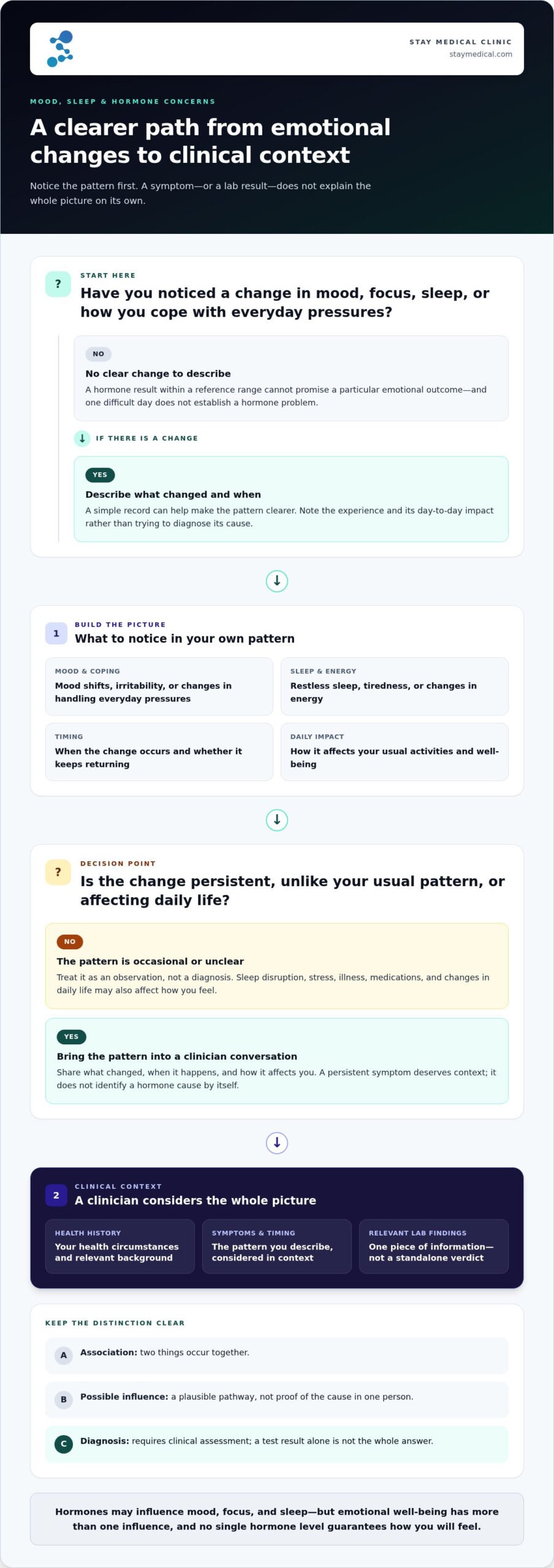
How to track emotional changes and prepare for a medical conversation
A few concise notes can make it easier to describe what’s changed without deciding in advance that hormones are the cause. Look for patterns, not proof. A useful record helps you explain what you’ve noticed, what affects daily life, and what questions you want answered.
Keep entries brief and consistent. You might note:
- Mood: Describe the change in plain language, such as feeling more irritable or less like yourself.
- Sleep and energy: Record whether sleep felt restful and how your energy shifted during the day.
- Timing and frequency: Note when changes began, how often they occur, and whether they seem to follow a pattern.
- Daily impact: Track effects on work, relationships, routines, or activities that matter to you.
- Other changes: Note medication changes, health concerns, major stressors, or life-stage patterns where relevant, without assuming they caused the symptoms.
There’s no need to create a detailed diary or monitor every feeling. A few clear examples can be more useful than a long list of scores. Write down what you most want help understanding, too. For instance, you might ask whether a recurring change deserves evaluation or what other factors could be contributing.
What to record before an appointment
Bring the basics: when the changes started, whether they come and go, what seems to ease or worsen them, and how they affect your day. If you’ve noticed a possible connection with a life-stage transition, include that as context rather than a conclusion. List current medications and relevant health changes, along with your top questions, so the conversation can focus on what matters most to you.
What to expect from a thoughtful evaluation
A clinician can begin by listening to your concerns and reviewing your health history, symptoms, medications, and other relevant circumstances. An examination may help add context. The aim is to understand the broader picture, not to fit every emotional change into a hormonal explanation or assume treatment is needed.
Laboratory testing may be considered when it’s clinically appropriate. Which tests make sense depends on the person and the question being explored. A universal hormone panel isn’t a substitute for an individualized assessment. Results need to be interpreted alongside symptoms and health history, not treated as a complete answer on their own. Brickell laboratory testing can be one component of that broader clinical evaluation.
Arriving with observations can support a focused conversation about the emotional benefits of balanced hormones while keeping expectations grounded in your specific health context. A careful discussion can help distinguish what’s known, what may need further evaluation, and what practical next step makes sense.
Exploring hormone-related concerns with a Brickell primary care clinic
If emotional or physical changes persist, a primary care conversation can be a measured next step. It doesn’t commit you to hormone treatment. The purpose is to describe what you’ve noticed, consider possible explanations, and decide together whether further evaluation makes sense. Your concerns deserve attention even when the cause isn’t yet clear.
At Stay Medical Clinic in Brickell, Miami, a personalized discussion can consider emotional changes alongside your broader health. Notes about when symptoms began, how they affect daily life, and what else has changed can make the conversation more specific. The clinic is relevant to people seeking primary care in Brickell and nearby communities, including Aventura, Bal Harbour, Bay Harbor Islands, Biscayne Park, Coral Gables, Cutler Bay, Doral, El Portal, Florida City, Golden Beach, Hialeah, Hialeah Gardens, and Key Biscaya.
How primary care can put symptoms in context
A thoughtful evaluation may include a review of symptoms, health history, medications, and relevant life changes. Depending on the individual clinical picture, the clinician may also consider an examination or laboratory testing. Tests are selected to help investigate a specific question, then interpreted alongside the rest of the evaluation, not as a standalone explanation for mood or energy changes.
That distinction can help keep the next step proportionate. Sometimes the discussion leads to further assessment; sometimes it helps clarify what to monitor or revisit. The emotional benefits of balanced hormones aren’t a guaranteed outcome of testing or treatment. A careful evaluation aims to understand what’s contributing to your concerns and what options may be appropriate for you.
When testosterone-related concerns deserve a focused discussion
Testosterone is one hormone among many, and it isn’t a general mood treatment. If symptoms or other health concerns raise a question about testosterone, evaluation should consider the broader clinical picture rather than relying on how someone feels alone. A discussion about testosterone replacement therapy in Brickell is specific to that clinical topic, not a default response to emotional changes.
For people receiving testosterone replacement therapy, Stay Medical Clinic provides ongoing monitoring and clinical oversight. This supports follow-up of the treatment in its health context, without promising a particular emotional result. Any decision about care should be individualized, with expectations grounded in the person’s needs and clinical findings.
It’s reasonable to bring questions without having a diagnosis or a preferred treatment in mind. A calm, clinician-guided conversation can help distinguish what’s known from what still needs to be explored, while keeping emotional well-being and overall health in view.
Take the Next Step at Your Own Pace
Understanding the emotional benefits of balanced hormones starts with curiosity, not certainty. You don’t have to arrive with a diagnosis or a ready-made treatment plan. A useful next step is to name what has changed, what matters most to you, and what you’d like to understand better.
Bring your questions into a personalized conversation. Together, you can consider the full picture and identify a measured path forward, whether that means further evaluation, continued observation, or another form of support. You deserve care that takes your experience seriously without reducing it to a single test result or explanation.
Your feelings are worth understanding, and seeking clarity is a meaningful place to begin.
Frequently Asked Questions
Can balanced hormones improve anxiety or low mood?
Hormones may influence systems involved in mood, but anxiety and low mood can have several contributors. The emotional benefits of balanced hormones aren’t guaranteed, and symptoms alone can’t establish a hormone problem. If changes persist or interfere with daily activities, note what’s becoming harder, such as concentrating at work or keeping up with routines, and discuss it with a healthcare professional who can consider physical, emotional, medication-related, and life factors.
Is there one normal hormone level that guarantees emotional well-being?
No, there’s no single result that guarantees a particular emotional state. A laboratory value is interpreted according to the specific test and its timing, alongside symptoms and health history. Reference ranges help clinicians assess results, but they aren’t promises about how you’ll feel. If a result raises questions, ask what it means in your personal context and whether it needs to be considered with other information.
How long does it take to notice emotional changes after a hormone change?
There isn’t a universal timeline for emotional changes after a hormone-related intervention. The response depends on the hormone involved, why it changed, and whether it contributed to symptoms in the first place. Other parts of life and health can affect mood during the same period. Rather than setting a deadline for feeling different, ask the treating clinician what changes to monitor and when to follow up.
Can hormonal changes affect emotional well-being at different life stages?
Yes, hormone patterns change across life stages, and some people notice emotional shifts around those changes. The timing can be useful context, but it doesn’t prove the cause. For example, a mood shift during a major transition may also coincide with altered sleep, stress, medication changes, or other health factors. If the change is persistent or disruptive, discuss the full pattern with a clinician, and consider whether psychological support from practices like Female Focused Therapy could help navigate the emotional impact of those transitions.
What if my hormone test results are within the reference range but I still feel different?
A result within range doesn’t invalidate your experience or explain every possible cause. Tell a clinician what feels different, when you noticed it, and how it affects your routine. They can consider the test alongside its timing, your history, and other health factors, then discuss whether further evaluation or another kind of support may be appropriate. Stay Medical Clinic provides primary care in Brickell, Miami, for individualized health discussions.
Can stress affect hormones and emotional well-being at the same time?
Stress and hormonal systems can interact, but that overlap doesn’t prove either one is the sole cause of a change in mood, sleep, or energy. For instance, a demanding period at work may coincide with disrupted sleep and feeling less patient, while other health factors may also be relevant. If the pattern continues or begins to affect daily life, share those details with a healthcare professional.
Disclaimer
This content is for informational purposes only and does not replace evaluation, diagnosis, or treatment by a medical professional. Always consult a qualified healthcare provider for personalized care.