

Weight loss medication: who qualifies and what it may cost
November 2, 2026
Beauty IV Drip in Aventura for Hydration and Electrolytes
November 4, 2026
A vitamin D shot is an intramuscular injection that delivers vitamin D. It may be considered when a deficiency or absorption concern calls for clinical attention. A shot isn’t automatically better than an oral supplement; the right option depends on your health and needs.
If you’re considering a vitamin D shot, understanding how it works can make the decision clearer. This guide explains how D3 injections are delivered, their potential benefits, and the safety considerations to discuss with a clinician. You’ll also learn how testing and follow-up help put treatment choices in context, so you can approach the conversation with informed expectations.
Key Takeaways
- Understand how an intramuscular vitamin D injection delivers the vitamin and why it may be considered when absorption is a concern.
- Learn how vitamin D supports immune function, alongside its role in calcium use and bone health.
- Explore what can influence the effects of an injection and why its potential benefits vary by individual.
- Recognize possible side effects and health factors that matter when discussing injection safety with a clinician.
- See how a primary care visit and laboratory testing can help inform a personalized conversation about vitamin D.
What are Vitamin D injections?
A vitamin D injection delivers the vitamin into muscle rather than through the digestive tract. The product, dose, and schedule matter because they affect absorption and how clinicians monitor treatment.
Injections Compared With Oral Supplements
Oral supplements pass through the digestive system, while intramuscular injections bypass gut absorption. That difference may matter for people who have difficulty absorbing nutrients, but an injection is not automatically more effective for everyone.
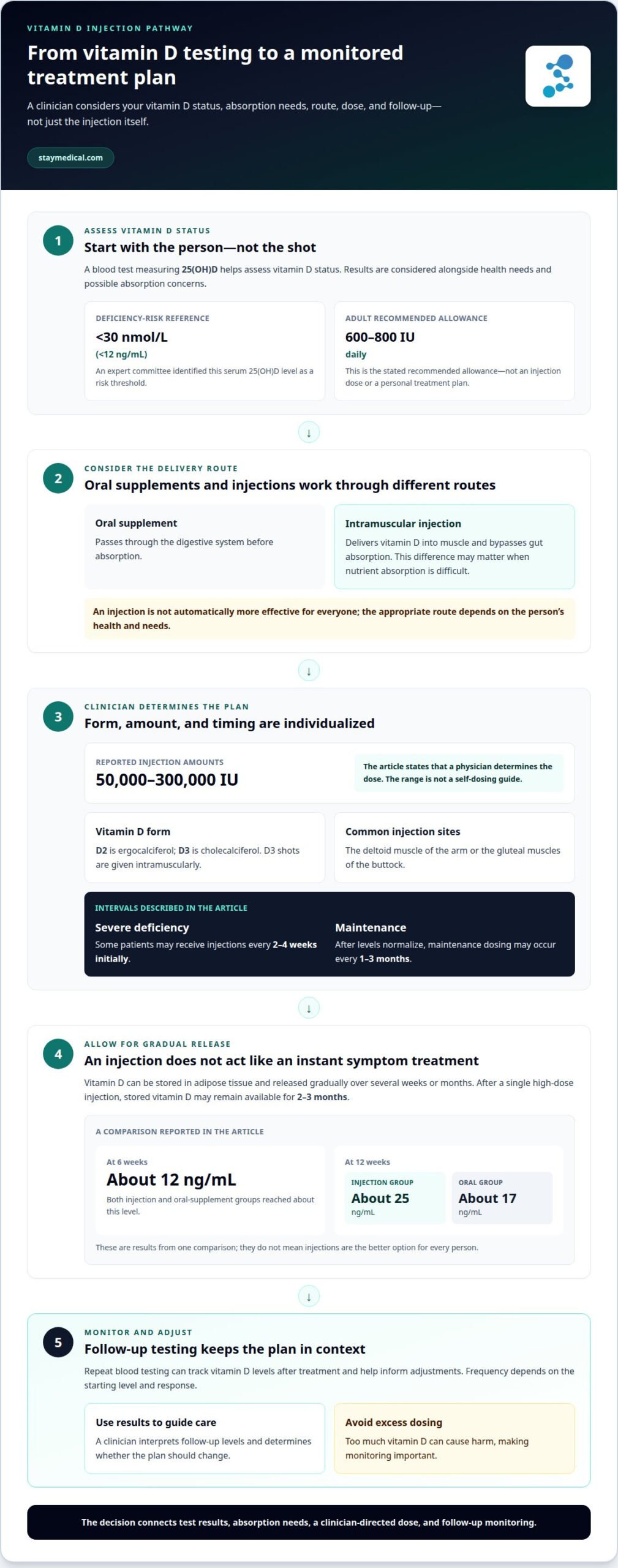
Vitamin D3 injections can be stored in adipose tissue and released gradually over several weeks or months. In one 2017 comparison, injection and oral supplement groups reached about 12 ng/mL by 6 weeks; at 12 weeks, levels were about 25 ng/mL and 17 ng/mL, respectively. A 2024 study found consistently higher levels with monthly injections than weekly or daily oral supplements.
Injection Forms and Administration
Vitamin D supplements and injections may contain D2, also called ergocalciferol, or D3, called cholecalciferol. D3 injections are administered intramuscularly, commonly into the deltoid muscle of the arm or the gluteal muscles of the buttock. The injection route avoids digestion, which may be relevant when absorption is impaired.
Doses vary: reported injection amounts range from 50,000 to 300,000 IU, with a physician determining the dose. A 300,000 IU injection has been described as equivalent to about 3,000 IU daily over 3 months or 1,500 IU daily over 6 months. These comparisons describe total exposure, not a reason to choose a dose independently.
For adults, the recommended allowance is 600 to 800 international units (IU) daily, according to the National Institutes of Health, Office of Dietary Supplements. The same organization reports that an expert committee found people at risk of vitamin D deficiency when serum 25(OH)D concentrations are less than 30 nmol/L (12 ng/mL). A blood test measuring 25(OH)D helps assess vitamin D status; follow-up testing can track levels after treatment and inform adjustments.
Frequency depends on the starting level and response. Some patients with severe deficiency may receive injections every 2 to 4 weeks initially; maintenance dosing may occur every 1 to 3 months once levels normalize. Stored vitamin D may remain available for 2 to 3 months after a single high-dose injection. These intervals make monitoring important, since excessive dosing can also cause harm.
Can you get a vitamin D shot without a prescription in the United States? There isn’t one blanket answer for every injectable product; prescription status depends on the specific product and how it is supplied. A clinician can assess whether an injection is appropriate and determine a suitable plan.
How much does a vitamin D shot cost in the United States? The price depends on the case and is given after a quote request; factors include the product, dose, and clinical services involved.
What Are Vitamin D3 Shots?
Vitamin D3 shots deliver cholecalciferol, a fat-soluble form of vitamin D, by injection. Their health relevance comes from vitamin D’s roles in immune function, calcium use, and other body processes.
Vitamin D and Immune Function
Vitamin D helps regulate innate and adaptive immune responses, which contribute to the body’s defenses. Adequate levels support normal immune function, while low levels may accompany greater susceptibility to infection and inflammation. Sun exposure and food contribute to vitamin D intake, but levels vary from person to person. A shot addresses vitamin D delivery, not every possible cause of immune symptoms.
Vitamin D also helps the body absorb and use calcium, supporting strong bones and teeth. This is especially relevant when low vitamin D accompanies bone concerns, since low levels are associated with increased risks of fractures and osteoporosis. Correcting a deficiency can support normal calcium processes, but an injection is not a direct treatment for every bone condition.
Mood and mental health are also part of the discussion. Low vitamin D has been linked to depression and other mental health disorders, and adequate vitamin D can help improve mood and energy levels. These connections don’t mean an injection treats depression or replaces mental health care. Vitamin D status is one factor clinicians may consider alongside symptoms and other health information.
Potential Health Benefits
Vitamin D3 shots may help restore vitamin D when levels are low, supporting functions that depend on this nutrient. Potential benefits relate to correcting deficiency, rather than treating a separate disease with an injection. This distinction helps set realistic expectations and keeps attention on the reason for treatment.
Vitamin D’s effects extend beyond bones. It supports innate and adaptive immune responses, and its role in calcium absorption helps maintain bone and teeth strength. Vitamin D may also help regulate blood pressure. These functions show why vitamin D matters across body systems, but they don’t establish that shots prevent cardiovascular disease or replace blood pressure care.
For cognitive health, vitamin D helps with cognitive development and maintaining mental health. Low levels have been associated with cognitive decline and dementia, but an association does not show that an injection prevents either condition. A clinician can interpret vitamin D status alongside symptoms, medical history, and other health findings.
Sun exposure, diet, and supplements are other ways vitamin D enters the body. A vitamin D injection is one delivery method, not a general immune booster or a substitute for balanced care. To discuss whether an injection fits into your health needs, explore personalized medical care.
What vitamin D shots are and how they work
A vitamin D shot delivers the vitamin into muscle, bypassing the digestive system. The injected vitamin can be stored in adipose tissue and released gradually, shaping how its effects develop. This helps distinguish a vitamin injection from pain-relief therapy or an immediate treatment for symptoms.
After an intramuscular injection, vitamin D enters circulation without needing to be absorbed through the gut. This route may matter for people who have difficulty absorbing nutrients, including those with certain digestive conditions. Unlike a joint injection, it supplies vitamin D systemically rather than placing medicine directly into a painful joint.
Vitamin D stored in body fat may remain available for weeks or months. The active form of cholecalciferol has a half-life of 2 to 3 weeks in the body. That describes how the body processes the active form, not a promise that symptoms will change within that period. The dose and a person’s starting vitamin D status influence the clinical picture.
Some patients may feel effects within days after a vitamin D shot, while most may notice effects within 1 to 3 weeks after the first shot. Timing can differ because the injection supports vitamin D levels rather than acting as a fast-acting pain medicine. Symptoms such as fatigue or muscle discomfort also have many possible causes, so their timing alone cannot establish a vitamin D deficiency.
Vitamin D shots may help reduce inflammation and ease joint pain, but they aren’t injected into a joint or designed to act as a direct anesthetic. Their relevance depends on whether low vitamin D is part of a person’s health concerns. For example, someone with joint discomfort and a documented deficiency may discuss vitamin D treatment as one part of care, alongside an evaluation of the joint symptoms.
For someone in Miami asking about a vitamin D injection, the basic mechanism is an intramuscular dose that enters the body and is processed over time. The local climate doesn’t change how vitamin D is absorbed or metabolized. A clinical visit can consider symptoms, medical history, previous treatment, and laboratory findings when assessing whether this approach fits the person’s needs.
Sun exposure can contribute to the body’s vitamin D production, while an injection offers a route that doesn’t rely on sunlight or gut absorption. It is not interchangeable with every form of vitamin therapy, including IV therapy, because vitamin D is fat-soluble. A clinician considers the reason for treatment and relevant health details before selecting an approach.
Benefits of vitamin D shots
Vitamin D shots are most clearly relevant when treatment addresses a deficiency. Vitamin D supports several body functions, but an injection isn’t a general treatment for every condition associated with low levels. Restoring vitamin D and treating an unrelated disease are different goals. Any potential benefit should be understood in relation to a person’s vitamin D status and health concern.
One established role involves calcium. Vitamin D helps the body absorb and use calcium, supporting strong bones and teeth. Low vitamin D levels are linked to increased risks of fractures and osteoporosis. Correcting a deficiency can support the body’s calcium-related processes, but a shot does not repair a fracture or replace care for osteoporosis.
Immune function is another area of interest. Vitamin D supports innate and adaptive immune responses, and people with low levels may be more susceptible to infections and inflammation. This describes a role in normal immune function, not proof that injections prevent a specific infection. A shot should not replace appropriate care for an active illness.
Mood and energy may also enter the conversation. Low vitamin D has been linked to depression and other mental health disorders, while adequate vitamin D can help improve mood and energy levels. This link does not mean low vitamin D causes depression in every person or make an injection a replacement for mental health treatment. Its relevance depends on the broader clinical picture.
Other potential benefits require careful interpretation. Vitamin D may help regulate blood pressure, but that doesn’t establish a shot as treatment for hypertension. Low vitamin D levels are associated with cardiovascular disease, certain cancers, cognitive decline, and dementia. An association alone does not show that injections prevent these conditions or reverse their effects.
Research has also considered certain cancers, including breast and colon cancer. Vitamin D may be associated with a reduced risk of these cancers and improved survival among people diagnosed with either. These are potential associations, not a guarantee of prevention or better outcomes from a shot. Cancer care still requires treatment directed at the specific diagnosis.
For example, someone with low vitamin D and a bone-health concern may discuss correcting the deficiency as one part of care. Someone seeking an injection solely to prevent dementia or cancer is asking a different question, since vitamin D treatment does not assure those outcomes. Distinguishing established vitamin D functions from possible disease-related benefits helps keep expectations grounded.
Side effects, safety, and contraindications
A vitamin D injection delivers a nutrient into muscle, but high doses can cause harm if they aren’t monitored. The main safety concern is excess vitamin D, which can raise blood calcium. A vitamin D blood level above 100 ng/mL is categorized as potentially toxic. Monitoring helps clinicians assess whether treatment is correcting deficiency without pushing levels too high.
Injection-site pain and headaches are reported side effects. Excess vitamin D3 can also cause nausea, vomiting, poor appetite, constipation, weakness, weight loss, confusion, and disorientation. More serious effects include heart rhythm problems and kidney damage. These symptoms can have other causes, so they need to be considered alongside dose history and relevant blood test results.
Improperly monitored dosing can increase the risk of kidney stones, excessive thirst, and hypercalcemia, meaning too much calcium in the blood. Hypercalcemia can affect the kidneys and other body functions. A high-dose injection is not a routine nutrient boost for everyone. Dose selection and follow-up matter because injected vitamin D may remain available after administration.
Health conditions also affect whether vitamin D3 is appropriate. Contraindications include sarcoidosis, high blood phosphate, high blood calcium, excessive vitamin D levels, arteriosclerosis with occluded arteries, kidney stones, reduced kidney function, and vitamin D allergy. Kidney history is especially relevant because excess vitamin D can contribute to kidney stones or damage.
Absorption problems, including those associated with celiac disease or Crohn’s disease, can affect vitamin D status. Other risks, such as kidney function or existing high calcium, still need consideration. An injection enters circulation through muscle, but its effects depend on how the body processes and stores the nutrient.
Medication review is another safety step. Vitamin D3 can interact with many medications, so new medicines and supplements should be discussed with a clinician. This includes products taken for other ongoing conditions, not just treatments related to bone health. Share relevant health conditions, medications, and supplements during the clinical discussion.
Before treatment, discuss why you are considering an injection, previous vitamin D results, kidney stones, and any history of high calcium. Blood testing can help assess vitamin D and calcium status, and follow-up results can guide monitoring. Report new symptoms such as persistent nausea, unusual thirst, confusion, or muscle weakness, since excess vitamin D can affect several systems, including cognitive function and kidney health.
Stay Medical Clinic: Vitamin Injection
Stay Medical Clinic provides vitamin injections as part of its wellness services. A primary care visit and laboratory testing can help put vitamin D results, health history, medications, and symptoms into context before you discuss whether an injection fits your needs. This can be useful if you have concerns about deficiency, absorption, or possible interactions, rather than seeking a shot without understanding its role.
Care should focus on the reason for treatment and appropriate monitoring, not simply on receiving an injection. If you’d like to discuss vitamin injection care or your vitamin D questions, contact Stay Medical Clinic.
Make your next step an informed one
Deciding whether a vitamin D shot belongs in your care plan is a personal choice, not a shortcut to better health. Bring questions about your results, symptoms, and current medications to a clinical conversation. That context can help you understand which options suit your needs and what follow-up may involve.
If you’re considering a vitamin D shot, focus on a plan that fits your health history rather than assuming a benefit. You deserve clear explanations, thoughtful care, and space to make a decision at your own pace. Stay Medical Clinic can help you explore vitamin injection care.
A considered next step can make health decisions feel more manageable. Start with your questions and move forward with confidence.
Frequently Asked Questions
What are forms of Vitamin D Supplement?
Vitamin D supplements commonly come as D2, or ergocalciferol, and D3, or cholecalciferol. They’re available in oral forms, while injections deliver vitamin D through muscle. Check the active ingredient on a supplement label when comparing products, since the form and delivery route differ. The right option depends on factors such as vitamin D status, absorption, and the treatment plan being considered.
What is the importance of Vitamin D?
Vitamin D helps the body use calcium and supports bone health and normal immune function. It also plays a role in cognitive development and mental health. These are different functions, so one symptom alone doesn’t show whether vitamin D is low. For example, fatigue or mood changes can have several possible explanations. A blood test can help assess vitamin D status when a deficiency is a concern.
Who is at risk of low vitamin D?
Risk can be higher with limited sunlight exposure or difficulty absorbing nutrients through the digestive system. Celiac disease and Crohn’s disease are examples of conditions that can interfere with fat absorption. People older than 65 are also more likely to have low vitamin D. These factors don’t diagnose deficiency by themselves; blood testing helps determine whether vitamin D levels are low.
What is a vitamin D shot?
A vitamin D shot is an injection that delivers vitamin D into muscle, usually as D3, or cholecalciferol. Unlike an oral capsule, it doesn’t rely on absorption through the digestive system. That distinction may matter when gut absorption is difficult. The injection is a systemic treatment, not a shot placed into a painful joint, and it doesn’t replace evaluation of other symptoms.
What are the benefits and evidence for vitamin D shots?
Vitamin D shots can raise vitamin D levels, and studies have compared blood-level responses after injections and oral supplements. These measurements show how levels change, but they don’t prove that injections prevent conditions such as cancer, dementia, or cardiovascular disease. Potential benefits relate most directly to addressing deficiency and supporting vitamin D’s normal functions. Evidence for broader disease outcomes should be interpreted cautiously.
Who may need a vitamin D injection instead of oral supplements?
An injection may be considered for someone with a documented deficiency and difficulty absorbing vitamin D orally, including some people with celiac disease or Crohn’s disease. Limited sunlight exposure may also contribute to low levels, though it doesn’t automatically mean an injection is needed. The choice depends on blood results, medical history, absorption concerns, and risks such as kidney problems or high calcium.
What vitamin D dose is used in injections, and how often are they given?
Reported injection doses range from 50,000 to 300,000 IU, with the amount selected according to clinical needs. For severe deficiency, an initial schedule may involve injections every 2 to 4 weeks; maintenance dosing may occur every 1 to 3 months once levels normalize. These schedules aren’t interchangeable. Follow-up blood results and safety considerations help guide the plan and avoid excessive vitamin D exposure.
What are the side effects and risks of vitamin D injections?
Possible side effects include injection-site pain and headaches. Excess vitamin D can cause nausea, constipation, weakness, confusion, excessive thirst, and kidney problems; a blood level above 100 ng/mL is potentially toxic. Kidney stones, reduced kidney function, high blood calcium, sarcoidosis, and vitamin D allergy are among the concerns that can affect safety. Medication and supplement interactions also deserve review before treatment.
Disclaimer
This content is for informational purposes only and does not replace evaluation, diagnosis, or treatment by a medical professional. Always consult a qualified healthcare provider for personalized care.