

Tirzepatide long-term use safety: risks and monitoring
November 5, 2026
Testosterone Therapy for Mood Improvement: Effects and Risks
November 7, 2026
You don’t need a special appointment or a dramatic goodbye to change primary care doctors. You can make the switch whenever you choose, and the process for switching primary care doctors is easier when you treat telling your current doctor, confirming insurance details, and transferring records as separate steps.
If you’re considering a change, you may already know what isn’t working: perhaps you don’t feel heard, appointments feel rushed, or you’re looking for a better fit. You can briefly share your decision, offer constructive feedback if you wish, or simply arrange for your records to reach your new practice.
This guide explains what to say to your current doctor, how to review your plan’s network and referral requirements, and how to request a records transfer. It also covers common reasons people switch, so you can make a considered decision and help your new doctor understand your care needs.
Key Takeaways
- Keep your message to your current doctor simple, and use a final appointment to discuss ongoing care if that would be helpful.
- Review your plan’s network and referral process so your new primary care provider fits your coverage.
- Send a signed records request that identifies the recipient and destination, or ask the new practice to request your records.
- Consider what matters most in a doctor-patient relationship, such as feeling listened to and comfortable raising concerns.
- Stay Medical Clinic provides primary care for people seeking a new setting for ongoing medical care.
How Can You Tell a Doctor You Are Changing Providers?
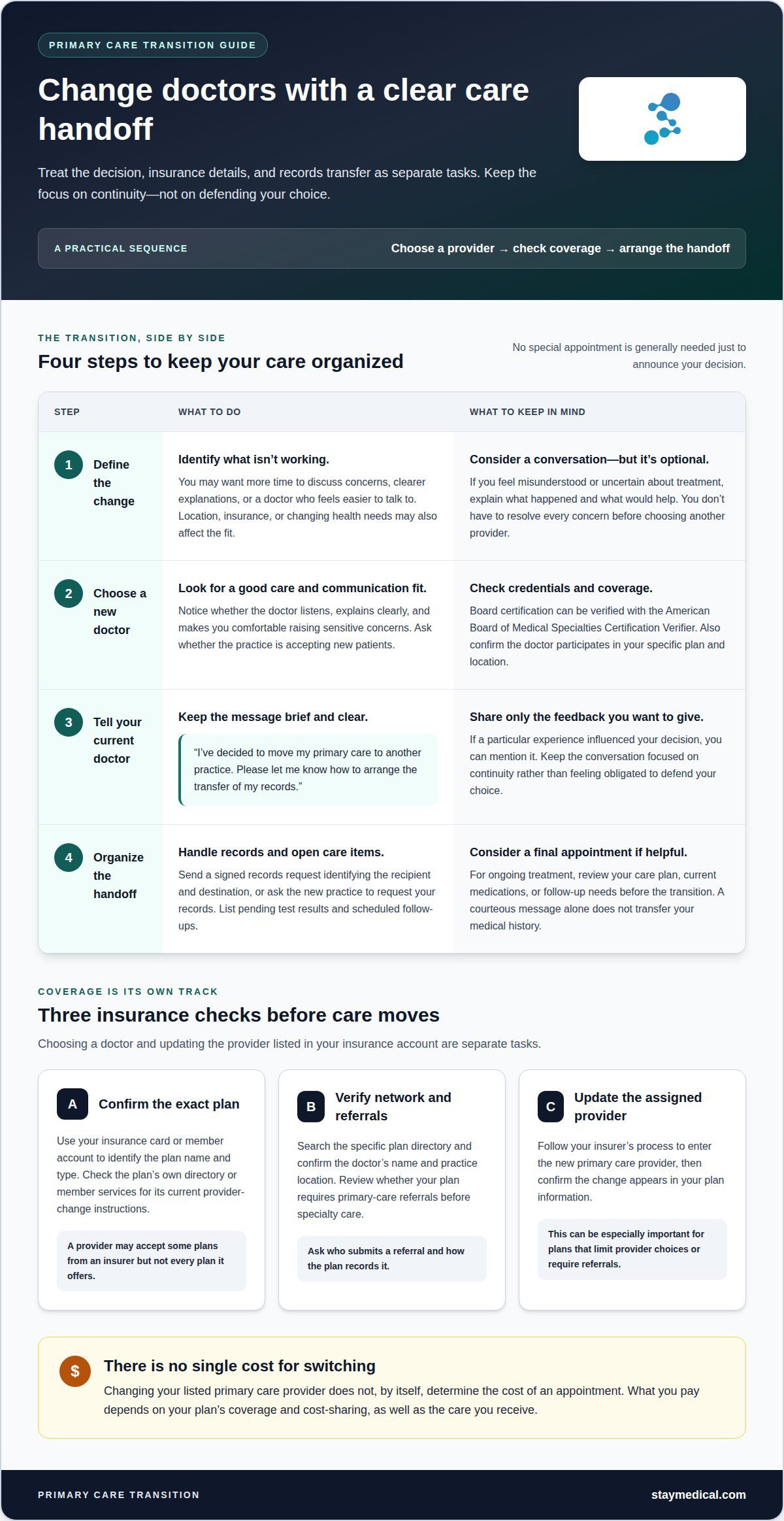
In the United States, choose a new primary care provider, review your insurance plan’s network and referral rules, and arrange to transfer your medical records. You can tell your current doctor directly, but you generally don’t need a special visit just to announce your decision.
- Decide what needs to change. Identify the specific parts of your care that prompted the decision. For example, you may want more time to discuss concerns, clearer explanations, or a doctor who feels easier to talk to. A change in location, insurance, or health needs may also affect whether your current arrangement still works.
Consider whether a direct conversation could address the problem. If you’re uncertain about treatment or feel misunderstood, describe what happened and what would help. A candid discussion may clarify expectations or show whether the relationship can improve. You don’t have to resolve every concern before choosing another provider.
- Choose a new doctor who fits your needs. Ask questions during an introductory conversation or appointment. Notice whether the doctor listens, explains things clearly, and makes you comfortable raising sensitive concerns. If you prefer a female physician, you can raise that request with your current provider or practice while discussing a transition.
To verify a physician’s board certification, use the American Board of Medical Specialties Certification Verifier. Certification is one consideration, alongside communication and the type of care you need. As you narrow your options, confirm that the prospective doctor accepts your insurance and is taking new patients.
- Tell your current doctor briefly and clearly. You might say, “I’ve decided to move my primary care to another practice. Please let me know how to arrange the transfer of my records.” If a particular experience influenced your decision, such as feeling rushed or having a concern left unanswered, you can share that feedback.
If you have ongoing treatment, ask for an update before the transition. A final appointment can help you review your care plan, current medications, or follow-up needs. Your doctor may also be able to help you identify another provider. Keep the conversation focused on continuity, rather than feeling obligated to defend your decision.
- Keep the transition organized. Treat choosing a new doctor, updating your insurer’s provider information, and transferring records as separate tasks. A courteous message to your current doctor does not transfer your medical history. Make a short list of outstanding items, such as pending test results or a scheduled follow-up, to address as care changes.
Patients often move to other practices, so switching doesn’t need to become a confrontation. If you’re leaving because of a concern, share only the feedback you’re comfortable giving. A respectful, direct message can close the conversation and keep attention on the next steps in your care.
Insurance networks, coverage, and referral requirements
Changing doctors involves more than choosing a name: your plan’s network, provider-selection rules, and referral process can affect access and costs. With an HMO or Medicare Advantage plan, review the provider network and instructions for changing your assigned primary care provider. Your insurer may require you to select the new provider in its system, especially if the plan limits provider choices or requires primary-care referrals.
There isn’t one cost that applies to every switch. Changing your listed primary care provider does not, by itself, determine the cost of an appointment. What you pay depends on your plan’s coverage and cost-sharing, as well as the care you receive.
- Identify your exact plan. Use your insurance card or member account to find the plan name and type. An employer plan, an HMO, and a Medicare Advantage plan can have different provider networks and procedures. Use the plan’s own directory or member services to find its current instructions for changing a primary care provider.
Keep the plan name handy when reviewing a doctor’s participation. A provider may accept some plans from an insurer but not participate in every plan that insurer sells.
- Check the new doctor’s network status. Search for the provider in your specific plan’s directory, not just the insurer’s general directory. Confirm the doctor’s name and practice location, since network participation can vary by plan and location. Also ask whether the provider is accepting new patients.
For example, an office listed in a broad insurer search may not be available under your particular HMO. Both the plan’s provider-selection procedures and the provider’s availability matter.
- Review referral requirements before booking specialty care. Some plans require primary-care referrals, while others allow different routes to a specialist. Check your plan’s rules and ask whether your new primary care provider must initiate referrals. This helps avoid assuming a referral from your former doctor will work under the new arrangement.
Write down the plan’s steps, including who submits a referral and how the plan records it. If you’re receiving ongoing specialist care, clarify how your new primary care relationship affects future referrals.
- Update your assigned provider with the insurer. Choosing a doctor and changing the PCP listed in your insurance account are separate tasks. Follow your insurer’s process to enter the new provider, then confirm that the change appears in your plan information. This step can be especially important if your plan limits provider choices or requires referrals.
Keep a record of the confirmation and effective date if your insurer provides one. Use your new PCP information when arranging covered care.
- Ask how your plan applies costs to the care you need. Your out-of-pocket amount can depend on whether the provider is in network, the service you receive, and your plan’s cost-sharing. For a planned visit, ask your insurer how your benefits apply and whether you need to complete referral or provider-selection steps. This gives you a clearer picture than assuming every in-network visit has the same cost.
For an HMO or Medicare Advantage plan, use the plan’s own process to select your new PCP, confirm network status, and understand referral rules before arranging care.
Requesting medical records without discussing reasons for leaving
You can arrange a records transfer without explaining why you’re changing doctors. Focus your request on the information, recipient, and destination needed for continuity of care.
-
Request Your Medical Records
Send a written request to the organization that maintains your records. You don’t need to include your reasons for leaving; state that you want copies or want eligible information sent to a new practice. Under HIPAA, you may submit a written, signed request asking a covered healthcare provider to send eligible health information to a designated person or organization.
Identify the recipient and where the information should go. A brief courtesy message to your former doctor isn’t a records request and won’t transfer your history by itself.
- Make the request specific. Name the new doctor or practice as the recipient and include its mailing address or another destination for the records. State whether you want copies sent to you or the information sent directly to the new provider. Clear details help the organization identify the destination and process your request as intended.
Use the practice’s records-release form if it provides one. Complete each requested field, sign the authorization, and keep a copy of what you submit. Avoid relying on a general message such as “please send my file,” which may not identify the recipient or destination.
-
Transfer Medical Records
Ask the new doctor’s office whether it can send a medical-records release to your former practice. The new office can use the release to request your records. Complete and sign the consent forms before expecting the transfer to proceed.
Use consistent names and recipient details across the forms. The organization that created and maintains a medical record keeps the physical record when you switch providers, while you can request access to your medical information.
- Follow the Texas written-consent process if it applies. Texas patients may request copies of their medical records or ask that copies be sent to a new doctor after the physician receives written consent. Specify whether you want the records delivered to you or sent directly to the new practice.
For example, a Texas patient can authorize the former physician to send copies to the named new doctor. A request for your own copies and a request for direct transfer have different destinations, so make your instructions clear.
- Track the transfer and identify missing information. Keep a copy of your signed request and note which practice received it. If your new doctor needs a particular record, such as prior test results or treatment information, identify it in your request rather than assuming a general transfer includes everything.
Tell the new office whether you requested the records yourself or authorized it to request them. This helps both practices coordinate the handoff without requiring you to discuss why you’re leaving.
Whether patients need to notify their current doctor
You generally don’t need a special visit just to tell your current doctor you’re leaving. You can switch primary care physicians whenever you choose, while finding an in-network doctor and arranging an appointment are separate steps.
- Decide whether to send a notice. You can tell your current doctor directly, send a brief message, or move your care without scheduling a special notification visit. For example, write, “I’ve chosen a new primary care doctor. Please let me know how to direct my records request.” You don’t need to explain personal reasons for changing practices.
If a concern influenced your choice, share constructive feedback only if it feels useful. A clear example, such as difficulty discussing a treatment concern, is more actionable than a general statement that the relationship didn’t work.
- Find an in-network doctor accepting new patients. Search your health plan’s directory using the exact plan name, then look for primary care providers listed for that plan. Confirm the doctor’s practice location and whether the office is accepting new patients. An insurer’s broad directory may include clinicians who don’t participate in every plan it offers.
Use a short call to clarify practical details: “Are you accepting new patients with this plan, and what appointment openings do you have?” This tells you whether the office can take you and gives you a clear next step.
- Ask about the appointment timeline. There isn’t one standard interval for switching doctors and getting an appointment. Timing depends on whether the new practice accepts your plan and new patients, its available appointment openings, and any plan steps for assigning a primary care provider.
For example, a practice with an open appointment and no outstanding plan-selection step may schedule differently from one with limited openings. Ask the new practice about its next available appointment, then complete any insurer update your plan requires.
- Keep care continuity in view. Before your first appointment, note any pending follow-up, test result, or treatment question that needs attention. Give the new doctor a concise summary, such as “I’m waiting to discuss a recent test result,” so the concern is clear during your visit.
Your current doctor can help with the transition if you choose to discuss it, but you remain free to select another provider. Keep your decision separate from your appointment arrangements: notifying the former practice doesn’t book care with the new one.
Reasons for switching primary care doctors
A change can be about more than dissatisfaction. Consider whether your current care supports your health needs, communication preferences, and practical circumstances. A useful switching primary care doctors process starts with identifying what you want to improve, then considering whether a new relationship could meet that need.
- Identify what is not working. Name the moment or pattern behind your concern. For example, you may leave appointments unsure about the next step or feel uncomfortable raising questions. A specific experience can help you distinguish a communication problem from a broader mismatch in care.
Notice whether the concern affects your ability to discuss symptoms, understand treatment, or follow up. If a direct conversation might resolve it, you can raise the issue before deciding. If the same problem continues, that pattern can inform your choice.
- Consider whether your health needs have changed. A new diagnosis, ongoing treatment, or need for regular follow-up may lead you to reassess your primary care relationship. Ask yourself whether your current doctor understands your priorities and explains how care decisions relate to them.
For instance, if you need help coordinating several ongoing concerns, consider whether appointments leave you with a clear plan. Focus on the care you need now, rather than relying only on how well the relationship worked in the past.
- Account for practical changes. A move, a change in insurance, or difficulty reaching the practice can make an established arrangement less workable. These reasons don’t necessarily reflect the quality of your doctor’s care. They may simply change which practice is accessible in your circumstances.
Separate logistics from clinical concerns. If your plan changes, find out whether your doctor remains in network. If travel becomes difficult, consider whether the practice location still fits your routine and appointment needs.
- Decide whether a concern can be addressed. Before switching, write down what you want to improve, such as clearer explanations or more opportunity to ask questions. A candid conversation may help you understand whether expectations can be aligned. You can still choose another doctor if the relationship no longer feels right.
For example, tell your doctor, “I’m leaving visits unsure about my follow-up plan. Can we review the next steps before I go?” The response can help you assess whether communication can improve. Use the switching primary care doctors process to make a considered choice, while giving concerns that could be addressed a chance to be heard.
- Choose for the relationship you want next. Look for a doctor who listens carefully, answers questions clearly, and helps you feel comfortable discussing your health. During an introductory appointment, notice whether you can explain your priorities and understand the proposed next steps.
A good reason to switch isn’t limited to a major conflict. A persistent mismatch in communication, changing needs, or practical access can all matter. Use your experience to define what you want from your next primary care relationship.
Stay Medical Clinic: Primary Care
Stay Medical Clinic offers primary care for people seeking a new setting for ongoing healthcare. If you’re changing doctors because you want a more personal approach to discussing your health, a primary care relationship can provide a place to address your needs over time.
Stay Medical Clinic also offers a Weight Loss Program, Testosterone Replacement, and IV Therapy. These services may be relevant when they align with your health goals and care needs. As you consider a new primary care relationship, think about the communication and attention to your individual priorities that matter to you.
If you’re ready to discuss primary care, contact Stay Medical Clinic.
Make Your Next Primary Care Relationship Your Own
Changing doctors is also an opportunity to define what you want from care going forward. Before your first appointment, consider how you prefer to discuss concerns, what helps you feel heard, and which priorities you want your new doctor to understand. A thoughtful process for switching primary care doctors can set the tone for a more purposeful relationship, not simply close the previous one.
Stay Medical Clinic offers primary care alongside a Weight Loss Program, Testosterone Replacement, and IV Therapy. If one of these services connects with your health goals, raise it as part of a conversation about the care you’re seeking. Your priorities can guide what you discuss and which questions you bring to an appointment.
Taking this next step with clarity can help you approach a new care relationship with confidence and a stronger sense of what matters to you.
Frequently Asked Questions
Is It Okay to Switch Primary Care Physicians?
Yes. You can change primary care physicians when you decide another relationship better fits your needs. For example, you may want a doctor who communicates differently, or your health priorities or insurance may have changed. Consider what you want from future visits, such as time to discuss concerns or clearer explanations. That gives you a practical basis for choosing a doctor who suits your current situation.
Can I change primary care doctors without telling my current doctor?
Yes. You can move your care without giving your current doctor advance notice or explaining your reasons. If you want to close the relationship clearly, a short message can say you’ve chosen another practice. Keep that message separate from arrangements for your records and future care. For example, if you have a pending test result, make a plan for receiving and discussing it during the transition.
How do I choose or change my PCP through my health insurance plan?
Use your insurer’s directory for your exact plan, then follow its instructions to select or update your primary care provider. Confirm that the doctor and practice location participate in that plan, and ask whether the office is accepting patients. If you’re looking around Aventura, Bal Harbour, Bay Harbor Islands, Biscayne Park, Coral Gables, Cutler Bay, Doral, El Portal, Florida City, Golden Beach, Hialeah, Hialeah Gardens, Miami, Brickell, or Key Biscaya, use those locations to narrow your search.
Do I need a referral or approval to switch primary care doctors?
Whether you must formally select a new doctor or follow a referral process depends on your insurance plan. Plans that restrict provider choices or require primary-care referrals may have specific steps for updating your assigned PCP. Review the plan’s instructions before arranging specialist care. For instance, ask whether a referral from your former doctor remains usable or whether your newly selected PCP must handle future referrals.
How do I transfer medical records to a new primary care doctor?
Authorize the former practice to send your records to the new doctor, or ask the new office to request them using its release form. Include the recipient’s name and the destination for the information. You can also request copies for yourself. For example, if you want to bring a particular test result to your first visit, identify it in your request rather than relying on a general transfer.
What happens to prescriptions and ongoing care when changing primary care doctors?
Tell your new doctor about current prescriptions, treatment plans, pending tests, and upcoming follow-ups so they can be reviewed as part of care planning. Bring an up-to-date medication list or the prescription details available to you. If a refill or follow-up is approaching, raise it before the transition so you know which clinician will address it. Don’t change a treatment plan without discussing it with a healthcare professional.
Disclaimer
This content is for informational purposes only and does not replace evaluation, diagnosis, or treatment by a medical professional. Always consult a qualified healthcare provider for personalized care.