
Tirzepatide vs Bariatric Surgery: Which Costs Less Overall
November 26, 2026
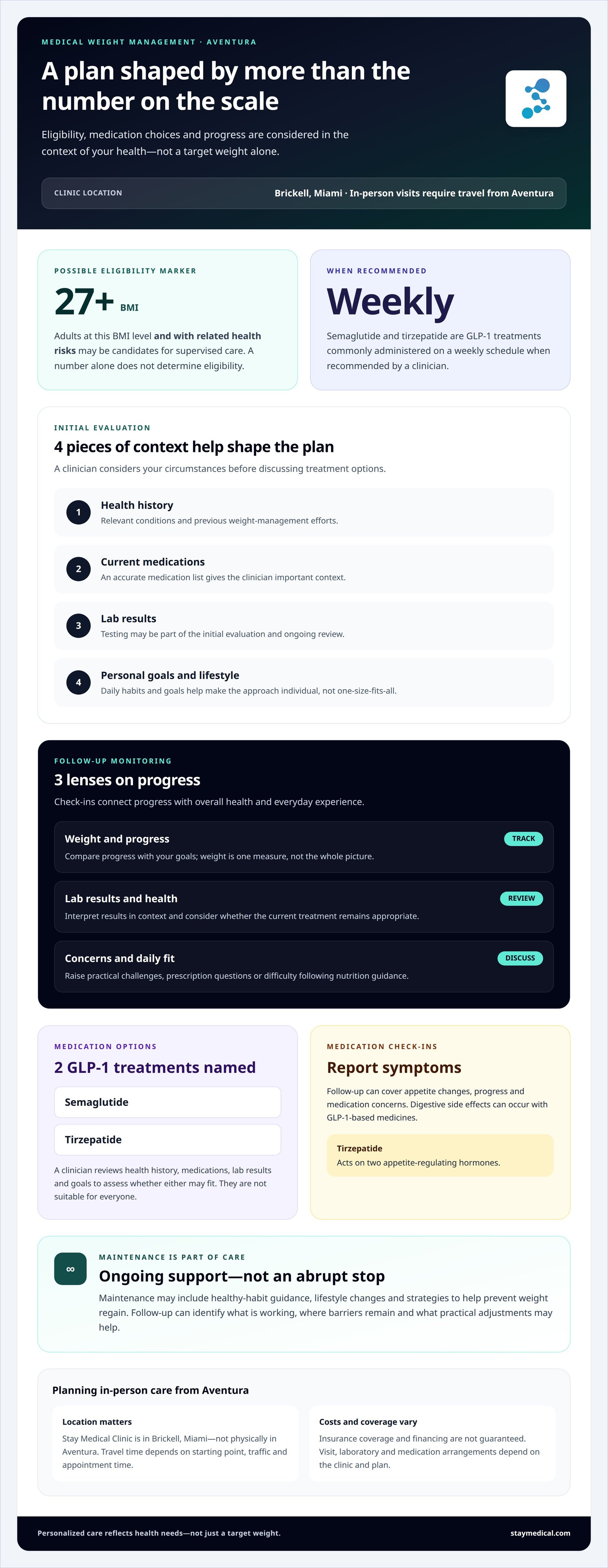
A number on the scale alone doesn’t determine whether medical weight management may be appropriate. For medical weight loss in Aventura, adults with a BMI of 27 or higher and related health risks may be candidates for a supervised program. A clinician can consider health history, current medications, lab results, and personal goals when shaping a plan.
It’s understandable to want clear answers before beginning treatment, especially when options may include prescription medication. This guide explains who may qualify, what an initial evaluation can involve, and how follow-up helps monitor progress and address concerns. It also covers whether GLP-1 treatments such as semaglutide or tirzepatide may be offered, and why a personalized approach matters: the right plan should reflect your health needs, not just a target weight.
Key Takeaways
- Learn which health factors may shape eligibility for supervised weight management.
- Understand how follow-up visits can track progress, review lab results, and support long-term maintenance.
- See how a personalized plan may combine lifestyle guidance with prescription options when appropriate.
- Discover what clinicians consider when assessing whether semaglutide or tirzepatide may fit your care plan.
- Find out how to take the next step toward individualized weight-loss support.
Aventura clinic location and appointment details
For Aventura residents considering medical weight loss, clinic location and appointment logistics matter alongside the care plan. Stay Medical Clinic is in Brickell, Miami, so in-person visits require travel from Aventura.
Clinic Locations Serving Aventura
When planning in-person care from Aventura, account for Stay Medical Clinic’s Brickell location. Travel time depends on your starting point, traffic, and appointment time, so allow flexibility rather than relying on a fixed estimate. Consider whether recurring visits fit your schedule, particularly if care includes follow-up and lab testing. Aventura and Brickell are distinct locations, so plan around the clinic’s actual address.
When choosing medical weight loss serving Aventura, distinguish a clinic that serves local patients from one physically located in Aventura. That difference affects travel planning, not the clinical questions to discuss. Consider how appointments fit your work, family, and lifestyle, especially if your plan involves ongoing visits. A realistic travel routine can help you decide whether in-person care is practical.
Consultation Preparation and Appointments
An initial consultation commonly reviews your health history, current medications, and lifestyle habits. Bring an accurate medication list and be ready to discuss relevant health concerns, previous weight-management efforts, and personal goals. These details give the clinician context to assess treatment options, including whether semaglutide may be appropriate.
Lab testing may also be part of the initial evaluation. The consultation gives the clinician a chance to understand your health needs before discussing a care plan. Prepare questions about follow-up, how progress will be reviewed, and what information the care team needs. This keeps the conversation focused on your circumstances rather than a one-size-fits-all approach.
Medical weight management differs from dietitian-led support and other weight-loss pathways in its clinical scope. Dietitian-led care focuses on nutrition guidance, while medically supervised care can assess health history, medication options, and lab results. Other pathways may involve different interventions. The appropriate approach depends on your health needs and goals.
Insurance coverage and financing vary by clinic and plan, so they are not guaranteed by the phrase “medical weight loss.” Separate clinical eligibility from payment arrangements, and clarify how visits, laboratory testing, and medication are handled before starting care. Coverage may depend on the plan and service involved, so one answer may not apply to every patient. Keep payment questions distinct from the clinical evaluation.
GLP-1 treatments, including semaglutide and tirzepatide, may be discussed after a clinician reviews medical history, lab results, and health goals. These medications are commonly administered weekly when recommended and can affect appetite regulation. They aren’t suitable for everyone, so the consultation should address potential concerns and whether medication fits alongside nutrition guidance and lifestyle changes.
Follow-up monitoring and maintenance planning
Follow-up makes a weight-loss plan an ongoing clinical process. Visits can include tracking weight, reviewing lab results, and addressing concerns, so changes are considered alongside your overall health. A progress discussion can also clarify whether the current treatment remains appropriate or needs adjustment.
Monitoring works best when each check-in has a clear purpose. The clinician can compare your progress with your goals, review how treatment fits into daily life, and discuss changes since the previous visit. Raise practical concerns, such as difficulty following nutrition guidance or questions about a prescription. These details inform the next step rather than leaving care on autopilot.
When lab results are part of care, they offer another point of reference. A clinician can review results in context, explain what they mean for the plan, and address relevant health concerns. Weight is one measure, not the whole picture. Follow-up can also consider whether lifestyle changes feel manageable and what support could make them more sustainable.
Semaglutide and tirzepatide monitoring
Semaglutide and tirzepatide are GLP-1 medications commonly administered on a weekly schedule when recommended. During treatment, follow-up gives patients an opportunity to discuss appetite changes, progress, and concerns about the medication. Digestive side effects can occur with GLP-1-based medicines, so reporting symptoms helps the clinician assess how treatment is going.
Tirzepatide acts on two appetite-regulating hormones. The medication choice and continued use depend on a clinician’s assessment of your health history, current medications, and treatment goals. A review can also address whether treatment remains appropriate and whether the care plan needs adjustment. The aim is attentive monitoring, not simply repeating a prescription.
Are there Florida rules for prescribing compounded semaglutide or tirzepatide? Prescribing and dispensing compounded medicines involves requirements that depend on the product and circumstances. The clinician should explain which formulation is prescribed and account for applicable requirements as part of the prescribing process.
Maintenance and lasting support
Maintenance is an active phase, not an abrupt end to care. It can include guidance on healthy habits, lifestyle changes, and strategies to prevent weight regain. Follow-up discussions with your clinician can identify which routines are working, where barriers remain, and what ongoing support may help preserve progress.
For example, if your schedule changes, discuss how that affects meals, activity, or treatment routines. A follow-up can focus on practical adjustments that fit your new circumstances. Regular review connects wellness goals with everyday decisions and supports a more lasting approach to weight management.
Keep medication changes, symptoms, lab results, and progress concerns within the clinical conversation. For details about ongoing weight-management support, use the care team’s established channels.
Medically supervised, personalized weight management
A supervised plan connects health information with nutrition guidance, exercise recommendations, and prescription options when appropriate. For adults, a BMI of 27 or higher with related health risks may indicate candidacy for a medical weight-management program.
Personalized Medical Weight-Management Plans
An individualized plan relates your health history, current medications, lifestyle habits, and goals to potential care options. A clinician can use these details to decide which parts of the plan need attention first, rather than treating a target weight as the only measure of progress.
For example, current medications and relevant health risks can shape whether prescription options are considered. The plan may include nutrition guidance, exercise recommendations, and medication when appropriate. Each element should have a clear purpose tied to your needs and health goals.
Personalization also means distinguishing what you want from what your health profile supports. A clinician considers the full picture before recommending a path, including lab results when obtained as part of care. If your goals or circumstances change, the plan can be revisited instead of relying on a fixed template.
Nutrition and Exercise Planning
Nutrition guidance and exercise recommendations should reflect your lifestyle and current routines. A clinician can discuss which changes are practical and connect them to the broader weight-management plan. This keeps recommendations relevant to everyday life rather than presenting a generic schedule.
For instance, if you have a demanding work routine, discuss realistic meal patterns and activity options. The conversation should account for your existing habits and health concerns, then identify achievable changes. Regular review can help determine whether the approach remains workable as circumstances shift.
A personalized plan brings these elements together without assuming every patient needs the same combination. One person may focus first on nutrition guidance, while another may discuss exercise recommendations and prescription options with a clinician. The deciding factors include health history, current medications, related risks, and individual goals.
Medical supervision gives the plan a clinical framework. The clinician evaluates relevant health information, explains the reasoning behind recommendations, and considers how each option fits your goals. Raise concerns about time, routines, or treatment preferences during the discussion to help make the proposed approach understandable and practical.
Useful questions include which goals the plan addresses, how recommendations fit your routines, and what factors could prompt a review. These questions clarify the role of nutrition, exercise, and medication without assuming a prescription is necessary. The result is a considered approach to weight management, centered on individual health rather than a one-size-fits-all formula.
Do you offer GLP-1s like semaglutide or tirzepatide?
Yes, semaglutide and tirzepatide may be offered as part of medically supervised weight-loss care. A provider evaluates your health history, current medications, lab results, and goals before discussing whether either treatment fits.
Semaglutide and Tirzepatide Treatment
Both medicines are commonly given as weekly injections when recommended by a clinician. GLP-1 medications can affect appetite regulation, helping some people feel satisfied with less food, and may help steady blood sugar.
Tirzepatide acts on two appetite-regulating hormones. A tailored evaluation considers whether treatment aligns with your metabolic health and medical history. The discussion can also cover how medication fits alongside nutrition guidance and lifestyle changes, rather than treating an injection as a complete plan.
Medication Options and Support
Semaglutide and tirzepatide are GLP-1 treatment options. Phentermine is a separate medication option discussed in medical weight-loss settings, not a GLP-1 medicine. Each has a different role, so the provider’s evaluation should connect the option under consideration with the patient’s health profile and goals.
Before recommending a prescription, the provider reviews your health history, current medications, lab results, and individual goals. This evaluation helps determine whether a medication may be appropriate and what other elements, such as nutrition or activity recommendations, may support your care. Raise any concerns about treatment expectations during this conversation.
Benefits, Risks, and Side Effects
GLP-1 medicines may affect appetite and help some people feel satisfied with less food. Digestive effects, including nausea, can occur, and some people may not be suitable candidates. Discussing potential benefits and side effects with the provider helps keep the decision grounded in individual health needs.
Monitoring remains part of medication support. Discuss appetite changes, digestive symptoms, progress, and questions during follow-up, giving the provider relevant information for ongoing care. Changes in symptoms or circumstances can prompt a review of how treatment fits the broader plan.
Choosing between semaglutide and tirzepatide isn’t simply a preference between two names. The provider considers your medical history, current medications, lab results, metabolic needs, and personal goals. A careful evaluation also makes space for concerns about side effects and the practical demands of weekly treatment.
Medication is one possible component of medically supervised weight management, alongside nutrition guidance and lifestyle support. To understand how a weight-loss program can incorporate these options, consider how clinical evaluation and follow-up fit your needs.
Medically supervised weight-loss services in Aventura, Florida
A medically supervised program combines clinical evaluation with support for weight-management decisions. Its value lies in connecting assessment, treatment options, and ongoing care rather than offering medication in isolation.
Available Weight-Loss Services
An initial evaluation may include reviewing your health history, current medications, lifestyle habits, and individual goals. Lab testing may also be part of the consultation, giving the clinician additional information to consider before discussing a plan.
Services may combine nutrition guidance, behavioral support, metabolic assessment, and prescription options when appropriate. Each serves a different purpose: nutrition guidance addresses eating patterns, behavioral support can explore habits, and clinical assessment helps inform treatment decisions.
Look for a weight-loss program that can explain how its components relate to your needs. For example, you may seek medication while also needing nutrition guidance and follow-up, or you may focus first on lifestyle changes. The plan should make each component’s role clear.
Provider Qualifications
Florida prescribing rules should not be confused with a general checklist of qualifications. A useful provider can evaluate your health history, current medications, lab results, and goals before discussing prescription treatment. The clinician should also explain the reasoning behind recommendations.
During an initial consultation, notice whether the provider discusses relevant health concerns and asks about your current medications. A conversation that moves directly to a prescription without considering those details leaves important parts of the evaluation unaddressed.
You should receive clear explanations of the proposed plan, available options, and how follow-up fits into care. For example, the provider should be able to describe what informs a recommendation and how you can discuss concerns or lab results later.
Medical supervision matters because treatment decisions depend on individual health information. A clinician can review lab results alongside your health history, then explain whether prescription options or complementary support may be relevant. This helps distinguish a tailored care plan from a standard package that treats every patient alike.
Ongoing support can also help make a plan sustainable. Follow-up may include reviewing progress, discussing concerns, and considering whether lifestyle guidance remains practical. If your work schedule changes, for instance, you may need to revisit how nutrition recommendations fit your daily routines.
Before beginning care, make sure you understand the proposed approach: what the initial evaluation considers, which services may be included, and how progress and concerns are addressed. These details help you assess whether medically supervised weight management matches your needs.
Stay Medical Clinic: Weight Loss Program
Stay Medical Clinic offers a Weight Loss Program for people seeking medically supervised support and individualized weight-management care. It may be a natural next step if you want to discuss treatment options, nutrition guidance, and how follow-up can support your goals. A clinician can consider your health history, current medications, and concerns, including whether prescription options may be appropriate. The focus is on understanding your needs and discussing a plan suited to your health, rather than assuming one approach fits everyone.
If you’re ready to discuss your weight-management goals, contact Stay Medical Clinic.
Choose a next step that fits your health goals
A conversation about medical weight loss in Aventura can help before you decide on a particular treatment. Start by sharing what you hope to change, what concerns you, and what kind of ongoing support feels realistic. These priorities can shape a discussion around your needs, rather than starting with a medication or target number.
Weight management is personal, and an initial conversation doesn’t commit you to a specific option. It gives you space to discuss your health priorities and ask how recommendations relate to them. A considered plan should make its reasoning clear and leave room for your questions as care progresses.
Stay Medical Clinic also offers Testosterone Replacement and IV Therapy. These services address different health needs, so the conversation can stay centered on why you’re seeking care and what support is relevant to your goals.
Whether you’re ready to begin or still considering your options, take the next step at your own pace.
Frequently Asked Questions
Who Qualifies for Treatment?
Adults with a BMI of 27 or higher and related health risks may be candidates for medical weight management. That threshold is one part of the assessment, not a treatment decision by itself. A clinician also considers health history, current medications, lab results, and individual goals. For example, two people with the same BMI may need different plans because their health circumstances and treatment considerations differ.
Do I need an evaluation before starting a GLP-1 medication?
Yes. A clinician’s evaluation should come before starting semaglutide or tirzepatide. It can consider your medical history, current medications, lab results, and weight-management goals to assess whether a GLP-1 treatment may be appropriate. This review also gives you a chance to discuss concerns and understand how medication might fit with other parts of care. A medication choice shouldn’t replace an individualized clinical assessment.
What are the most frequently asked questions about medical weight loss?
People often ask whether they may qualify, what an initial evaluation involves, and whether medication is an option. Other useful questions concern follow-up, lab review, and how a care plan can support ongoing changes. At a consultation, ask what information informs recommendations and how concerns are addressed over time. Clear answers help you understand the process and decide whether the approach suits your health goals.
Is a GLP-1 program only about taking medication?
No. Medication can be one component of a broader weight-management plan. Care may also include nutrition guidance, exercise recommendations, and follow-up to discuss progress or concerns. For example, if your daily routine makes consistent meals difficult, raise that challenge during care discussions. The clinician can consider how lifestyle support and treatment options relate to your goals, rather than treating medication as the entire program.
What medical weight-loss clinics are in Aventura, Florida?
Stay Medical Clinic serves patients in Aventura, while its clinic is located in Brickell, Miami. That distinction can help you plan whether in-person visits fit your travel and schedule needs. The clinic offers a Weight Loss Program, including a clinical discussion of weight-management options. If location convenience matters, consider how the clinic’s physical location fits with any ongoing appointments.
Which Aventura clinics offer GLP-1 medications such as semaglutide or tirzepatide?
Stay Medical Clinic offers semaglutide and tirzepatide as weight-management options, with clinical evaluation informing whether treatment may be appropriate. The clinic is in Brickell, Miami, and serves Aventura, but is not physically located there. Before considering either medication, discuss your health history, current medications, lab results, and goals with a clinician. These details help frame a treatment conversation around your individual needs.
What are the eligibility requirements for prescription weight-loss medications?
Adults with a BMI of 27 or higher and related health risks may be candidates for a medically supervised program. Medication eligibility also depends on clinical factors, including health history, current medications, lab results, and individual goals. The BMI threshold alone doesn’t establish that a prescription is appropriate. A clinician uses the broader health picture to consider treatment options and whether prescription support aligns with a patient’s circumstances.
What medical evaluations and lab tests are required before starting a weight-loss program?
An initial evaluation commonly reviews your health history, current medications, lifestyle habits, and personal goals. A provider may also conduct lab testing as part of the consultation, then consider results in the context of your health. The specific tests depend on the clinical assessment, so there isn’t one test list that applies to everyone. This process helps inform the care plan before treatment options are discussed.
Disclaimer
This content is for informational purposes only and does not replace evaluation, diagnosis, or treatment by a medical professional. Always consult a qualified healthcare provider for personalized care.