
TRT for mental clarity: How treatment may affect focus and brain health
November 9, 2026
GLP-1 agonists for stubborn fat can support weight loss throughout the body, but they don’t selectively target a particular pocket of fat, and weight may return after treatment stops without continued lifestyle changes. That can feel frustrating when your appetite has changed and the scale has moved, yet some areas still look much the same.
It’s reasonable to wonder what the medication is changing, and how lasting those changes may be. These medicines can affect appetite, digestion, and blood sugar, while the pattern of fat that remains is influenced by factors such as genetics, hormones, and age. This article explains how GLP-1 treatment works, what weight loss may mean for body composition, and why stubborn areas can persist, so you can better understand what to expect and what questions may matter in a personalized weight-loss plan.
Key Takeaways
- GLP-1 medicines can reduce weight across the body, but they don’t choose which areas lose fat first; genetics, hormones, and age influence what remains.
- Weight regain is likely after treatment stops without continued lifestyle changes. Talk with the prescriber before making changes to your medication.
- These medicines can reduce appetite, slow digestion, and affect blood sugar. Understanding these effects can help you recognize what may be influencing your experience.
- Dual-receptor treatments act on both GIP and GLP-1 receptors, offering a different medication approach to discuss as part of weight-management care.
- In the United States, overweight is defined as a BMI of 25 to 29.9, and obesity as a BMI of 30 or higher; these categories are useful context, not a complete personal assessment.
How permanent is GLP-1-associated weight loss?
GLP-1 treatment can produce substantial weight reduction, but results may not last after medication stops. Whether weight stays off depends partly on continued lifestyle changes and the factors shaping an individual’s response.
Weight-Loss Timelines and Health Changes
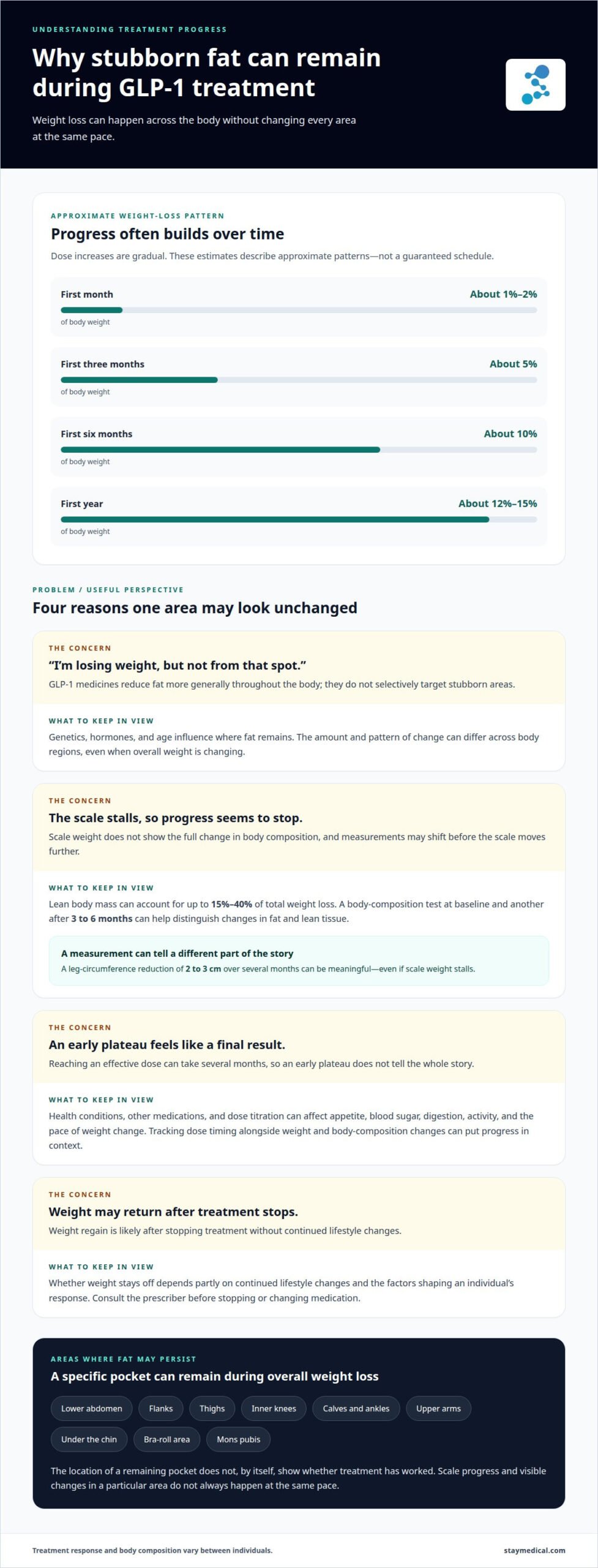
Weight loss often builds over time as the dose is gradually increased. Typical estimates are about 1% to 2% of body weight during the first month, 5% during the first three months, 10% during the first six months, and 12% to 15% during the first year. These are approximate patterns, not a guaranteed schedule.
Studies show that some people lose up to 15% of their body weight. The scale, however, doesn’t show the full reduction: lean body mass can account for up to 15-40% of total weight loss. A baseline body-composition test, followed by another after 3 to 6 months, can help distinguish changes in fat and lean tissue.
Weight loss may also show up in measurements before the scale changes further. For example, a leg-circumference reduction of 2 to 3 cm over several months can be meaningful even when scale weight stalls. After stopping treatment, weight regain is likely without continued lifestyle changes; consult the prescriber before stopping medication.
Factors Shaping Weight-Loss Response
Health conditions, other medications, and dose titration can affect appetite, blood sugar, digestion, activity, and the pace of weight change. Reaching an effective dose can take several months, so an early plateau does not tell the whole story. Tracking dose timing alongside weight and body-composition changes helps put progress in context.
Changes to medications or health conditions may also affect weight, energy, and eating patterns. Insurance coverage varies by plan and prescribed indication, so there is no single answer for private insurance or Medicare. Review the applicable benefit terms for the specific treatment and use.
Why Localized Fat Can Remain
GLP-1 medicines reduce fat more generally throughout the body rather than selectively targeting stubborn areas. Genetics, hormones, and age influence where fat remains, so a person may lose weight overall while still noticing specific areas. The amount and pattern of change can differ across body regions.
Fat may persist after weight loss in areas such as the lower abdomen, flanks, thighs, inner knees, calves, ankles, upper arms, and under the chin. The bra-roll area and mons pubis may also remain concerns. This is why scale progress and visible changes in a particular area do not always happen at the same pace.
How GLP-1 medications affect appetite, blood sugar, and digestion
GLP-1 receptor agonists mimic gut hormones involved in appetite, digestion, and blood sugar regulation. By influencing these processes, medications can change hunger and eating patterns while supporting blood sugar control. Semaglutide injections are generally taken once a week, while semaglutide tablets are taken daily.
Slower gastric emptying means food leaves the stomach more slowly, which can contribute to a fuller feeling. Gastrointestinal events occurred in 49.1% of participants who continued semaglutide and 26.1% of those who received placebo, according to JAMA Network. Nausea, diarrhea, constipation, and fatigue were associated with semaglutide in a trial described by the National Center for Biotechnology Information.
Common effects and serious risks: Reported effects include nausea, diarrhea, constipation, and fatigue. Serious risks depend on the medication and a person’s health history. A prescriber can explain medication-specific warnings and symptoms that need prompt attention.
Compounded medicines: Compounded GLP-1 drugs can differ in formulation and dosing from a particular branded product. Discuss the exact preparation, dose, and safety information with the prescribing professional before using one.
Monthly costs: There is no single monthly cost for Wegovy, Zepbound, or compounded GLP-1 medications. Out-of-pocket costs depend on the product, insurance coverage, and pharmacy pricing.
Exercise supports a broader approach to weight management. Resistance training two to three times per week can help preserve muscle during weight loss, while the suggested cardio target is 150 minutes per week. These activities serve different purposes: resistance work challenges muscle, while cardio adds sustained movement. A plan that fits current ability can make both forms of activity more manageable.
GLP-1 medications and liposuction also work differently. Medication reduces fat more generally throughout the body, while liposuction targets fat in specific areas. Liposuction doesn’t change appetite or blood sugar in the same way medication does. The distinction matters when the main concern is overall weight and metabolic health, rather than a localized deposit.
For people managing diabetes, blood sugar effects are part of the treatment discussion, alongside weight management. Ozempic, Wegovy, and Mounjaro are examples of medications used in this treatment landscape. Their formulations and dosing schedules differ, so a medication’s name alone cannot predict its effects on eating, digestion, or blood sugar for an individual.
Areas where stubborn fat may persist
GLP-1 medicines can reduce fat across the body, but the reduction isn’t evenly distributed. Genetics, hormones, and age help shape where fat remains, so two people with similar weight loss may notice different changes. The location of a remaining pocket doesn’t, by itself, show whether treatment has worked.
Common areas where fat may persist include the lower abdomen, flanks, thighs, inner knees, calves, and ankles. Some people also notice fullness in the upper arms, under the chin, around the bra line, or at the mons pubis. These are examples of areas where fat may remain, not a predictable sequence of change.
Body shape can shift even when one area changes slowly. For example, a waistband may feel looser while fullness remains in the lower abdomen, or the thighs may change without a similar change around the knees. A mirror shows appearance at one moment, while clothing fit and measurements capture other aspects of change.
Track the same area consistently: measure at the same point and under similar conditions, then compare the result with weight and clothing fit. Placement, posture, and normal daily variation can affect a single measurement, so repeated observations are more informative than one reading. This can help distinguish gradual change from a temporary fluctuation.
GLP-1 medicines affect appetite and blood-sugar regulation, rather than directing fat loss to a chosen site. Insulin and glucagon are involved in blood-sugar control, but a medication’s overall effects don’t guarantee a specific contour. Exercise and sustainable lifestyle habits can support broader health and weight management; they don’t make one body area selectively lose fat.
For example, someone may lose a meaningful amount of weight overall while still noticing fat around the flanks or upper arms. This reflects how the body distributes and loses fat, not necessarily a failure to follow an exercise routine. As surrounding areas change, remaining fat in one location may also become more noticeable, shifting proportions even if that area has not grown.
Focus on changes across your body, not just one stubborn area. Measure the area consistently and consider broader indicators such as weight and clothing fit. If a specific region remains a concern, describe its location and the changes you have noticed during a medical review. This gives the conversation a clearer starting point than appearance alone.
GIP and dual-receptor treatments
Some weight-management medicines act on more than one hormone receptor. Tirzepatide is a dual GIP/GLP-1 receptor agonist: it activates both the GIP and GLP-1 receptors. This differs from a medicine that acts through the GLP-1 receptor alone. The distinction describes the treatment’s mechanism, not a promise that one person will lose more weight or see a particular body area change first.
A receptor is a site through which a signal can affect the body. Dual-receptor treatment engages two pathways with one medicine, rather than using two separate medications. The shared goal is weight management, but individual response depends on the treatment plan and health context. A drug’s receptor activity alone cannot predict how much progress a person will make.
A reported comparison found a 33.9% reduction in total body fat mass with tirzepatide, compared with 8.2% with placebo. These are group-level figures, not a prediction for each person. Total fat mass measures body fat overall; it does not show whether a specific fat cell or localized deposit will change in a particular way. That distinction matters when a person’s main concern is one stubborn area.
The two percentages also shouldn’t be read as a direct comparison between every dual-receptor medicine and every GLP-1-only treatment. The reported placebo comparison describes a particular table, not a universal outcome for all doses, studies, or patients. Progress is better interpreted in context, including the prescribed medicine, treatment duration, weight trend, and body-composition change. A percentage in a study doesn’t establish an individual’s expected result.
- Receptor activity: Dual GIP/GLP-1 treatment activates both named receptors; GLP-1-only treatment acts through the GLP-1 receptor.
- Reported body-fat result: The cited table reports 33.9% with tirzepatide and 8.2% with placebo.
- What the result means: It describes total body-fat reduction, not selective fat removal from one area.
- How to interpret progress: Consider the broader treatment course and personal response, rather than treating one study figure as a forecast.
For someone considering a dual-receptor option, the useful question is how its role fits the whole weight-management approach. Appetite, digestion, dose progression, health conditions, and treatment goals all matter alongside receptor activity. Slower stomach emptying is part of GLP-1 medication effects, but receptor labels alone don’t determine how a person will experience it. A balanced review keeps the mechanism informative without mistaking it for a guarantee of localized change.
Who qualifies for prescription weight-loss GLP-1 medications in the United States?
Body mass index (BMI) is one measure used to describe weight categories in the United States. These categories can provide context when discussing prescription weight-management treatment, but they do not capture a person’s full health picture or predict a specific result.
A BMI of 30 or higher is described as obesity. A BMI from 25 to 29.9 is described as overweight. These ranges help distinguish the categories: for example, a BMI of 29.9 falls within the overweight range, while a BMI of 30 falls within the obesity range. The cutoff matters for classification, not as a complete measure of health.
For a treatment discussion, BMI is best considered alongside the reason for treatment and related health conditions. A person may be exploring medication for weight management, blood sugar regulation, or both. Certain GLP-1 medications have FDA approval for long-term obesity management and for regulating blood sugar in type 2 diabetes. Approval and intended use vary by medication, so the drug’s purpose matters.
Diabetes care may involve additional clinical considerations. Healthcare providers may consider GLP-1 agonists when a person hasn’t reached their target A1C within three months of treatment and also has conditions such as atherosclerosis, heart failure, or chronic kidney disease. This describes a specific treatment consideration, not a universal eligibility rule for everyone seeking weight loss.
A practical discussion can clarify the goal first: weight management, type 2 diabetes blood sugar regulation, or both. Then BMI category and relevant health conditions provide context for evaluating treatment. For example, someone with a BMI of 27 and type 2 diabetes falls within the overweight category; the BMI label alone doesn’t explain the person’s blood sugar needs or treatment goals.
Medication choice also depends on the medicine’s approved purpose and the person’s clinical circumstances. A BMI threshold can inform a conversation, but it is not an automatic prescription. Distinguishing a weight-management indication from a diabetes-related indication helps clarify treatment goals and expectations. A clinician can review these factors alongside health history and current treatment.
For a thoughtful next step, bring your weight-management goals and relevant health conditions into a clinical conversation. A structured review can connect BMI categories with treatment purpose, A1C progress, and conditions such as heart failure or chronic kidney disease.
Stay Medical Clinic
Stay Medical Clinic’s Weight Loss Program and Primary Care help you discuss treatment in the context of your health history, goals, and experience with medication. You can review progress, questions about appetite or digestion, and factors that may be affecting your response. This may be useful if weight changes have slowed, side effects affect daily life, or you are considering next steps. The discussion can address related health factors, not just one stubborn area or the number on the scale.
Contact Stay Medical Clinic to discuss your concerns and possible next steps.
Choose a Next Step That Fits Your Goals
Progress is easier to interpret when your goals extend beyond one body area. Decide what you want to understand next: how treatment fits your health priorities, how to assess changes over time, or how to discuss a lingering concern without making it your only measure of success. A clear priority gives a clinical conversation a focused starting point.
If you’re considering GLP-1 agonists for stubborn fat, bring the question behind that interest into a medical conversation. You might focus on appetite changes, treatment expectations, ongoing support, or how your body composition is changing. A thoughtful next step considers your overall health and personal goals, not only the area you’d like to change. That perspective can make the discussion practical and grounded.
Stay Medical Clinic offers personalized care to help you explore your priorities. Contact the clinic when you are ready to discuss what matters most to you.
A clear conversation can be a meaningful beginning.
Frequently Asked Questions
What Are GLP-1 and GIP Treatments?
GLP-1 treatments act on the GLP-1 receptor, while dual GIP/GLP-1 treatments activate both the GIP and GLP-1 receptors. Tirzepatide is an example of a dual-receptor medicine. The distinction describes how the medicine signals through hormone pathways, not whether it can target a particular fat pocket. Treatment choice also depends on its intended use and a person’s health needs.
What are GLP-1 agonists?
GLP-1 agonists are medicines that activate receptors for glucagon-like peptide-1, a hormone naturally produced in the gut. These receptors help regulate appetite, digestion, and blood sugar. Semaglutide is one example. The term describes a medicine’s action, rather than a specific dose or brand. Some medicines act on GLP-1 alone, while dual-receptor treatments also act on GIP receptors.
What are GLP-1 agonists and how do they support weight loss?
GLP-1 agonists support weight loss by influencing hunger, digestion, and blood sugar regulation. A person may feel less driven to eat as appetite is suppressed, while slower stomach emptying can affect fullness after meals. These effects can make changes in food intake easier to sustain for some people. The medicines don’t replace attention to nutrition, activity, or ongoing medical care.
Are GLP-1 medications effective for stubborn fat or specific areas of the body?
GLP-1 medications can reduce fat and weight overall, but they don’t selectively remove fat from a chosen area. For example, someone may see changes in clothing fit while still noticing fullness around the abdomen or thighs. Genetics, hormones, and age influence where fat remains. GLP-1 agonists for stubborn fat should therefore be understood as medication for broader weight management, not spot reduction.
Which GLP-1 medications are FDA-approved for chronic weight management in the United States?
Wegovy, a semaglutide product, and Zepbound, a tirzepatide product, are FDA-approved for chronic weight management in the United States. Brand and generic names matter because the same active ingredient can be marketed for different uses. Ozempic and Mounjaro are related medicines, but their names alone do not establish an obesity-treatment indication. Prescribing should match the product’s approved use.
How much weight do semaglutide and tirzepatide typically help patients lose in clinical trials?
Clinical trial results vary by study, treatment, and participant group. Some studies report weight loss of up to 15% with GLP-1 medications. In the BELIEVE trial, semaglutide alone was associated with a 15.7% weight decrease. A reported 33.9% reduction for tirzepatide refers to total body fat mass, not body weight, so those figures shouldn’t be treated as directly comparable.
How are GLP-1 medications started, dosed, and monitored for weight loss?
GLP-1 treatment is generally started at a lower dose and increased gradually; reaching an optimal dose can take several months. The specific schedule depends on the medicine and prescribed plan. Monitoring can consider changes in weight, tolerability, and relevant health measures rather than relying on the scale alone. A prescriber guides dose changes and reviews concerns before treatment is adjusted.
What happens to weight and appetite after stopping GLP-1 medication?
Weight regain is likely after stopping GLP-1 medication without continued lifestyle changes. Appetite may also change as the medicine’s effects diminish, making established eating and activity habits important to ongoing weight management. Regain can occur in different areas than before and may be uneven. Talk with the prescriber before stopping, so the decision and next steps account for treatment goals and health needs.
Disclaimer
This content is for informational purposes only and does not replace evaluation, diagnosis, or treatment by a medical professional. Always consult a qualified healthcare provider for personalized care.