

Tirzepatide Weight Loss Results Month by Month and Over Time
October 28, 2026
Post-workout recovery IV drips in Coral Gables
October 30, 2026
Yes, testosterone replacement therapy (TRT) can reduce or stop sperm production, sometimes within weeks of starting treatment. When TRT and fertility concerns intersect, stopping treatment doesn’t necessarily restore sperm production right away. Recovery can take months or years.
If you’re planning to conceive, it’s understandable to want clear answers before changing treatment. TRT affects the body’s hormone signals, and recovery time varies. Don’t stop prescribed testosterone without first speaking with the clinician who manages your care.
This article explains how TRT can affect sperm production, what recovery after stopping may involve, and how clomiphene and other approaches may fit into fertility planning. It also outlines why discussing your goals and treatment options with a medical professional before trying to conceive can help you make an informed plan.
Key Takeaways
- TRT can suppress natural hormone signals and reduce sperm production, sometimes within weeks of starting treatment.
- Fertility recovery after stopping TRT can take months or longer, so timing matters when planning to conceive.
- Clomiphene may be used off-label to support the body’s own testosterone production while preserving fertility goals.
- Discuss fertility plans before starting TRT, including whether sperm banking may be appropriate.
- Don’t stop prescribed testosterone on your own; review treatment changes and conception plans with the prescribing clinician.
How quickly does TRT suppress sperm production?
Testosterone replacement therapy can affect sperm production within weeks. The change may be gradual, but some men develop very low sperm counts or no sperm in their semen. TRT treats low testosterone, also called hypogonadism, rather than infertility. If you may want biological children, discuss that goal before starting therapy.
The reason lies in the difference between testosterone in the bloodstream and testosterone inside the testes. Intratesticular testosterone is normally 50 to 100 times higher than the level measured in blood. Sperm production depends on this concentrated local supply. Testosterone taken as therapy can raise blood levels while suppressing the body’s own hormone signals to the testes. As those signals fall, sperm production may decline even when a blood test shows a normal testosterone level.
Suppression can progress over the first months of treatment. In clinical TRT practice, most men reach severe oligospermia or azoospermia within 3-6 months of starting therapy. Severe oligospermia means a very low sperm count; azoospermia means no sperm are detected in semen. In a World Health Organization male contraceptive trial, 64.5% of participants reached azoospermia within 6 months while receiving testosterone enanthate at 200 mg per week. That trial illustrates the potential effect, not an individual prediction.
Testosterone dose, treatment duration, administration, and individual response can all influence suppression. A falling sperm count may reduce the chance of conception, but it doesn’t establish infertility on its own. A semen analysis measures sperm in a sample, while hormone testing helps assess the body’s testosterone production. These tests answer different questions, so neither replaces the other when evaluating male fertility.
Some treatment approaches aim to support sperm production while addressing low testosterone. In one study, hCG at 500 IU every other day maintained sperm counts in 100% of participants receiving TRT. Clomiphene and other medicines may also be considered in fertility-focused care. The right option depends on the cause of low testosterone and reproductive goals. Medicines used incorrectly can lower sperm counts, so don’t start, stop, or adjust them without medical guidance.
In the United States, costs for fertility-preserving treatment and sperm banking depend on the services involved, such as medication, sample collection, testing, and storage. Insurance coverage varies by plan and benefits, so review your specific coverage before making financial decisions.
Fertility recovery after stopping TRT
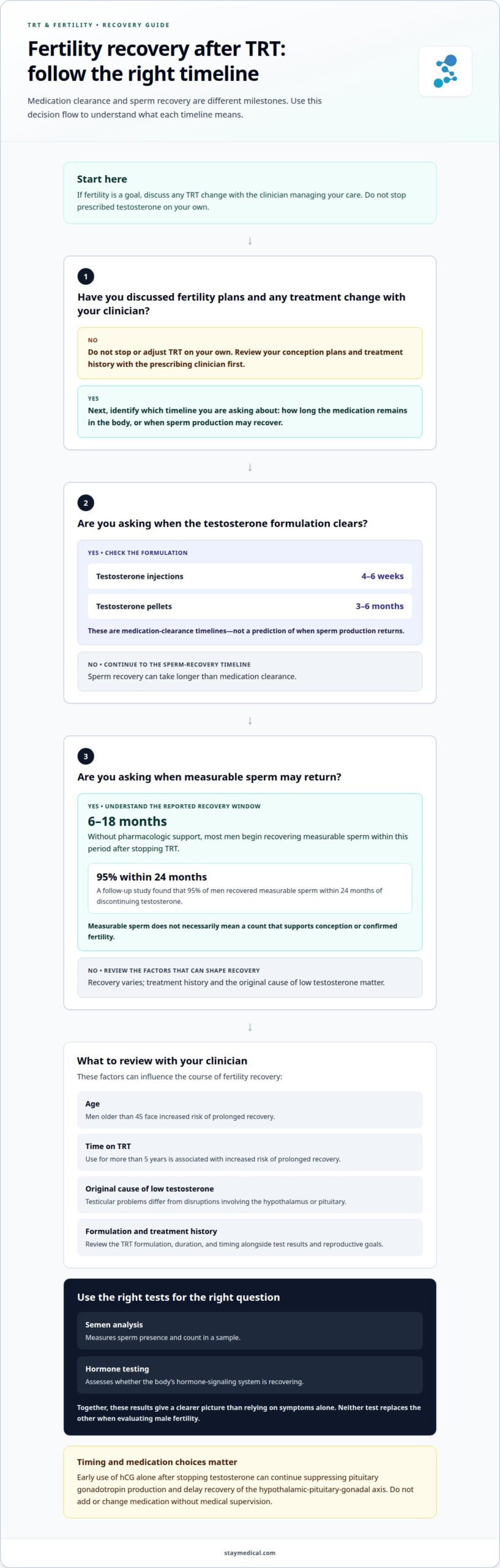
Stopping testosterone replacement doesn’t switch sperm production back on immediately. Without pharmacologic support, most men begin recovering measurable sperm within 6-18 months after stopping TRT. The hormonal system that signals the testes, including the pituitary, needs time to resume function. For some people, fertility effects can take months or even years to reverse, so conception timing can extend beyond the last dose.
A follow-up study found that 95% of men recovered measurable sperm within 24 months of discontinuing testosterone. Measurable sperm doesn’t necessarily mean a sperm count that supports conception, and recovery from azoospermia, or no sperm detected in semen, is not the same as confirmed fertility. Semen analysis tracks sperm presence and count; hormone tests assess whether the body’s signaling system is recovering. Together, these results give a clearer picture than relying on symptoms alone.
Recovery time is influenced by factors that existed before TRT and by the treatment history. Men older than 45 face increased risk of prolonged fertility recovery, as do men who used TRT for more than 5 years. The original cause of low testosterone also matters: testicular problems differ from disruptions involving the hypothalamus or pituitary. A clinician can consider these details alongside hormone results and semen analyses when assessing the course of recovery.
The formulation affects how long testosterone remains in the body after treatment stops. Testosterone injections typically clear within 4-6 weeks, while pellets typically take 3-6 months to clear. Those timelines describe clearance, not when sperm production returns. In addition, early use of hCG alone after stopping testosterone can continue suppressing pituitary gonadotropin production and delay recovery of the hypothalamic-pituitary-gonadal axis. Medication choice and timing therefore matter.
Stopping TRT to pursue fertility can leave sperm production suppressed while the hormonal system recovers, extending the wait to conceive. Discuss any change with the prescribing doctor rather than deciding on your own. A fertility-focused plan can account for age, treatment duration and formulation, test results, and reproductive timing. Medicines intended to increase sperm production can lower counts if used incorrectly, so don’t add or change medication without medical supervision.
If you’re reviewing treatment plans, a discussion of testosterone replacement can help frame questions about fertility goals, treatment history, and monitoring. Bring prior semen analyses and hormone results to the conversation; those records can help the provider assess changes over time.
Clomiphene as an alternative to TRT
For some men with low testosterone who want to preserve fertility, clomiphene citrate offers a different approach. Unlike testosterone replacement therapy, which supplies testosterone from outside the body, clomiphene stimulates the pituitary gland to increase the body’s own testosterone production. This distinction matters because fertility planning involves both hormone levels and sperm production, not testosterone readings alone.
Clomiphene is prescribed off-label for men with low testosterone. “Off-label” means a clinician prescribes a medication for a use beyond its approved labeling. In this context, the aim is to encourage the body’s own hormone signaling rather than replace testosterone directly. Whether it’s appropriate depends on the reason for low testosterone and the person’s reproductive goals.
A study reported testosterone levels and patient satisfaction comparable to TRT among hypogonadal men treated with clomiphene. That finding helps explain why clinicians may consider it, but comparable testosterone levels don’t establish that sperm production or fertility has improved. Semen analysis and hormone results assess different aspects of the picture. Discuss both when considering whether an approach fits your priorities.
Clomiphene belongs to a medication group called selective estrogen receptor modulators, or SERMs. For people with low testosterone who wish to preserve fertility, treatment options may also include human chorionic gonadotropin, known as hCG, or aromatase inhibitors. These medications may be used alone or in combination, depending on the medical factors involved. They aren’t interchangeable, and a treatment plan should reflect the underlying hormone pattern.
Clomiphene doesn’t guarantee conception and isn’t suitable for every cause of low testosterone. For example, a problem originating in the testes differs from one involving pituitary signaling, and that distinction can affect which treatments are considered. Clomiphene or hCG may not improve fertility in some cases, whether or not the person previously used TRT. Treatment goals should therefore include sperm production, not just testosterone levels.
Before changing testosterone therapy, discuss your fertility plans, current treatment, and test results with a medical professional. Bring any hormone results and semen analyses you have to make the conversation specific. Ask how the proposed approach addresses both testosterone and reproductive goals, and which outcomes will be assessed. Clomiphene is an option to discuss, not a self-directed substitute for prescribed testosterone or a guarantee of restored fertility.
Seeking medical advice before trying to conceive
Before starting TRT, discuss fertility goals with the clinician managing your treatment. Baseline tests and sperm banking can help inform decisions before testosterone affects sperm production.
Fertility Tests Before TRT
A semen analysis measures sperm in an ejaculate, while hormone testing assesses the body’s reproductive signals. Discuss both before TRT to document your starting point. If an analysis shows a low count, that result provides context for later comparisons. Hormone results help clarify the reason for testosterone treatment and the fertility questions to address beforehand.
Sperm Banking Before TRT
Sperm banking preserves semen samples for possible future use in family building. Men who may want biological children later should discuss banking before starting TRT. The process described here involves three separate ejaculatory samples. Banking is worth discussing beforehand because TRT can suppress sperm production, and recovery after stopping can take months or longer.
A medical discussion should connect test results to the reason for treatment. For example, low testosterone alongside a low sperm count raises different questions than low testosterone with a normal semen analysis. The testes, pituitary signaling, treatment history, and plans for conception all shape the conversation. Share relevant sexual symptoms, previous test results, and any history of testicular damage or genetic conditions.
Don’t stop prescribed testosterone on your own when pregnancy becomes a goal. Speak with the prescribing doctor first, then discuss how treatment changes, hormone monitoring, and semen analysis fit together. Testosterone therapy can affect sperm production even if you feel well, so symptoms alone don’t show whether sperm are present. A semen analysis provides direct information about a sample, while hormone tests measure a different aspect of reproductive function.
Timing also belongs in the plan. If you hope to conceive soon, ask how ongoing testosterone treatment could affect the timeline and which fertility-preserving approaches may suit the underlying cause of low testosterone. Medical options may include clomiphene or hCG, but these medicines don’t improve fertility in every case. Testicular causes of low testosterone require a different assessment from problems involving pituitary signaling.
Bring a clear list of priorities to your appointment: whether you want biological children, when you hope to conceive, and whether you’ve had semen or hormone testing. These details help the clinician weigh testosterone treatment against your reproductive goals. If infertility is already a concern, share how long you’ve been trying to conceive and any known semen-analysis findings. A plan based on specific results is more useful than relying on a testosterone level alone.
How does testosterone replacement therapy affect sperm production and fertility?
Testosterone replacement therapy (TRT) treats low testosterone, not infertility. For people weighing TRT and fertility concerns, the key distinction is that raising testosterone levels doesn’t necessarily support conception. Treatment may affect sperm production even as symptoms improve, so reproductive goals should be part of the treatment discussion from the start.
TRT changes the hormone signals that regulate the testes. External testosterone can suppress pituitary signals that normally prompt the testes to produce testosterone and sperm. As a result, blood testosterone may rise while signals supporting sperm production fall. The effect depends partly on the treatment’s administration and dosage, and sperm counts can decrease or become undetectable.
Low testosterone can also occur alongside fertility challenges. A lower-than-average sperm count may make conception more difficult, while decreased libido or erectile dysfunction can affect the timing of intercourse. These are distinct factors: sperm quantity, sexual function, and hormone levels all contribute to the overall picture. Improving one measure doesn’t necessarily resolve the others.
TRT may be prescribed for testosterone deficiency and other medical circumstances, but it isn’t a fertility treatment. You may feel better while sperm production declines, so symptoms alone can’t show whether fertility is preserved. Semen analysis evaluates sperm in an ejaculate; hormone testing provides information about the hormonal system. Reviewing both helps distinguish treatment effects from an existing reproductive issue.
The underlying cause matters, too. In primary hypogonadism, the problem is associated with the testes rather than the hypothalamus or pituitary, so treatment considerations differ. Testicular damage and genetic conditions such as Klinefelter syndrome can affect both testosterone and sperm count. An assessment should consider the underlying condition, not just the TRT dose or blood testosterone result.
When conception is difficult, assisted reproductive options may include intrauterine insemination, in vitro fertilization, or intracytoplasmic sperm injection. The suitable approach depends on semen findings and the reproductive circumstances of both partners. Male factors alone account for about 20% of infertility cases, while male and female factors together account for another 30%. These figures underscore the value of considering both partners during fertility assessment.
If you have TRT and fertility concerns, discuss family-building plans with the prescribing clinician before changing treatment. The conversation can cover treatment goals, test results, and fertility-preserving options. Don’t stop or adjust prescribed testosterone on your own; the reason for treatment and the cause of low testosterone influence which alternatives may be suitable.
Stay Medical Clinic: Weight Loss Program
Stay Medical Clinic’s Weight Loss Program may be relevant if weight management is part of your broader health goals alongside testosterone care. Weight loss is associated with increased testosterone levels, but this doesn’t make a weight loss program a fertility treatment or guarantee sperm recovery.
If you’re considering testosterone replacement while planning for children, discuss how your treatment goals, health history, and fertility priorities fit together. Stay Medical Clinic also offers Primary Care to support conversations about your overall health and next steps. For fertility testing or recovery concerns, bring your questions and relevant test results to your appointment.
Contact Stay Medical Clinic to discuss your health goals and care options.
Make Your Next Conversation Count
Turn your family-building goals into a clear agenda for your next medical conversation. Write down when you hope to conceive, what matters most to you about testosterone treatment, and any questions you have about preserving fertility. Bringing these priorities together can help focus the discussion on choices that fit your health and plans.
If you’re weighing TRT and fertility concerns, be open about both goals rather than treating them as separate decisions. Ask how your options align with your reproductive timeline, what information would guide the plan, and how progress will be reviewed. A thoughtful discussion can help you understand the trade-offs and decide on a path with your care team.
You deserve care that takes your health goals seriously and gives you room to make informed decisions. Start the conversation when you’re ready.
Your next step can begin with one honest conversation.
Frequently Asked Questions
Can Testosterone Replacement Therapy (TRT) Cause Infertility?
Yes, TRT can lower sperm production and make conception difficult while treatment continues. For example, a semen analysis may show a reduced count even when testosterone levels have improved. TRT treats low testosterone, not infertility. If having biological children is important to you, raise that goal before starting or changing therapy so treatment decisions account for your reproductive plans as well as your symptoms.
What if I have low testosterone?
Low testosterone calls for evaluation, not an automatic decision to start TRT. The American Urological Association recommends diagnosing and considering treatment for hypogonadism when total blood testosterone is below 300 ng/dl on two separate occasions and signs or symptoms are present. Tell the clinician about fertility plans before treatment. Discussing symptoms and laboratory results in a clinical visit can help frame next steps at Stay Medical Clinic.
Why does TRT reduce sperm?
TRT can reduce sperm because it changes hormone signals from the brain to the testes. Those signals normally support testosterone production inside the testes, where levels are 50 to 100 times higher than in blood. Sperm need that local hormonal environment to develop. A blood test showing a normal testosterone level therefore doesn’t establish that sperm production is unaffected; semen analysis assesses sperm directly.
Does Taking Testosterone Make You Infertile as a Male – How Quickly?
It can reduce fertility within weeks of starting testosterone, with suppression often becoming clearer over subsequent months. In clinical TRT practice, most men reach severe oligospermia or azoospermia within 3-6 months. These terms describe very low sperm counts or no sperm detected in semen. A semen analysis can show whether sperm are present; testosterone symptoms or blood levels alone cannot answer that question.
How does TRT work?
TRT adds testosterone to raise levels in people treated for low testosterone, also called hypogonadism. Available forms include injections, gels, patches, pellets, and creams. As blood testosterone rises, the body may reduce its own hormone signals to the testes. This feedback helps explain why testosterone therapy can improve hormone levels while affecting sperm production. Discuss the treatment form and your reproductive goals with the prescribing clinician.
Is Testosterone-Induced Infertility Permanent?
Testosterone-related infertility isn’t always permanent, but sperm production isn’t guaranteed to resume after TRT stops. A follow-up study found that 95% of men recovered measurable sperm within 24 months of discontinuation. Measurable sperm doesn’t necessarily mean conception will occur, since fertility involves more than sperm presence. Recovery assessment can include repeat semen analyses, which show whether sperm counts are changing over time.
Is clomiphene a safe alternative to testosterone for men who want to have children?
Clomiphene may be considered for some men with low testosterone who want to preserve fertility. It’s prescribed off-label to stimulate the pituitary gland to increase the body’s own testosterone production, rather than supplying testosterone directly. It isn’t suitable for every cause of low testosterone, and hCG or other treatments may be considered. Use it only under medical supervision, since medications used incorrectly can lower sperm counts.
Can TRT cause temporary or permanent infertility?
TRT can have fertility effects that last beyond treatment, sometimes taking months or years to reverse. Some men recover sperm production after stopping, while others may not recover fully, so permanent infertility can’t be ruled out. The underlying cause of low testosterone, age, and treatment duration can affect recovery. Follow-up semen testing provides more useful information than assuming fertility has returned based on how you feel.
Disclaimer
This content is for informational purposes only and does not replace evaluation, diagnosis, or treatment by a medical professional. Always consult a qualified healthcare provider for personalized care.