

How to Prepare for IV Therapy: A Patient-Friendly Guide
October 6, 2026
Causes of High Blood Pressure: What Can Raise Your Readings?
October 8, 2026
What if an abnormal blood test result isn’t the whole story? A number outside the reference range can feel alarming, while instructions about fasting or medications may leave you unsure how to prepare. Results are most useful when considered alongside your health history, symptoms, and other findings, not viewed in isolation.
This guide explains what common blood tests assess, including a complete blood count, metabolic panel, lipid panel, and A1C. You’ll also learn how to follow preparation instructions, what results can and can’t tell you, and why a result outside the expected range doesn’t automatically mean something is wrong. A healthcare professional can interpret findings in the context of your overall health and discuss practical next steps. If you’re looking for laboratory testing in Miami, Stay Medical Clinic offers blood work as part of its primary care services. Knowing what to expect can help you feel more prepared before your test and more confident discussing what comes next.
Key Takeaways
- Learn what common blood test panels are designed to assess, so you can understand why a particular test may be considered.
- Use your symptoms, health history, and medications as important context when discussing results with a healthcare professional.
- Follow the instructions provided for your test, including whether fasting is needed, and ask about next steps.
- Explore laboratory testing at Stay Medical Clinic in Brickell as part of a broader primary care relationship.
What Is a Blood Test, and What Can It Tell You?
A blood test analyzes a sample to measure selected substances or cells. Depending on what a clinician is assessing, the results may offer clues about how parts of the body are functioning, help investigate symptoms, or show how a condition or treatment is changing over time.
Blood testing provides measurements that can support a clinical assessment, but results need to be interpreted in the context of the person being tested. A result by itself doesn’t establish a diagnosis or necessarily explain a symptom. Your health history, medicines, current concerns, and other findings all help shape what it means. For a broader overview of the purpose and common types of testing, see What is a Blood Test?
What happens during a blood test?
A healthcare professional collects a small sample, commonly from a vein in the arm or, for some tests, from a fingertip. The collection method depends on the measurements requested. The sample is then analyzed for the specific cells or substances the clinician ordered. Not every sample is tested for the same things.
Timing and collection details vary with the test and your circumstances. Some tests require preparation, while others don’t. If you’re unsure what applies to you, clarify the instructions before your appointment rather than making assumptions.
Why might a clinician recommend blood work?
Testing may be part of a routine health assessment, help explore symptoms, or monitor an existing condition or treatment. For instance, a clinician might use selected measurements to look for changes in blood-cell levels, assess aspects of organ function, or follow a marker relevant to an ongoing care plan. The appropriate test depends on the question being asked.
More testing isn’t automatically more useful. A clinician considers your health history and current needs when deciding which measurements may help. A broad panel isn’t necessary for everyone, and a single result may need to be considered alongside symptoms, examination findings, or other tests before deciding on next steps.
Think of results as one part of a larger conversation about your health. They can guide that conversation, but they don’t replace it. In a primary care setting, you can discuss why a test was recommended and how its findings fit with your overall health. For those exploring advanced preventative screening beyond routine blood work, platforms like preventis.ai offer specialized genetic testing panels to help clarify hereditary health factors.
Common Blood Tests Explained: CBC, CMP, Lipids, and A1C
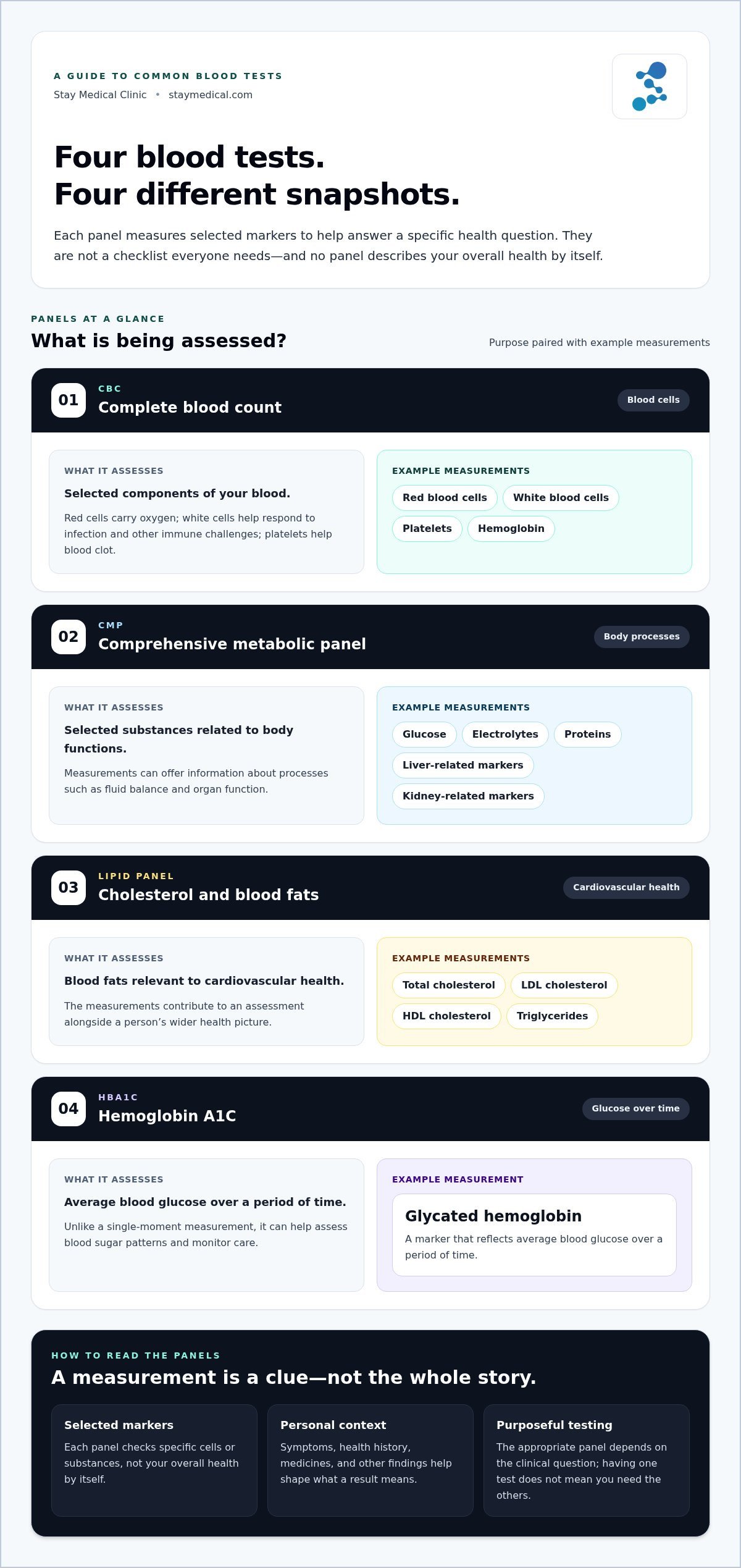
Blood tests are ordered to answer specific health questions. Knowing what the panel names on a lab request generally measure can make them easier to understand. These tests cover different aspects of health; they aren’t a checklist everyone needs. A panel measures selected markers, not your overall health by itself.
| Test | Broad purpose | Example measurements |
|---|---|---|
| Complete blood count (CBC) | Measures selected blood cell components | Red and white blood cells, platelets, hemoglobin |
| Comprehensive metabolic panel (CMP) | Assesses selected substances related to body functions | Glucose, electrolytes, proteins, and markers related to liver and kidney function |
| Lipid panel | Measures blood fats relevant to cardiovascular health | Total cholesterol, LDL and HDL cholesterol, triglycerides |
| Hemoglobin A1C (HbA1c) | Reflects average blood glucose over a period of time | Glycated hemoglobin |
What does a complete blood count measure?
A CBC looks at components of your blood. Red blood cells carry oxygen, white blood cells help the body respond to infection and other immune challenges, and platelets help blood clot. The panel may also include measures such as hemoglobin, a protein in red blood cells that carries oxygen.
A result needs context. A change in one cell measurement, for example, may have different explanations depending on your symptoms, medical history, and other findings. A clinician considers the pattern rather than treating one number as a complete answer.
What do metabolic, cholesterol, and A1C tests assess?
A CMP measures selected substances that offer information about processes such as fluid balance and organ function. A lipid panel looks at blood fats, including cholesterol and triglycerides. These measurements can contribute to an assessment of cardiovascular health, but they’re interpreted alongside a person’s wider health picture.
HbA1c reflects average blood glucose over a period of time rather than at a single moment. It can help a clinician assess blood sugar patterns and monitor care. The appropriate panel depends on the clinical question, so having one test doesn’t mean you need the others.
Stay Medical Clinic provides laboratory testing in Brickell as part of its medical services. A healthcare professional can discuss which evaluations fit your care.
Do Blood Test Results Always Mean Something Is Wrong?
No. A result outside the laboratory’s reference range doesn’t automatically confirm a health condition, and a result within range doesn’t always explain how you feel. Lab values are clues to consider, not a diagnosis on their own. It’s understandable to feel concerned when a result is flagged, but the flag is a prompt for interpretation, not a conclusion.
What does an out-of-range result mean?
A reference range shows values commonly seen in a defined comparison group. It helps clinicians assess a result, but it isn’t a universal boundary between health and illness. A value just beyond the range may have a different significance from a larger or persistent change. The reason for testing matters too.
Depending on the finding and the clinical picture, a healthcare professional may review the result alongside other measurements, ask about symptoms, or consider repeat testing or additional evaluation. There isn’t one automatic next step for every flagged result. Avoid drawing conclusions from a single number or changing medicines without guidance from a qualified professional.
Why does personal health context matter?
Age, symptoms, medical history, medicines, and the reason the test was ordered can all inform how results are understood. A medicine may affect certain measurements, for example, while symptoms may help a clinician decide whether a result needs closer attention. The pattern across several results can also provide more useful information than one marker viewed alone.
Your clinician may explain how a finding relates to your health, whether it should be monitored, and what follow-up is appropriate. The next step may be reassurance, a discussion of possible contributing factors, or further assessment. It depends on the whole picture, so an out-of-range result by itself can’t predict the outcome.
If a result is unclear, bring your questions to a healthcare professional who can review it in context. You might ask:
- What does this result measure, and how does it relate to why the test was ordered?
- Could my symptoms, health history, or medicines affect how it’s interpreted?
- Do I need any follow-up, and when should I expect to discuss it?
A clear conversation can help turn an unfamiliar result into a practical next step. Reviewing results as part of primary care also gives a clinician the opportunity to consider them alongside your broader health history, rather than treating a lab value as the whole story.
How to Prepare for a Blood Test and What to Ask
A little preparation can make the appointment easier and help your care team interpret the results. Instructions depend on the test, so don’t assume you need to fast or change your routine. Use this checklist to feel ready.
- Confirm your instructions. Check whether fasting is required and clarify what you may eat or drink, and when. Fasting applies only to some tests. If instructions are unclear, ask your care team before your appointment rather than guessing.
- Share relevant information. Tell your healthcare professional about prescription medicines, over-the-counter medicines, supplements, relevant health history, and current symptoms. Bring your test order or appointment details if applicable. Don’t stop prescribed medicines unless a healthcare professional instructs you to.
- Attend as directed. Follow the appointment details and any preparation instructions you’ve received. If something has changed, such as your ability to follow fasting instructions, let the care team know so they can advise you on what to do next.
- Discuss results and follow-up. Ask how and when you’ll receive results, who will review them with you, and whether follow-up may be needed. Writing questions down beforehand can help you remember what matters to you.
Should you fast before a blood test?
It depends on the specific test and your clinician’s instructions. Some tests require fasting, while others don’t, so avoid starting a fast unless you’ve been told to. If the guidance doesn’t clearly explain permitted food or drinks, or when to begin, clarify those details with your care team. Don’t guess based on instructions you received for a different test.
What information should you share before testing?
Give your care team a clear picture of the medicines and supplements you take, relevant health history, and symptoms you’re experiencing. These details may help provide context for test selection and interpretation. Keep your appointment or test-order information handy, and note questions about preparation, timing, how results will be shared, and possible next steps.
Preparation is also a chance to take an active role in your care. Knowing what the test is for and how follow-up works can make the process clearer from appointment to results.
Getting a Blood Test in Brickell, Miami: A Clear Next Step
Stay Medical Clinic offers laboratory testing in Brickell as part of its primary care services. This setting connects testing with your health needs, rather than treating a result as something to interpret on its own. A healthcare professional can discuss why testing may be appropriate and how findings could inform possible next steps.
What to expect from a patient-centered testing visit
A thoughtful conversation can begin with the reason for testing. You may be following up on a concern, discussing symptoms, or reviewing your health as part of ongoing care. Sharing relevant history and questions helps your clinician understand what you hope to learn and what information may be useful.
The appropriate tests depend on the individual and the clinical question. Not everyone needs the same panel, and a test result is only one part of a broader assessment. After testing, you can discuss how results fit with your health history and whether follow-up is appropriate. Timing and next steps can vary, so avoid assuming a particular result or turnaround time.
Learn more about blood testing in Brickell and how it fits into a broader primary care visit in Brickell. These resources can help you understand the care pathway and prepare questions for your healthcare professional.
How to take the next step in Brickell
Stay Medical Clinic is located at 33 SW 2nd Ave, Suite 502, Miami, FL 33130, and is open Monday through Saturday. Its Brickell location offers a local setting to discuss laboratory testing as part of personalized primary care. The clinic serves patients in Miami and nearby communities, including Aventura, Bal Harbour, Bay Harbor Islands, Biscayne Park, Coral Gables, Cutler Bay, Doral, El Portal, Florida City, Golden Beach, Hialeah, Hialeah Gardens, and Key Biscaya. Before your visit, gather any test instructions and relevant health information, and note questions about the reason for testing, preparation, and how results will be reviewed.
Understanding the purpose of a test and the plan for discussing results can make the process feel more manageable. Explore Stay Medical Clinic’s blood testing and primary care information to learn how care can fit your needs.
Make Your Next Health Decision with Confidence
A blood test can offer useful information, but its meaning depends on the person and the reason it was ordered. Understanding what common panels measure, following test-specific preparation instructions, and reviewing results with a healthcare professional can help you approach testing with greater confidence. An out-of-range finding isn’t a diagnosis by itself, and questions about follow-up are a natural part of care.
Stay Medical Clinic offers laboratory testing within a primary care setting in Brickell, Miami. Its healthcare professionals take a personalized approach, helping you discuss testing in relation to your health needs and understand possible next steps. Your results are one part of a broader picture, and clear, thoughtful guidance can help you consider them in context.
To discuss blood testing as part of primary care, explore services at Stay Medical Clinic in Brickell, Miami.
Frequently Asked Questions
What does a blood test check for?
A blood test checks selected cells or substances in a sample, depending on what a clinician orders. For example, a complete blood count measures blood cell components, while a lipid panel measures fats such as cholesterol and triglycerides. Other tests may assess substances related to organ function or blood glucose. The right test depends on the health question, so a clinician may not recommend every panel for every person.
Do I need to fast before a blood test?
Fasting is needed for some tests, but not all. Follow the instructions provided for your specific test rather than fasting just in case. If you’re unsure what you may eat or drink, or when to begin fasting, clarify the directions with your healthcare professional before the appointment. Instructions can vary with the test and your circumstances, so guidance for one test may not apply to another.
How long does it take to get blood test results?
Results timing varies depending on the tests ordered and the laboratory’s process, so there isn’t one timeframe that applies to every person. Ask your care team how and when results are expected to be shared, and who will review them with you. If you haven’t heard back within the timeframe you were given, follow up with the clinic. A healthcare professional can explain findings and discuss whether further steps are appropriate.
Can a blood test diagnose a medical condition?
A blood test can provide information that helps a clinician assess or investigate a possible condition, but results are usually considered alongside other details. Symptoms, medical history, examination findings, and sometimes additional tests may all contribute to a diagnosis. A laboratory result alone may not explain how you feel or establish what is causing a concern. Review your results with a qualified healthcare professional rather than drawing conclusions from a single value.
What does it mean if a blood test result is abnormal?
An abnormal or out-of-range result doesn’t automatically mean you have a medical condition. Reference ranges help clinicians interpret measurements, but they aren’t a diagnosis by themselves. Your symptoms, health history, medicines, and the pattern across other results can affect what a finding means. Depending on the circumstances, a clinician may review the result, consider repeat testing, or discuss other information. Ask what the finding means for your care.
Can I take my regular medication before a blood test?
Don’t stop or change prescribed medicines for a test unless your healthcare professional instructs you to. Some medicines or supplements may be relevant when interpreting results, so tell your care team what you take. If your preparation instructions don’t address medication, ask for guidance before the appointment. The right advice depends on the test and your health circumstances, and general instructions shouldn’t replace guidance specific to your care.
Where can I get a blood test in Brickell, Miami?
Stay Medical Clinic offers laboratory testing in its primary care setting at 33 SW 2nd Ave, Suite 502, Miami, FL 33130, and is open Monday through Saturday. The clinic serves Brickell and nearby communities, including Coral Gables, Doral, Aventura, Bal Harbour, Bay Harbor Islands, Biscayne Park, Cutler Bay, El Portal, Florida City, Golden Beach, Hialeah, Hialeah Gardens, and Key Biscaya. Healthcare professionals can discuss testing in relation to your needs and help you understand possible follow-up.
Disclaimer
This content is for informational purposes only and does not replace evaluation, diagnosis, or treatment by a medical professional. Always consult a qualified healthcare provider for personalized care.