

Non-Surgical Weight Loss Options in Aventura: A Comprehensive 2026 Guide
September 17, 2026
Physician-Led Weight Loss Program in Miami: The 2026 Guide to Sustainable Results
September 19, 2026
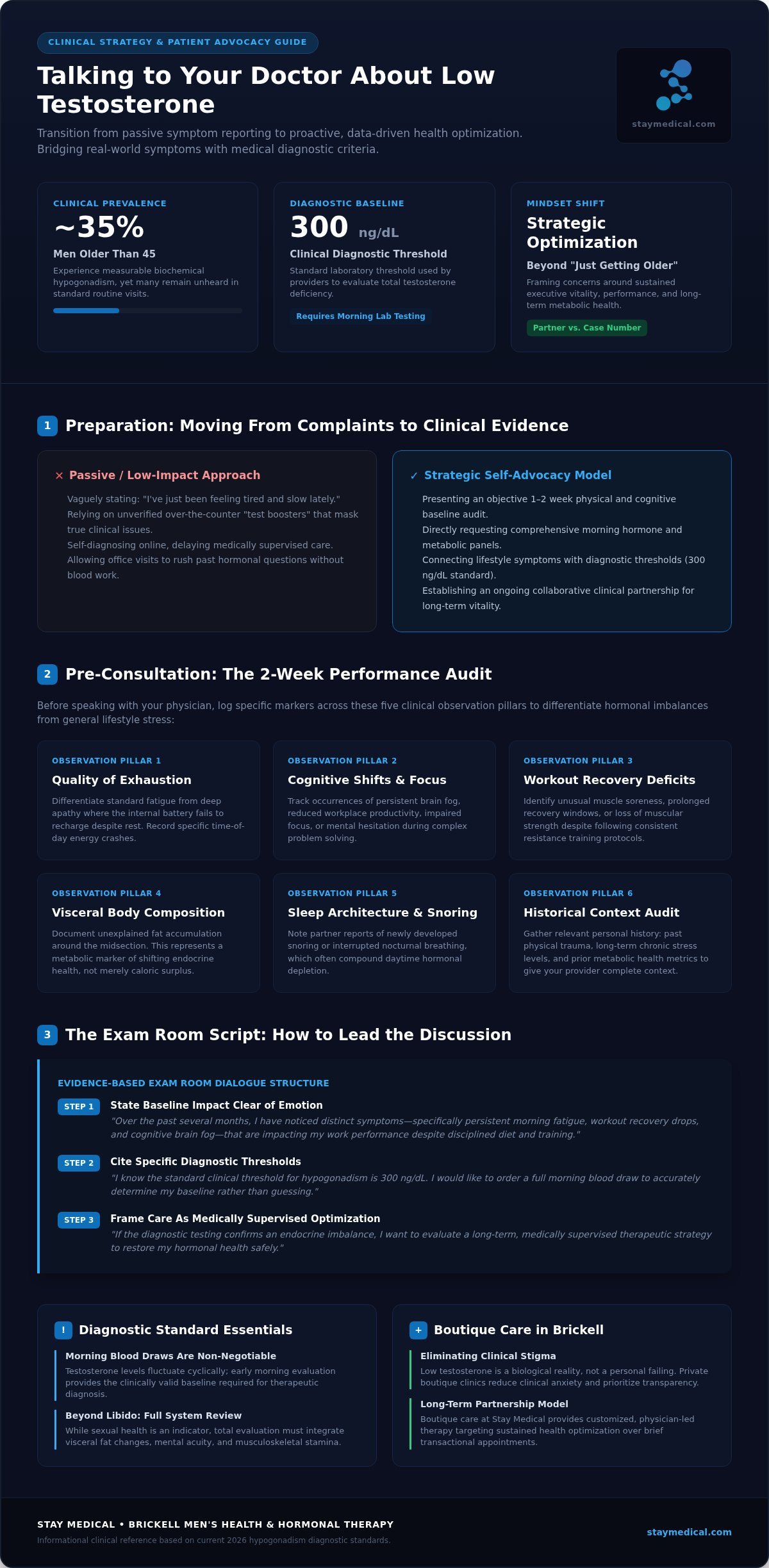
What if the persistent fatigue and loss of drive you’ve been dismissing as a side effect of a busy 2026 schedule isn’t just “getting older,” but a measurable medical condition that deserves a professional strategy? It’s a common struggle. Research shows that approximately 35% of men older than 45 experience biochemical hypogonadism, yet many feel their concerns are minimized during brief office visits. Learning how to talk to your doctor about low testosterone is the essential first step toward moving past the frustration of feeling unheard and reclaiming your sense of self.
We understand that discussing sexual health or declining energy can feel deeply personal and even a bit uncomfortable. You deserve a healthcare partner who looks beyond the surface and treats you as an individual rather than a clinical case. This guide promises to help you master the conversation with your provider to ensure your symptoms are heard and your path to hormonal balance is clear. We’ll explore the specific diagnostic thresholds, such as the 300 ng/dL clinical standard, and outline how to prepare for a collaborative relationship that prioritizes your long-term vitality through medically supervised care.
Key Takeaways
- Shift your perspective from merely reporting symptoms to advocating for a strategic health optimization plan that prioritizes your long-term vitality.
- Create a detailed record of your symptoms, focusing on the specific quality of your fatigue and mental clarity to help your provider differentiate hormonal shifts from lifestyle factors.
- Understand the necessity of comprehensive laboratory testing, including morning blood draws, to establish an accurate clinical baseline for your hormonal health.
- Master how to talk to your doctor about low testosterone by using a direct, evidence-based script that bridges the gap between your personal experience and medical diagnostic criteria.
- Identify the advantages of choosing a boutique medical partner in Brickell for a more personalized, trust-based approach to long-term hormonal therapy.
Preparing for Your Consultation: Why Clarity and Strategy Matter
Approaching a medical appointment can feel like a chore, but it’s actually your most valuable opportunity for health optimization. When you’re learning how to talk to your doctor about low testosterone, the most powerful shift you can make is moving away from “complaining” about symptoms and toward presenting a data-driven case for your well-being. Self-advocacy is the most critical tool in modern men’s healthcare; it ensures you aren’t just another chart number, but a partner in a clinical strategy. By framing your concerns as a desire to maintain peak performance, you set the stage for a more productive, professional dialogue.
To better understand how clinical evaluations work and what to ask, watch this helpful video:
Your medical history plays a vital role in contextualizing these changes. Factors like past injuries, chronic stress, and metabolic health provide the necessary background for a diagnosis. While it’s tempting to reach for over-the-counter supplements or “test boosters” found online, self-diagnosing often masks underlying issues. It can also delay the start of medically supervised testosterone replacement therapy if it’s truly required. Professional guidance ensures you address the root cause with clinical precision rather than guesswork.
Audit Your Daily Performance
Before your visit, spend a week observing your baseline. This data makes the conversation objective and helps your provider see the human impact of your symptoms. Focus on these three areas:
- Track energy levels: Note specific times of day when you feel a significant “crash” or lack of motivation.
- Note cognitive shifts: Is “brain fog” or a lack of mental clarity affecting your productivity at work?
- Identify recovery issues: Pay attention to whether you’re feeling unusually sore or exhausted after a standard workout routine.
Overcoming the Stigma of ‘The Talk’
Many men hesitate to bring up hormonal concerns due to embarrassment or a sense of personal failing. It’s essential to normalize this as a standard pillar of primary care. Low testosterone is a biological reality, not a reflection of your character or masculinity. Choosing a boutique environment like Stay Medical helps reduce clinical anxiety; it provides a private, intentional space where your vitality is the priority. Understanding how to talk to your doctor about low testosterone becomes much easier when you know you’re in a supportive, professional setting that values transparency and long-term outcomes.
Documenting Your Symptoms: The Essential Checklist for Your Doctor
Many men assume that talking to a provider about hormonal health starts and ends with sexual performance. While libido is a significant indicator, focusing solely on it can lead to an incomplete diagnosis. When you are learning how to talk to your doctor about low testosterone, you must describe the specific quality of your exhaustion. It’s often not the simple sleepiness that follows a late night; it’s a deep-seated apathy or a feeling that your internal battery won’t charge regardless of rest. You might also notice shifts in body composition, specifically an increase in visceral fat around the midsection. This isn’t just about aesthetics. It’s a metabolic signal that your hormonal balance is shifting, and documenting these changes provides your physician with a more comprehensive data set.
The Physical Symptom Tracker
Keep a detailed log of your physical performance for at least two weeks before your appointment. Note if you are losing muscle mass or strength despite consistent resistance training. Pay close attention to your sleep quality. Have you or your partner noticed new snoring or interrupted breathing at night? These could be signs of sleep apnea, which frequently coexists with low T. Highlighting these metabolic shifts is especially helpful if you’re already navigating weight loss challenges, as it helps your doctor see the full physiological picture rather than viewing weight gain as an isolated issue.
The Cognitive and Emotional Impact
The mental impact is often the most overlooked aspect of hypogonadism. Many men report a sense of brain fog or difficulty focusing on complex professional tasks that used to be second nature. You might feel more irritable or less resilient to daily stressors than you were in years past. It’s important to distinguish these feelings from general clinical depression. While the symptoms overlap, the root cause in this context is biochemical. Sharing these nuances ensures your provider understands that your emotional well-being is tied to your hormonal health. Ultimately, these documented symptoms provide the necessary justification for a testosterone levels blood test, which offers the objective data needed to move forward with a treatment plan.
Taking the time to organize these observations allows for a more intentional and efficient primary care visit where your long-term vitality is the central focus.
Navigating the Diagnostic Process: Blood Work and Lab Testing
The diagnostic phase is where your subjective experience meets objective clinical reality. While documenting your symptoms is essential, blood work provides the definitive data required for a diagnosis. A common pitfall in traditional healthcare is relying on a single “Total Testosterone” screening. However, clinical standards in 2026 require at least two separate morning blood draws, conducted between 7:00 AM and 10:00 AM in a fasting state, to account for your body’s natural circadian rhythm. When learning how to talk to your doctor about low testosterone, it’s vital to request a panel that looks at the whole hormonal environment rather than just a single number.
Utilizing a specialized blood work clinic in Brickell ensures that these samples are handled with the precision necessary for accurate results. Beyond the primary hormone, your provider should evaluate Sex Hormone Binding Globulin (SHBG), Albumin, and Estradiol (estrogen). These markers determine how much of the testosterone your body produces is actually available for your tissues to use. Understanding the symptoms and evaluation of low testosterone means recognizing that the “Total” number is only one piece of a complex puzzle.
Beyond the Number: Total vs. Free Testosterone
Total testosterone measures the entire amount of the hormone in your bloodstream, but much of it is “locked up” by proteins like SHBG. Free testosterone represents the unbound, biologically active portion that actually drives your energy, mood, and muscle growth. You can have a “normal” total level but still experience debilitating symptoms if your free levels are suppressed. Bioavailable testosterone consists of both the free hormone and the portion weakly bound to albumin, representing the total amount of testosterone readily accessible to your body’s cells. This distinction is often why patients feel dismissed by general screenings that ignore the nuances of hormone transport.
The Comprehensive Panel Approach
A boutique primary care experience prioritizes a holistic view of your health. At Stay Medical, we look for related markers like Vitamin D levels and thyroid function, as deficiencies in these areas can mimic or exacerbate the symptoms of low T. We also conduct Prostate-Specific Antigen (PSA) testing as a mandatory pre-treatment safety measure. This detailed diagnostic approach prevents the “one-size-fits-all” treatment trap, ensuring that if you begin therapy, it is tailored specifically to your physiological needs and long-term safety profile. By mastering how to talk to your doctor about low testosterone and insisting on these comprehensive labs, you move from a place of uncertainty to a clear, medically supervised path forward.
The Conversation Script: A Step-by-Step Guide for the Exam Room
Entering the exam room with a plan transforms an intimidating encounter into a collaborative session. When you’re figuring out how to talk to your doctor about low testosterone, the goal is to present your case with clarity and confidence. Most primary care visits are brief; you need to be efficient with your information. By leading with documented trends and specific goals, you help your provider move past generic advice and toward a diagnostic strategy that fits your lifestyle. This professional approach ensures that your symptoms are treated with clinical gravity rather than being dismissed as simple fatigue.
Opening the Dialogue
Learning how to talk to your doctor about low testosterone involves shifting the focus from what you want to why you need it. Start by leading with your documented symptom trends rather than a request for medication. You might say, “I’ve noticed a significant decline in my baseline vitality and mental focus over the last six months.” This specific language helps the doctor understand the change in your physiological state. Finally, connect these observations to your goals by stating, “I want to ensure my hormones aren’t hindering my metabolic health or physical recovery.”
It’s common for providers to attribute these shifts to stress or the natural aging process. While these are certainly factors, they shouldn’t be used to silence clinical concerns. If you hear, “You’re just getting older,” you can pivot by saying, “I understand that aging is a factor, but these changes feel abrupt and are impacting my quality of life. I’d like to see where my levels sit within the clinical reference range to be sure.” This keeps the conversation focused on objective data and your personal well-being.
Questions to Ask Your Provider
Asking targeted questions demonstrates that you are an informed participant in your care. These questions help you evaluate if the provider’s philosophy aligns with your health objectives. Consider including these in your discussion:
- “Based on my symptoms, can we run a comprehensive hormone panel that includes Free T and SHBG?”
- “How do you distinguish between age-related decline and clinical hypogonadism in your practice?”
- “What is your philosophy on medically supervised TRT versus natural optimization?”
A dedicated partner in your health journey will welcome these questions and provide transparent, evidence-based answers. They should explain how they monitor long-term outcomes and what markers they prioritize to ensure your safety. This dialogue is the foundation of a trust-based relationship that prioritizes your vitality over a “one-size-fits-all” approach.
Book your consultation at Stay Medical Clinic
Choosing the Right Partner for Your TRT Journey in Brickell
Selecting the right clinical partner is the final, most critical step in reclaiming your vitality. While you now understand how to talk to your doctor about low testosterone, the success of that conversation depends on who is sitting across from you. Many high-volume clinics treat hormonal health as a simple transaction, prioritizing patient turnover over personal care. In contrast, a boutique primary care experience focuses on a trust-based relationship where your long-term well-being is the primary objective. You aren’t just a case study; you’re an individual with specific lifestyle demands and health goals.
Managing hormonal balance is a marathon, not a sprint. Ongoing monitoring is non-negotiable for safe and effective therapy, as it allows for precise adjustments based on how your body responds over time. We don’t believe in a “set and forget” mindset. Instead, we integrate your treatment into a broader wellness strategy. This might include IV therapy to support cellular health or targeted vitamin injections to boost recovery. This holistic view ensures that your hormonal health supports every other aspect of your physical and mental performance.
The Stay Medical Advantage
Our approach is defined by personalized protocols that reflect your unique lab data and professional lifestyle. We understand that Miami professionals in 2026 face high-stress environments that can impact hormonal health. Being based in Brickell allows us to provide high-end care that fits seamlessly into your busy schedule. We maintain a strict commitment to ethical, medically-led care, ensuring that safety and moral integrity are never compromised for the sake of speed. Every protocol is intentional, transparent, and designed for sustainable success.
Taking the Next Step
Your journey toward hormonal balance begins with a single, focused conversation. To prepare for your initial visit, gather any medical records from the past year and keep your symptom tracker handy. This data helps us establish a baseline quickly and accurately. We invite you to experience a different standard of healthcare where you are heard, understood, and supported by seasoned experts who are deeply invested in your personal success.
Schedule your consultation at Stay Medical Clinic today
Reclaiming Your Vitality Through Informed Action
Taking control of your hormonal health is a significant step toward a more vibrant, intentional lifestyle. By arriving at your appointment with documented symptom trends and a clear understanding of comprehensive lab panels, you ensure your concerns are met with the clinical attention they deserve. Mastering how to talk to your doctor about low testosterone allows you to bridge the gap between subjective fatigue and objective medical solutions. It’s about moving from a place of frustration to a clear, collaborative diagnostic path.
Stay Medical Clinic provides the sophisticated, high-touch environment necessary for this transition. With our dedicated Brickell location and board-certified medical oversight, we offer a level of precision that traditional hospital systems often lack. Our on-site high-complexity lab testing ensures that your results are accurate and actionable, providing the foundation for a truly personalized treatment plan. You deserve a partner who sees you as an individual and remains invested in your long-term success.
Your path to balance is within reach, and we’re here to guide you every step of the way.
Frequently Asked Questions
Can I just ask my doctor for a testosterone prescription?
No, a prescription requires a clinical diagnosis based on both subjective symptoms and objective blood work. Providers must follow strict medical guidelines, including two separate low morning testosterone readings, before initiating therapy. At Stay Medical Clinic in Brickell, we prioritize a medically supervised approach to ensure your safety. We don’t prescribe based on requests alone; we treat based on data to protect your long-term health and vitality.
What should I do if my doctor says my levels are ‘normal’ but I still feel symptoms?
You should seek a second opinion from a provider who understands the nuance of optimal versus normal ranges. Many standard labs use broad reference ranges that don’t account for your individual baseline. Knowing how to talk to your doctor about low testosterone involves asking for a breakdown of your Free Testosterone and SHBG. If your current provider dismisses your symptoms, a boutique clinic can offer a more personalized evaluation.
Is there a specific time of day I should have my blood drawn for a T-test?
Yes, you must have your blood drawn early in the morning, typically between 7:00 AM and 10:00 AM. Testosterone levels are highest in the morning and naturally decline as the day progresses. To ensure accuracy, these tests should also be performed in a fasting state. Our on-site laboratory testing in Brickell follows these strict protocols to provide the most reliable data for your clinical assessment.
How do I explain my low libido to my doctor without feeling embarrassed?
Frame the discussion as a concern about your overall biological performance and quality of life. Doctors view libido as a clinical marker of hormonal health, much like blood pressure or heart rate. It’s a standard part of a primary care visit in Miami. Using direct, medical language helps normalize the conversation. Remember that your provider is a professional partner dedicated to your health, not a judge of your personal life.
Will my insurance cover the conversation and testing for low testosterone?
Coverage varies significantly between providers and often depends on whether your results meet specific medical necessity thresholds. Many insurance plans have rigid cutoffs that may not align with your symptoms. At Stay Medical, we focus on transparent billing for our specialized wellness programs. We recommend checking with your specific carrier, though many patients in Brickell choose direct-pay models to avoid the restrictions and delays often found in traditional insurance cycles.
What is the difference between a primary care doctor and a TRT specialist?
A primary care doctor manages general health, while a specialist focuses deeply on hormonal optimization and long-term endocrine balance. While some general practitioners may feel uncomfortable managing hormone therapy, a dedicated clinic integrates testosterone replacement into a broader wellness plan. At Stay Medical, we combine both worlds. We provide comprehensive primary care alongside specialized expertise in hormonal health to ensure your entire system stays in balance.
Can I bring my partner to the appointment to help describe my symptoms?
Yes, bringing a partner is often very helpful for providing a complete picture of your daily vitality. Partners frequently notice subtle changes in mood, energy, or motivation that you might overlook yourself. Their observations add valuable context to your medical history. We welcome this collaborative approach at our Miami clinic, as it helps us build a more accurate and compassionate understanding of how your symptoms affect your life.
What happens if my lab results show that my testosterone is actually fine?
We will investigate other potential causes for your symptoms, such as thyroid dysfunction, vitamin deficiencies, or lifestyle factors. Feeling unwell is a valid concern even if your testosterone levels are optimal. Our comprehensive laboratory testing looks at a wide array of markers to find the root cause of your fatigue or brain fog. We’ll work together to develop a strategy, which might include IV therapy or a tailored weight loss program.
Disclaimer
This content is for informational purposes only and does not replace evaluation, diagnosis, or treatment by a medical professional. Always consult a qualified healthcare provider for personalized care.