

Signs your body gives when you’re overweight
November 8, 2025
Testosterone and L-Arginine: Benefits, Evidence, Safety & When to Get Tested
January 13, 2026In early January 2026, the U.S. government released the 2025–2030 Dietary Guidelines for Americans with a clear headline message:
“EAT REAL FOOD.” The new edition positions food—not pharmaceuticals as the foundation of health, doubles down on reducing
ultra-processed foods, and introduces a refreshed “food pyramid” designed to make healthy eating easier to understand and teach.
Below is a detailed, practical guide to what the Guidelines say, what changed, why experts are debating the update, and how families can apply the
recommendations without falling into extremes.
1) What the Dietary Guidelines are (and why they matter)
The Dietary Guidelines for Americans (DGA) are the federal government’s official nutrition framework. They are not a “diet plan” for each individual.
But they directly influence food standards, education, and procurement across public systems—especially in programs tied to federal funding.
That means changes to the DGA can ripple into how institutions buy food, design menus, label nutrition education materials, and set benchmarks for health initiatives.
2) The legal basis: why these Guidelines shape policy
A key reason the DGA matter is that federal law requires the U.S. government to publish them on a regular cycle (at least every five years) and to base
recommendations on the preponderance of current scientific and medical knowledge available at the time of publication.
While individuals are not “required” to follow the DGA, agencies often use them to guide nutrition messaging and standards within federally supported programs.
3) The “Eat Real Food” message: what it means
The 2025–2030 Guidelines emphasize returning to minimally processed, nutrient-dense foods. The core idea is straightforward:
build most meals from foods that look like foods—rather than products engineered to be shelf-stable, hyper-palatable, and easy to overconsume.
In practical terms, the Guidelines elevate the importance of cutting back on:
- Ultra-processed foods (especially packaged salty and sweet ready-to-eat items)
- Sugary drinks and foods with significant added sugars
- Excess sodium
- Certain additives (e.g., artificial flavors and colors referenced in the public-facing materials)
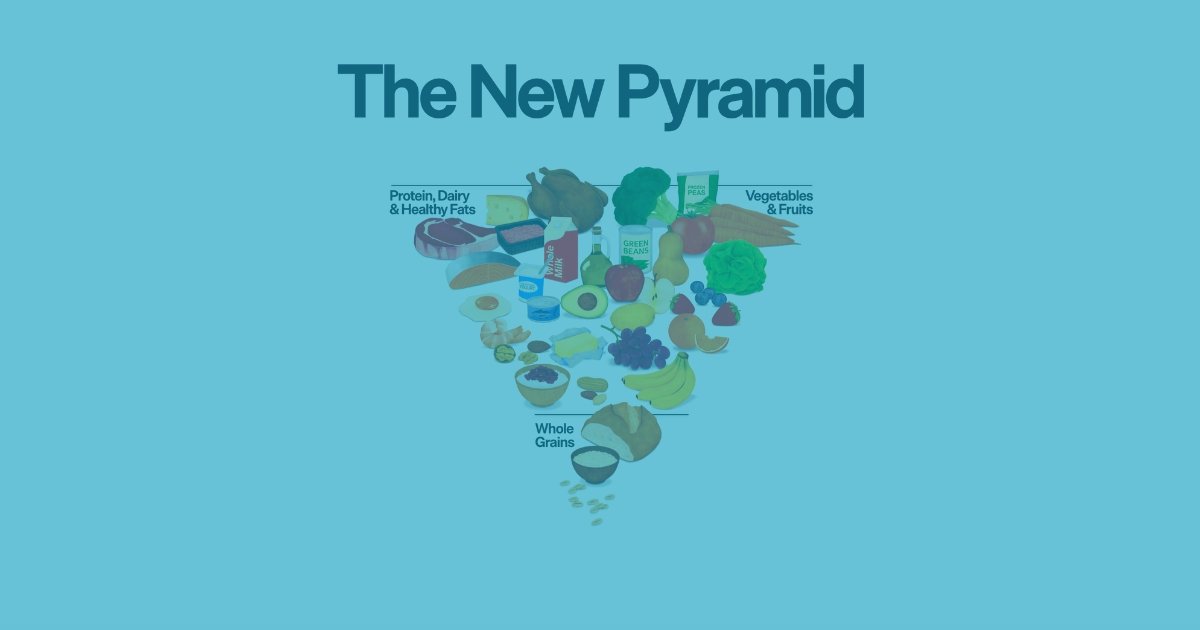
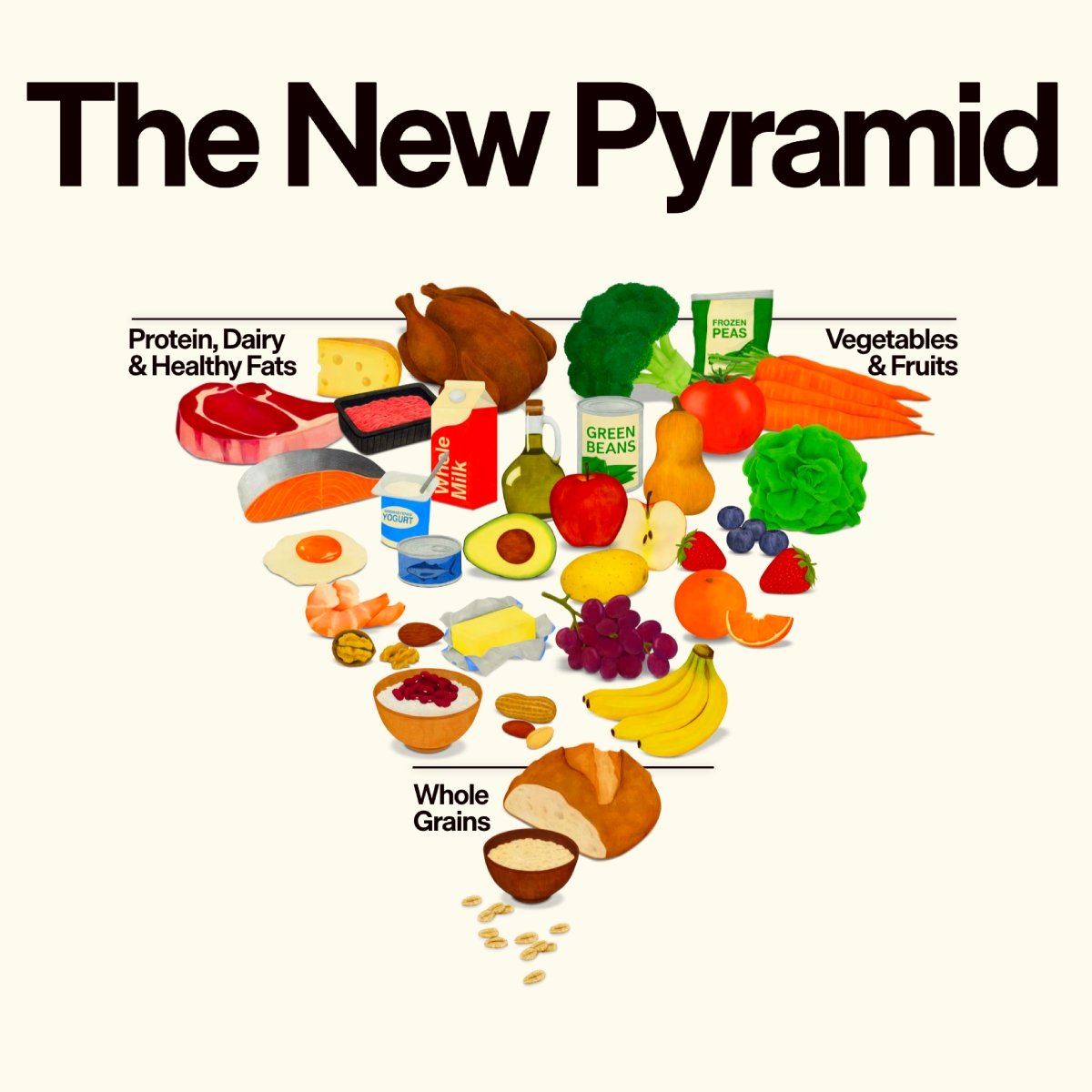
4) The “New Pyramid”: a visual reset for nutrition education
A major communication shift is the renewed use of a food pyramid on the public portal (often described in media as an “inverted” approach).
The intent is to create a clearer, more teachable model that highlights whole-food patterns.
In simple terms, the pyramid emphasizes:
- Protein, dairy, and healthy fats as key building blocks
- Vegetables and fruits as everyday staples
- Whole grains as a component—favoring truly whole forms over refined grain products
The big takeaway: the pyramid is a tool meant to help people replace ultra-processed calories with foods that provide protein, fiber, vitamins, minerals, and essential fats.
5) Key changes in the 2025–2030 Guidelines (with numbers you can use)
A) Higher protein targets
The Guidelines set a protein target range of 1.2–1.6 grams per kilogram of body weight per day, and encourage prioritizing protein at each meal,
using both animal and plant sources.
B) Full-fat dairy is back (with conditions)
The document recommends including full-fat (whole) dairy without added sugar, and suggests an overall target of
three servings per day within a 2,000-calorie pattern.
C) A tougher stance on added sugar
The 2025–2030 update states that no amount of added sugar or non-nutritive sweeteners is recommended as part of a healthy diet, and adds a practical guideline:
aim for no more than 10 grams of added sugar per meal.
D) Ultra-processed foods and additives
The Guidelines repeatedly emphasize avoiding highly processed products and limiting certain additives mentioned in public materials.
The overall direction is clear: the more engineered and ingredient-heavy the product, the less it should serve as the foundation of daily eating.
E) Fats: olive oil first, but other options appear
The Guidelines encourage oils rich in essential fatty acids (often pointing to olive oil), while also stating that other cooking options may include
butter or beef tallow. At the same time, they maintain a long-standing public-health benchmark:
keep saturated fat at or under 10% of daily calories.
F) Sodium remains a focus
For most people ages 14+, the general target stays at under 2,300 mg of sodium per day, with age-based ranges for children and notes about needs varying by activity and sweating.
G) Alcohol: “drink less” as the headline
Rather than focusing on numeric limits in the main public messaging, the Guidelines’ headline direction is to consume less alcohol,
while noting groups who should avoid it entirely.
6) Why this update sparked debate
Many clinicians and public-health voices agree on the value of reducing ultra-processed foods and sugary drinks. The debate centers on whether the new emphasis
(especially on higher protein, full-fat dairy, and the inclusion of butter/tallow in messaging) may conflict with decades of cardiovascular guidance—particularly
when paired with the continued goal of keeping saturated fat under 10% of calories.
Supporters argue that a “real food” framework can improve diet quality and metabolic health by reducing ultra-processed intake.
Critics worry the headline messaging may encourage people to overcorrect—choosing higher saturated-fat patterns without balancing overall diet quality, fiber, and
cardiometabolic risk.
The most practical lens: “Eat real food” can be helpful, but overall dietary pattern still matters—especially for heart health.
7) Practical takeaways for real life (no extremes required)
If you want to apply the 2025–2030 Guidelines without confusion, focus on these fundamentals:
Build meals around “real food” anchors
- Protein: eggs, fish, poultry, lean meats, beans/lentils, tofu/soy, yogurt, nuts and seeds
- Produce: vegetables and fruit (fresh, frozen, or canned without added sugar)
- Whole-food carbs: oats, brown rice, truly whole-grain bread, potatoes, traditional grains
- Fats: olive oil, avocado, nuts; use richer fats thoughtfully based on your personal health context
Use a simple “ultra-processed filter”
- Short ingredient lists you recognize usually beat long lists filled with additives.
- Beware products that are easy to overeat because they’re engineered to be hyper-palatable.
- Choose water and unsweetened beverages as defaults.
When to get personalized guidance
If you have cardiovascular disease risk, diabetes, kidney disease, elevated cholesterol, or other medical conditions, talk with a qualified clinician or registered dietitian.
A “real food” approach should be adapted to your needs—not copied blindly from a headline.
Educational note: This article is informational and does not replace medical advice.
Primary sources
- Dietary Guidelines for Americans 2025–2030 (official) —
realfood.gov - Dietary Guidelines PDF (official) —
Dietary Guidelines landing page - Legal basis (U.S. Code) —
U.S. Code (search: 7 U.S.C. 5341)
Suggested reading (reactions and analysis): Consider linking to statements from major medical and nutrition organizations plus reputable news coverage,
so readers can compare perspectives.